
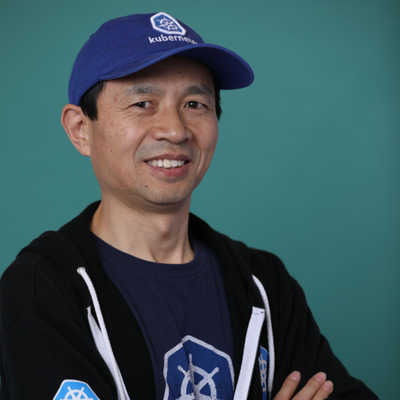
Yongkang He
Founder @KSUG.AI @KubeSmart.AI | Creator @awstronaut @kubestrong
Singapore
Actions
Yongkang He is a Google Developer Expert (GDE), CNCF Kubestronaut, AWS Community Builder, Microsoft MVP, and Alibaba MVP with over 20 years of experience in the IT industry. Based in Singapore, he specializes in Kubernetes, cloud-native technologies, and multi-cloud solutions.
Widely recognized as one of the most certified professionals in the Kubernetes and cloud ecosystem, Yongkang is passionate about open source, community-driven learning, and making the cloud-native journey more affordable by sharing the latest resources, certifications, and event discounts. https://linktr.ee/ksug.ai
He actively contributes automation tools and hands-on learning content to help developers and engineers upskill faster. Check out his projects on GitHub. https://github.com/ksug-ai
Area of Expertise
Topics
“A Kubestronaut Riding a Dragon”: Scaling Generative AI on GKE
Generative AI is quickly becoming a production workload, but running models like Stable Diffusion XL on GKE introduces challenges around GPUs, scheduling, and performance.
In this session, we present a real-world implementation of an AI image generation platform running on Kubernetes. You’ll learn how to containerize, deploy, and scale inference workloads using open-source tools like Diffusers, PyTorch, and Streamlit.
We’ll explore GPU vs CPU performance, model loading behavior (~8GB), and cold start impacts, along with how Kubernetes distributes and scales inference workloads.
The talk includes a live demo generating images in real time (including “a kubestronaut riding a dragon in space”) and shares practical insights for running generative AI workloads on Kubernetes in any environment.
🔒 Securing AI Workloads on K8s with KubeArmor
As organizations deploy more AI and LLM workloads on Kubernetes—the importance of runtime security has never been greater. Since most AI inference and fine-tuning jobs run inside containers, securing your Kubernetes workloads effectively means securing your AI workloads.
In this session, we’ll explore KubeArmor, an open-source runtime security system purpose-built to enforce zero-trust execution and fine-grained policies across Kubernetes environments. You’ll see how KubeArmor can help safeguard not just microservices, but also AI pipelines, model-serving containers, and GPU-powered inference nodes.
Secure your containers with Falco
In this session, you will learn how to use Falco to secure your Containers on Kubernetes Cluster. A live demo will be included as part of the session. Falco is a cloud-native security tool. It provides near real-time threat detection for cloud, container, and Kubernetes workloads by leveraging runtime insights.
Platform Engineering: Powering the Next Cloud-Native Evolution
Distributed Platforms: How platform engineering is at the core of the next evolution in a workload-centric cloud native world.
Distributed platforms. Run workloads when it makes more sense
Platform Engineering, Create a scaleable and sustainable platform
Lifecycle, Security and compliance considerations through the whole lifecycle
Next-Gen Agentic Coding with Qoder
The development world is witnessing a seismic shift: the rise of Agentic Coding. Forget simple autocomplete—this is about autonomous AI agents that can plan, execute, and iterate on complex, multi-file software development tasks with minimal human intervention. It’s a race to build the ultimate developer teammate, where every tech giant is entering the fray with their own AI-powered environment, from Google's "antigravity" projects to Amazon's "Kiro."
In this session, we will dive deep into Qoder, Alibaba Cloud's pioneering Agentic Coding Platform. We will explore how Qoder moves beyond traditional coding assistants to offer true project-level understanding and full task automation.
What you will learn:
The Agentic Coding Paradigm: Understand the shift from passive AI assistants to autonomous, goal-oriented AI agents that can reason across your entire codebase.
Qoder's Core Capabilities: A hands-on look at what sets Qoder apart:
Quest Mode: Delegate complex features or refactoring tasks by simply writing the specifications. Qoder autonomously plans, codes, and tests the solution across multiple files.
Enhanced Context Engineering: How Qoder achieves a deep, project-wide understanding—including architecture, dependencies, and even your coding style—to drastically reduce AI "hallucinations."
Knowledge Visibility (Repo Wiki & Action Flow): Learn how Qoder makes the AI's "thinking" transparent and auditable by automatically generating documentation and showing its execution plan.
Practical Workflow Transformation: See real-world demos of using Qoder to accelerate feature delivery, refactor legacy code, and manage complex cross-file modifications within your development lifecycle.
Join us to learn how to transition from simply coding with AI to effectively delegating to an AI partner, maximizing your productivity and focusing on high-level design.
My Kubernetes Journey - the world's 1st kubestronaut
In this session, I’ll take you through my personal journey to becoming the world’s very first Kubestronaut. As the pioneer in this unique program, I’ll share what it took to reach this milestone and the dedication required to stay at the forefront of Kubernetes and cloud-native technology.
The Kubestronaut program is an elite recognition awarded to leaders who commit deeply to their Kubernetes education. To become a Kubestronaut, one must successfully complete the CNCF’s Kubernetes certifications – CKA, CKAD, CKS, KCNA, and KCSA – maintaining a high standard of knowledge and skill. As the first Kubestronaut, I’ll share insights into the rewards and opportunities that come with this title, including exclusive access to CNCF events, special community discounts, and, of course, the iconic Kubestronaut jacket. Join me to learn what it takes to embark on this unique path and how you, too, can set your course for Kubernetes excellence.
Container's DR on EKS made easy
Implementing Disaster Recover for your containers can be very challenging.
Beyond the Cluster: Scaling a Global Cloud-Native & AI Community to 180,000+
While Kubernetes provides the infrastructure, communities provide the soul. This session explores the journey of KSUG.AI (KubeSmart & AI User Group), which began as a single meetup in Singapore in August 2022 and exploded into a global network of 180,000+ passionate learners by 2025.
We will delve into the strategies used to bridge the gap between Cloud-Native and Generative AI, focusing on how to build hubs that foster genuine knowledge exchange, networking, and collaboration. Drawing from a "KubeSmart" philosophy—prioritizing community impact and real-world ROI over vanity metrics—the speaker will share a blueprint for scaling volunteer-led organizations.
Whether you are an engineer looking to lift others up or a leader trying to build a local chapter, this talk offers a hands-on guide to growing a resilient, impact-driven ecosystem.
AI Image Generator on Kubernetes
"Let’s explore how AI can help us simplify our work. In this hands-on workshop, I’ll demonstrate how to build an 🎨 AI Image Generator powered by Stable Diffusion on Kubernetes. Together, we’ll deploy a Python app that generates AI images from text prompts — running on CPU or GPU nodes inside a Kubernetes cluster.
🚀 What you’ll see in action:
Generate AI images from text prompts
Run workloads on Kubernetes (CPU or GPU nodes)
Scale seamlessly with Kubernetes deployments
Compare performance: GPU (NVIDIA T4 ~30 seconds per image) vs CPU (15+ minutes per image)
By the end, you’ll walk away with practical know-how to set up your own AI playground on Kubernetes, blending AI creativity with cloud-native scalability."
Locking Down GKE: Secure Your Containers with KubeArmor
As organizations move workloads to Kubernetes on Google Cloud, container security becomes a critical challenge. In this session, we’ll dive into KubeArmor, an open-source runtime security enforcement system designed to safeguard Kubernetes workloads through fine-grained policies and zero-trust execution.
We’ll start with an introduction to KubeArmor—its architecture, core features, and why it’s a must-have for Kubernetes security. Next, you’ll learn how to automate the creation of a GKE cluster, deploy a containerized application, and finally apply KubeArmor policies to lock down your workloads against unauthorized actions.
Whether you’re new to Kubernetes security or looking to strengthen your GKE environment, this session provides a hands-on guide to improving your cloud-native security posture.
⸻
Learning Objectives:
1. Understand the fundamentals of KubeArmor and its role in runtime security for Kubernetes.
2. Learn how to automate GKE cluster provisioning and deploy applications efficiently.
3. Implement security policies with KubeArmor to protect containers running on Google Cloud.
Devfest Brisbane 2025 Sessionize Event
KubeCon + CloudNativeCon + Open Source Summit + AI_Dev China 2024 Sessionize Event
Global Azure Bootcamp Singapore Sessionize Event
AWS Community Day Singapore 2023 Sessionize Event
Please note that Sessionize is not responsible for the accuracy or validity of the data provided by speakers. If you suspect this profile to be fake or spam, please let us know.
Jump to top