
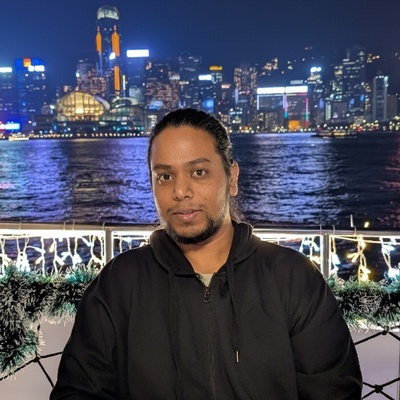
Jones Zachariah Noel N
Sr Developer Relations Engineer @ New Relic | AWS Serverless Hero
Bengaluru, India
Actions
I'm Jones Zachariah Noel N a.k.a zachjonesnoel
AWS Serverless Hero | AWS Serverless Architect | Developer | Technical Writer | Home Chef | Photographer
Currently Developer Advocate at New Relic
Previously AWS Architect - Serverless / Developer @ Mobil80 Solutions and Services Pvt Ltd. And contributor for AWS ASEAN Community, reSkill Community India, AWS UGs in India.
Speaker at various AWS Community Days in India and APJ region, AWS Summit India, AWS Dev Day Bengaluru, UG meet-ups globally.
Area of Expertise
Topics
Challenges with Serverless Monitoring with AWS Lambda
AWS Lambda has evolved over the last decade but the age-old problem about monitoring them still exists. Let's understand the challenges with AWS Lambda monitoring and how coupled it is with AWS native offerings such as CloudWatch and X-Ray and also extending the capabilites of sending telemetry data to other tools. In this session, we will also look at how Lambda layers, Lambda extensions play a vital role with OpenTelemetry and monitoring with third-party observability tools like New Relic.
Category: Serverless, Observability
Level: 200
Speaker experience: Expert
How Agentic AI with AWS DevOps Agent and Telemetry Closed our 2 AM Incident
The era of "staring at dashboards" is ending. While traditional observability tells us when something is broken, the cognitive load of finding the why still falls on the engineer. In this session, we explore a paradigm shift: the integration of the AWS DevOps Agent with New Relic’s Model Context Protocol (MCP) server.
We will walk through a live architectural deep-dive of an autonomous SOC. You’ll learn how New Relic telemetry feeds high-fidelity signals into the AWS DevOps Agent, allowing it to move beyond simple alerts to performing automated root cause analysis (RCA) and suggesting—or even executing—remediation steps.
Key Takeaways:
- How to configure the AWS DevOps Agent Space to ingest New Relic entity data.
- Moving from "Alert Fatigue" to "Actionable Intelligence" using AI-driven telemetry correlation.
- A framework for building "Guardrailed Remediation" where AI suggests fixes (IaC updates, rollbacks) for human approval.
Logs at Scale 101: Harnessing OpenTelemetry Collector Processors
Logs remain the most widely used telemetry signal, yet managing them at scale is often challenging due to inconsistent formats, bundled payloads, and the need for governance and cost control. The OpenTelemetry Collector provides a vendor-neutral way to ingest, process, and export logs, enabling organizations to build scalable and manageable pipelines.
This session will explore how to design log ingestion pipelines utilizing the Collector’s built-in processors for filtering, enrichment, and transformation, ensuring logs are manageable and scalable across diverse environments. We will highlight the new Unroll Processor, which expands bundled log records (such as JSON arrays) into individual events, making downstream analysis more reliable. Attendees will also learn how to normalize structured, semi-structured, and unstructured logs, apply transformations with the OpenTelemetry Transform Language (OTTL), and enrich telemetry with metadata for better context.
Attendees will learn how to design log pipelines using the OpenTelemetry Collector processors. They will leave with practical strategies to normalize, transform, and manage logs efficiently across distributed systems.
Monitoring the Agentic Loop: OTel-Driven Observability for AWS Strands on Lambda
As AI evolves from simple chatbots to autonomous agents, the challenge shifts from monitoring single inferences to observing complex "agentic loops." The AWS Strands SDK simplifies this by using a model-driven approach where LLMs plan and execute tools autonomously. However, in a serverless environment like AWS Lambda, these multi-step loops can become a "black box," leading to unpredictable latencies, soaring token costs, and difficult-to-trace hallucinations.
In this session, we demonstrate how to instrument AWS Strands agents using OpenTelemetry (OTel) to gain deep visibility into the "thought process" of your AI. We will explore the integration of the AWS Distro for OpenTelemetry (ADOT) with the Strands SDK to capture granular telemetry across agent cycles, tool calls, and LLM reasoning steps.
Stop Paying for Digital Noise: 10 OTel Hacks to Cut Your Observability Bill in Half
Most organizations initiate their observability journey with the clear intention of gaining visibility, but as systems scale, telemetry data grows silently in the background. Frequently, the monthly observability bill rises significantly faster than the actual value teams derive from the data, leading to a state of "uncontrolled volume" where organizations may even pay more for observability than their actual infrastructure. The problem is rarely the tools themselves, but rather a lack of control over what enters the pipeline. In this session, Jones positions the OpenTelemetry (OTel) Collector as a central control plane for cost governance. We will move beyond the "collect everything" mindset to explore how to shape, filter, and route telemetry before it reaches expensive backends. And you'll be walking out with some of the tips from sampling to agressive filtering with practical guidelines.
The Serverless Signal: Mastering OpenSearch & Lambda Observability with OTel
Serverless architectures often trade infrastructure management for operational complexity. When your "search" is a black box and your "compute" is ephemeral, how do you debug a high-latency query or a failing ingestion pipeline? In this session, we’ll dive into a production-ready blueprint using Amazon OpenSearch Serverless and AWS Lambda. We will walk through instrumenting these services using OpenTelemetry (OTel)—without manual boilerplate—and how to use New Relic as your central brain for correlating traces, metrics, and logs across the entire serverless lifecycle.
Challenges with Serverless Monitoring with AWS Lambda
AWS Lambda has evolved over the last decade but the age-old problem about monitoring them still exists. Let's understand the challenges with AWS Lambda monitoring and how coupled it is with AWS native offerings such as CloudWatch and X-Ray and also extending the capabilites of sending telemetry data to other tools. In this session, we will also look at how Lambda layers, Lambda extensions play a vital role with OpenTelemetry and monitoring with third-party observability tools like New Relic.
SQS Monitoring Deep Dive: Advanced Techniques and Observability in Action
Building on our foundational understanding of observability in event-driven architectures. We move beyond basic queue health to explore advanced monitoring strategies for Amazon SQS, a critical component in many distributed systems. In this session, discover how to diagnose complex issues like message bottlenecks and Dead-Letter Queues (DLQs), trace messages end-to-end for comprehensive visibility, and optimize your architecture for cost efficiency. Importance of dashboards and configure intelligent alerts that transform your SQS monitoring from reactive to proactive, ensuring the resilience and performance of your event-driven applications.
DX lessons from adopting and scaling serverless at Freshworks
Sharing the Serverless Journey Freshworks developer platform has transformed and the learnings that come our way while ensuring a smooth developer experience for Freshworks' developers to build on top of the Freshworks developer platform.
Architectural choice while architecting Serverless APIs
APIs play a crucial role in enabling seamless communication and data exchange between applications and services. AWS offers a powerful trifecta of API services – API Gateway, AppSync, and Function URL – each with its unique strengths and use cases. This talk will dive deep into the world of serverless APIs, empowering developers, architects, and serverless enthusiasts to unlock their full potential.
We'll begin by exploring the versatility of API Gateway, AppSync, and Lambda function URLs which are the different infrastructure choices for hosting your Serverless APIs.
Throughout the talk, we'll dive into practical examples, best practices, and real-world use cases, empowering you to make informed decisions when choosing the right API service for your serverless applications. Whether you're building a traditional REST API, a GraphQL API, or a lightweight internal API, this talk will equip you with the knowledge and tools to unleash the full potential of serverless APIs.
In Serverless, we orchestrate and choreograph our workloads
This session will focus on the importance of orchestration and choreograph in modern Serverless workloads where we will deep dive into AWS Step Functions and Amazon EventBridge and how this combination is best suited for scalability and performance
Building Serverless Generative AI workflows using Amazon Bedrock and AWS Step Functions
This workshop would be focused on building generative AI workflows which can be orchestrated with AWS Step Functions which uses Amazon Bedrock integration to invoke the foundational models.
Serverless applications without Lambda functions, yes it's possible!
Traditionally, Serverless reflects it's using Lambda functions but certain workload can be built without Lambda functions. This approach breaks the limitations of Lambda functions and also improves performance with lesser latency.
This session will focus of the overcoming Lambda functions limitations with direct interactions across multiple services.
Choosing the right services for the serverless stack
When building serverless apps, we have a variety of choices with managed services and Serverless services, choosing them for the right use case is important.
This session will focus on certain factors which play an important role with choosing those services.
Serverless with more infrastructure code and less application code
With the growing Serverless workloads, managing and maintaining them is best recommended with Infrastructure as Code (IaC). While this holds the complete infrastructure and it's configurations, we could have events from one service destined to another via configuration. When building these configurations, we could also reduce the application code making it more maintainable and also scalable.
In this session, we will look at how a fully end-to-end solution is built with Amazon EventBridge and AWS Step Functions with SDK integrations which has helped me to improvise the application with just IaC and very minimal application code.
How the AWS Community helped me build better on AWS
AWS has a global community which has helped me grow and excel on AWS tech along with making networking engagements with great developers, solution architects, developer advocates and product team. This session would be about how it helped me grow and how others can be benefitted from these communities.
Evolution in AWS Serverless development and deployment
Over the course of 4 years with me developing and deploying Serverless apps over Lambda fns, AppSync and API Gateway. The developer experience has evolved immensely. This session speaks about my personal experiences from development over the AWS Console to CDK based environment. And most importantly infrastructure as code.
Focusing on your application with Serverless
This is a session which briefs about how Serverless helps in building robust systems without having to manage or maintain servers/instances and focusing on your application needs and leveraging AWS Serverless services via SDK.
Platform Engineering & Resilience Engineering Meetup User group Sessionize Event
AWS Community Day - Oceanic Virtual Edition 2025 Sessionize Event
AWS Dev Day Bengaluru 2022
https://speakerdeck.com/zachjonesnoel/amazon-eventbridge-integration-with-saas-product-events
Jones Zachariah Noel N
Sr Developer Relations Engineer @ New Relic | AWS Serverless Hero
Bengaluru, India
Actions
Please note that Sessionize is not responsible for the accuracy or validity of the data provided by speakers. If you suspect this profile to be fake or spam, please let us know.
Jump to top