
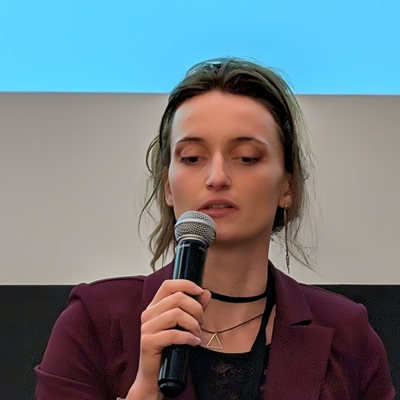
Zelda Ailine Luconi
Datwave, Senior Cloud Architect and Data Engineer
Milan, Italy
Actions
Zelda is a dynamic force at the intersection of AI, Data Engineering, and Cloud Architecture, bringing over 8+ years of experience to the technical landscape.
Her work focuses on the convergence of SDLC principles with modern cloud infrastructure, leveraging strong proficiency in Python, IaC, and DevSecOps methodologies.
She possesses a deep understanding of data governance and quality, ensuring that the systems she architects are not just functional but operationally resilient.
A strong advocate for continuous improvement, she helps organizations optimize service delivery by implementing rigorous MLOps cultures.
Her expertise extends far beyond the terminal. As an active speaker and Medium author within the Google Community, Zelda articulates in her articles the future of tech—ranging from Cloud to Quantum Computing-.
Whether refactoring legacy pipelines or designing novel AI systems, Zelda is committed to delivering efficient, value-driven solutions to the community.
Area of Expertise
Topics
The New Assembly Line: Designing AI Agents That Work Like Ford's Factory
After its debut at Coderful 2026 in Catania — where it was met with great enthusiasm and strong technical engagement — this talk now brings its mission to the GDG community: a full immersion into the world of AI Design Architecture applied to multi-agent systems.
Ford didn't know it, but he was inventing the future of artificial intelligence.
The idea that transformed industrial production — breaking a complex process into specialized stations, connected by precise handoffs — is today the most powerful paradigm for building AI systems that actually work in production.
A single monolithic agent suffers from the same pathologies as an assembly line run by a single worker: context dilution, lack of specialization, inability to parallelize, confirmation bias. The result? A one-way ticket to the AI project graveyard — that silent cemetery of ambitious pilots that never made it to production.
The answer is the digital assembly line: a multi-agent architecture where each station receives the output of its predecessor, applies its specific function, and passes the transformed artifact to the next station — with typed schemas, clean handoffs, and full technological heterogeneity across stations.
In this talk we will explore the three pillars of the assembly line applied to AI:
Structured workflow — Graph workflows and multi-agent orchestration with Google ADK: when to use a deterministic approach and when to leave room for autonomy.
Technological heterogeneity — Sub-agents, Tools, MCP, and the A2A (Agent-to-Agent) protocol: how to equip agents with tools and enable them to interact with data sources or with each other.
Structured handoffs — how to eliminate structural hallucinations and make the pipeline robust and self-corrective using input/output schemas with Pydantic.
All of this through a concrete, narrative use case — built live, slide after slide, line of code after line of code with Google ADK — all the way to the complete final architecture.
La nuova linea di assemblaggio: come progettare Agenti AI che funzionano come la fabbrica di Ford
Dopo aver debuttato al Coderful2026 a Catania riscuotendo un grande successo di pubblico e di engagement tecnico, questo talk approda alla community GDG di Lecce con una missione precisa: portare anche qui l'immersione completa nel mondo dell'AI Design Architecture applicata ai sistemi multi-agente.
Ford non lo sapeva, ma stava inventando il futuro dell'intelligenza artificiale.
L'idea che trasformò la produzione industriale — dividere un processo complesso in stazioni specializzate, collegate da handoff precisi — è oggi il paradigma più potente per costruire sistemi AI che funzionano davvero in produzione.
Un singolo agente monolitico soffre delle stesse patologie di una catena di montaggio gestita da un solo operaio: diluizione del contesto, mancanza di specializzazione, impossibilità di parallelizzare, bias di conferma. Il risultato? Un biglietto diretto verso l'AI project graveyard — quel cimitero silenzioso di pilot ambiziosi che non hanno mai visto la luce della produzione.
La risposta è la linea di assemblaggio digitale: un'architettura multi-agent in cui ogni stazione riceve l'output del predecessore, applica la sua funzione specifica e passa il manufatto trasformato alla stazione successiva — con schemi tipizzati, handoff puliti e piena eterogeneità tecnologica tra stazioni.
In questo talk esploreremo i tre pilastri dell'assembly line applicata all'AI:
Flusso di lavoro strutturato — Graph workflows e multi-agent orchestration con Google ADK: quando usare un approccio deterministico e quando lasciare spazio all'autonomia.
Eterogeneità tecnologica — Sub-agents, Tools, MCP e il protocollo A2A (Agent-to-Agent): come dotare gli agenti di strumenti e farli dialogare con data sources o tra di loro.
Handoff strutturati — come eliminare le allucinazioni strutturali e rendere la pipeline robusta e auto-correttiva utilizzando input/output schema con Pydantic.
Il tutto attraverso un caso d'uso concreto e narrativo, costruito live slide dopo slide linea di codice dopo linea di codice con Google ADK, fino ad arrivare all'architettura finale completa.
The New Assembly Line: Designing AI Agents That Work Like Ford's Factory
After its debut at Coderful 2026 in Catania — where it was met with great enthusiasm and strong technical engagement — this talk now brings its mission to the GDG Modena community: a full immersion into the world of AI Design Architecture applied to multi-agent systems.
Ford didn't know it, but he was inventing the future of artificial intelligence.
The idea that transformed industrial production — breaking a complex process into specialized stations, connected by precise handoffs — is today the most powerful paradigm for building AI systems that actually work in production.
A single monolithic agent suffers from the same pathologies as an assembly line run by a single worker: context dilution, lack of specialization, inability to parallelize, confirmation bias. The result? A one-way ticket to the AI project graveyard — that silent cemetery of ambitious pilots that never made it to production.
The answer is the digital assembly line: a multi-agent architecture where each station receives the output of its predecessor, applies its specific function, and passes the transformed artifact to the next station — with typed schemas, clean handoffs, and full technological heterogeneity across stations.
In this talk we will explore the three pillars of the assembly line applied to AI:
Structured workflow — Graph workflows and multi-agent orchestration with Google ADK: when to use a deterministic approach and when to leave room for autonomy.
Technological heterogeneity — Sub-agents, Tools, MCP, and the A2A (Agent-to-Agent) protocol: how to equip agents with tools and enable them to interact with data sources or with each other.
Structured handoffs — how to eliminate structural hallucinations and make the pipeline robust and self-corrective using input/output schemas with Pydantic.
All of this through a concrete, narrative use case — built live, slide after slide, line of code after line of code with Google ADK — all the way to the complete final architecture.
Devfest Pescara 2026 Sessionize Event Upcoming
DevFest Lecce 2026 Sessionize Event
Devfest Milano 2026 Sessionize Event
DevFest Modena 2026 Sessionize Event
Coderful
L’Edizione AI ruota attorno al tema più caldo del momento: l’intelligenza artificiale e il suo legame con il mondo del codice. 13 talk in single track, intervallati da momenti di networking, per imparare, approfondire, condividere e creare nuove connessioni.
The Reasoning Layer: Architecting Multi-Agent Support Systems with Google Cloud | GDG Cloud Milan
Hey there, awesome people! 😊 We've got something exciting to share with you—our next big event!
When? May 5th, 6:30 PM Where? Autogrill headquarters, Strada 5, Rozzano (MI)
Join us at the Innovation Hub and the Factory Food Designers, the beating heart of gastronomic innovation for the Avolta/Autogrill Group. It's a true idea incubator, where chefs, pastry chefs, nutritionists, designers, food bloggers and technologists meet every day to anticipate trends and bring new flavors, products and concepts to life—the same ones that end up in Autogrill stores around the world.
The space is organized into dedicated areas, each with its own specific function:
the Food Hall, designed for meetings, events and coworking sessions
the Food Academy, where staff are trained and show cooking sessions with top chefs take place
Area 51, the space for free-form experimentation, which also houses a small High-Tech Restaurant with table service and a chef experience table
the Concept & Food Tech Lab, where Autogrill's main formats are prototyped and tested before hitting the road
Here are some interesting links about the venue and sponsors:
Avolta Next Milano: https://avoltanextmilano.autogrill.it/
Factory Food Designers: https://www.autogrill.com/it/storie/factory-food-designers-la-ricerca-costante-delleccellenza
Was Coffee: https://www.autogrill.it/wascoffee/
Now, here's the scoop: We're diving into a time when software isn't just following orders anymore—it's thinking, planning, and playing it smart. Enter AI agents! These are like the new superheroes—smart systems that see what's up around them, make cool decisions, and go for it to hit their goals. So, what's in it for a food & travel retail company like Autogrill? Let's find out together!
In our chat, we'll break down AI agents into real-life examples straight from Autogrill's turf—from the highway pit stops to our Factory Food Designers innovation lab right here in Rozzano. And guess what? We're rolling out Google's Agent Development Kit (ADK), this open-source mastermind that helps you whip up, run, and show off multi-agent systems on Google Cloud. Oh, and we'll even throw a live demo on stage!
Please note: an additional registration will be required for venue access and will be requested from registered attendees
See you on the 5th! 🎉
Smart Agent Design - Building Agents with ADK and Ollama 🤖💻 | Google Developer Groups
Not every problem needs an AI agent. Join us for a deep dive into building AI agents that actually make sense—going beyond the hype to understand when, why, and how to deploy intelligent systems effectively.
What You'll Learn:
🎯 When to use agents (spoiler: not for 2+2)—understanding the right problems for agentic AI
🏗️ Agent Design Kit (ADK): patterns and architectures for building robust agents
🔧 Agent types: from simple task automation to complex multi-agent orchestration
🐋 Local models with Ollama: integrating open-source LLMs into your agent workflows
🌐 Open-source stack: building production-ready agents without vendor lock-in
Format:
📊 Conceptual overview with slides
💻 Live demos and code walkthroughs
🛠️ Hands-on patterns you can apply immediately
Who Should Attend: Developers, ML engineers, and tech enthusiasts interested in practical AI development. Whether you're building your first agent or optimizing existing systems, you'll leave with concrete strategies for purposeful AI deployment.
Prerequisites: Basic programming knowledge. Familiarity with Python and LLMs is helpful but not required.
Once the talk is over you can stay a bit longer for a networking session where you can chat, meet new people, and just have a good time. ✌️
Please note that Sessionize is not responsible for the accuracy or validity of the data provided by speakers. If you suspect this profile to be fake or spam, please let us know.
Jump to top