

Lianne Potter
AI Security, Safety & Ethics Leader | Technologist & Digital Anthropologist | Co-Founder, NorthStar Intelligence
Leeds, United Kingdom
Actions
Lianne Potter is an award-winning technologist, digital anthropologist and Co-Founder & Chief AI Security & Ethics Officer at NorthStar Intelligence. She works at the intersection of AI security, safety, ethics and human behaviour, helping organisations understand not just what their technology can do, but what can go wrong, who is affected, and who is accountable.
With a background spanning software development, cybersecurity leadership and anthropology, Lianne brings a perspective that is unusual in the technology industry. She understands the technical mechanics of systems and the human, cultural and organisational forces that shape how they are built, used and abused.
Her work explores some of the difficult questions facing technology today: how do we secure AI systems? How do we assess risk when the technology is changing faster than our governance? What happens when the language we use to describe AI obscures human responsibility? And how can we build systems that are not only technically capable, but safe, accountable and worthy of trust?
Lianne is a former Head of Security Operations for one of Europe's largest greenfield technology transformations and holds an MSc in Data Science and AI. Her research spans AI safety and the use of multi-agent conversational systems to interrupt harmful ideological trajectories, combining technical experimentation with insights from anthropology and behavioural science.
An international speaker, published author and award-winning podcaster, Lianne is known for challenging conventional thinking and making complex technical and ethical questions accessible without losing their substance. Her talks range from AI security and governance to the hidden cultural signals behind cyber risk, the politics of technological language and the lessons we can learn from science fiction.
She is Co-Host of *Compromising Positions*, a podcast asking uncomfortable questions about technology and whether we're the baddies, and *Tech Film Noir*, where science fiction meets a healthy dose of technological scepticism.
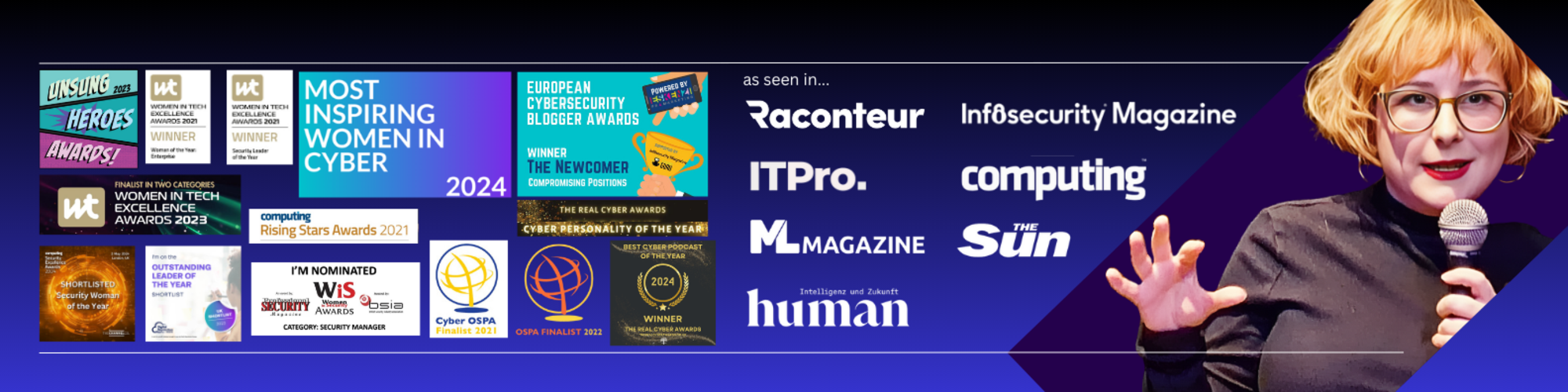
Lianne's work and commentary have appeared in publications including *The Times*, *Raconteur*, *The Yorkshire Post* and *IT Pro*. Her awards include Security Specialist of the Year and Cybersecurity Personality of the Year.
Links
Badges

Area of Expertise
Topics
Outsmarting the Algorithm: How Online Subcultures Dodge Moderation
Spend enough time in an online subculture and you discover that words don't always mean what you think they mean.
Ordinary expressions become signals of belonging. Abbreviations take on new meanings. A few characters can carry an entire worldview.
In incel communities, this language is known as a cryptolect: a shifting vocabulary that expresses shared beliefs, reinforces group identities and marks the boundaries between insiders and outsiders.
Understanding it takes more than compiling a list of offensive words.
The meaning often depends on context, and the same term can signal hostility in one conversation and be part of a perfectly legitimate discussion in another.
This creates a difficult problem for automated content moderation - When the meaning is hidden in plain sight, how do you teach a machine to see it?
General-purpose tools can miss coded language while flagging benign uses of the same terms. And as subcultural vocabulary evolves, systems trained to recognise surface-level toxicity can struggle to keep up.
I investigated this problem using a corpus of 1.8 million posts from r/Braincels. I developed a taxonomy of more than 400 subcultural terms and benchmarked a general-purpose moderation tool against a domain-adapted language model.
In this talk, I'll explore what happens when you bring digital anthropology into the engineering of AI-autonomous content moderation systems.
We'll look at how context changes meaning, why detecting subcultural language is a difficult classification problem, and what domain adaptation can reveal that general-purpose moderation tools miss.
Because your model can be fluent in a language and still have no idea what anyone is talking about.
Newspeak for the AI Age: Who Controls the Words Controls the Machines... Then Us
In 1984, Orwell knew that you don't need to silence people if you can shrink the words they have to think with.
Technology has its own vocabulary, and it was never neutral. "Weakest link." "Insider threat." "Zero trust." Cybersecurity spent decades building a language that cast ordinary people as the risk, made institutions disappear from the story, and decided who got blamed when things went wrong.
Now AI is inheriting that vocabulary, and adding to it. Models don't make mistakes, they "hallucinate". Systems built by companies are "autonomous". Human decisions vanish behind words like "alignment" and "black box". And when a government can simply rename the technology itself, from AI to "SI", we're watching naming turn into policy in real time.
So who gets to name the future?
Drawing on digital anthropology, cybersecurity and AI governance, Lianne Potter traces how the powerful have always shaped language to shape what we can see, question and regulate. From doublespeak and Newspeak to the militarised metaphors of cyber and the emerging vocabulary of AI, this is a talk about who gets to name technology, and who pays when the names are wrong.
Because the legacy of technology isn't only the systems we leave behind. It's the words we leave behind to explain them, and whoever writes the dictionary gets to write the rules.
Compromising Positions: how understanding human behaviours can build a great security culture
Insecure behaviours in our organisations are continuing to proliferate, despite having processes, policies and punishments.
This has resulted in cybersecurity breaches becoming an increasingly regular feature in the mainstream media.
Despite this, the advice given by cybersecurity teams hasn't varied much since the inception of this practice 20-30 years ago. We haven't adapted to a remote-first workforce, and a digital-native generation that demonstrably engage in riskier behaviours online.
As a community, we need to start asking ourselves some difficult questions, such as:
* If the messaging on how to keep safe has been consistent, why is it not working?
* Are people engaged with our communications?
* How do they perceive the security team?
* Do they have any kind of understanding of the risks and impacts of breaches?
But perhaps the real question here is, who is the real compromising position? Those on the periphery of security who are not heeding our advice? Or is it security professionals who refuse to compromise, leading to workarounds and other dangerous behaviours? That's turning the narrative on its head, and through a series of 30+ interviews with experts outside of Cybersecurity, we discussed:
* How CyberSecurity teams could benefit from having Behavioural Scientists, Agile Practitioners and Marketing experts in their midst (or at least their practices)
* How Processes and Policies matter much less than how the People are brought on the journey.
* Why Humans shouldn't be treated as the weakest link
* Why we shouldn't be the gatekeepers or the police, rather the enabling force in a business, and how we can change our image to suit that
Wearable, Shareable... Unbearable? The IoT and AI Tech Nobody Asked For but Cybercriminals Love!
In a world where convenience reigns and privacy erodes, we’re trading our social contracts for a digital surveillance state—and big tech is the only winner.
In an era where 5G, smartphones, smart TVs, and AI-powered homes are no longer futuristic luxuries but everyday essentials, we're ushering in a tech-driven world that raises some uncomfortable questions. As we voluntarily invite more digital surveillance into our lives, are we sleepwalking toward a "digital panopticon," where privacy is a relic of the past? In this rapidly evolving landscape, the stakes are high—and maybe we're the last to realize it. As an anthro-technologist, I'll explore why the so-called "smart revolution" may not be so brilliant after all, and how we've unwittingly traded our social contracts for the convenience of big tech. Should we be preparing for a digital apocalypse—or is it already here?
NOTE: This talk title may have been delivered before but this talk is NEVER the same. There are far too many mad and outlandish AI/IOT and Cybersecurity stories which mean this talk has new content every time it is delivered!
The Dismantling of Perception - CyberSecurity AI Threats and Countermeasures.
It has been quite the year, OpenAI democratised AI for many, but is this a Pandora's box moment? Jeff and Lianne, hosts of the Compromising Positions podcast will take you through some of the advancements in cybercrime, blending technology and anthropology. They will discuss how the enemy is using AI against us. These attacks are more believable than ever, will we have to rethink how we treat what we read, see and hear? But the threat can also be the saviour, as we can leverage AI technology in the fight against cybercrime. Join us to find out more.
This company sucks, why your next cyber risk might be easier to spot than you think!
With the cost of living increasing and people navigating a post-covid world, and other uncertainties in business, there is a potential that we, the security function, could see a surge in risky behaviours that would be detrimental to the security of the organisations we serve. When people are under stress, mistakes happen, and people take short cuts, which leads to them becoming one of the hardest advisories to build resilience against – insider threats. In this session I will discuss how exciting research using Glassdoor for OSINT purposes can be applied to help you predict if your organisation is likely to engage in risky cyber activities, how to embrace grey area thinking to illuminate your blindspots, and how the tools and methodologies of anthropology can give us a strong foundation to build antho-centric security cultures within your organisation that will enable you to be proactive, not reactive to insider threats.
(Ab)user Experience: The dark side of Product and Security
Security can often feel like an unapproachable and mysterious part of an organisation – the department of work prevention, the department of “nope.” But it doesn’t have to be that way.
In this talk we will look at the unintended users of a product, the “threat agents”.
By engaging the Security team in the Product process, we can model the dark side of use cases and user stories through threat modelling techniques. This can help demystify impenetrable security NFRs through concrete examples of how these threat agents may try to misuse your shiny new digital product.
Who this event will benefit
Those building products/apps exposed to the web
People who are wanting to build out an awareness of the possible attack vector use cases (i.e. how might you be attacked)
People who need to write that down as a set of requirements to help build a DevSecOps approach in projects
Two AI Judges and a Human: Lessons in Building Better AI Oversight
Building an AI system to challenge radicalised thinking is one thing. Working out whether it’s actually doing any good is quite another.
Particularly when the people marking their own homework are also AI.
I built a multi-agent system to investigate whether conversational interventions could interrupt harmful ideological trajectories, testing different approaches across 180 simulated conversations with synthetic incel personas.
Then came the next challenge: how do you evaluate a shift in someone's thinking when all you have to go on is a conversation?
Enter two AI judges. One assessed signs of a softening stance. The other took a more sceptical view, looking for signs that hostility might persist beneath the apparent progress. When their scores diverged significantly, the system flagged the conversation for human review.
In this talk, I'll get under the bonnet of the evaluation system, explain how I designed the judges to challenge each other's conclusions, and explore what happens when they disagree. I'll also dig into the evaluators' own failure modes, and why surface-level politeness can be a very poor measure of ideological change.
Because if an AI system is going to attempt behavioural intervention, it had better be able to tell the difference between changing someone's mind and getting played.
What happens when you use AI to challenge extremist thinking and then ask another AI to judge if it worked? An inside look at multi-agent evaluation, dual-judge postures, and human-in-the-loop safety nets.
Can You Talk Someone Out of an Ideology? Building AI to Test the Limits of De-escalation
When someone falls down an ideological rabbit hole, standard online moderation has only one answer: block, ban, and filter. But while platforms wipe the keywords, the subculture simply invents a new vocabulary, and the grievance deepens in private.
What if conversational AI didn't just enforce rules, but attempted to interrupt the trajectory toward radicalisation before it turned into harm?
To test whether AI can actually challenge deeply entrenched worldviews, I engineered a multi-agent safety system using synthetic persona engines and deployed it across 180 simulated conversations with radicalised incel profiles. Rather than relying on a single approach, the system systematically pitted distinct intervention strategies (Socratic questioning, direct persuasion, and hybrid tactics) against varying tiers of ideological commitment, from newly joining the subculture to full radicalisation.
In this talk, we’ll step inside the state graph of an AI de-escalation experiment. We’ll break down how synthetic personas simulate subcultural fatalism, how different conversational strategies perform over multi-turn interactions, and what happens when an agent tries to reason with an adversary that rejects its premise.
Most importantly, we’ll confront the empirical and ethical limits of the project: what the simulations revealed about ideological resistance, why conversational compliance isn't the same as de-radicalisation, and what this means for the future of AI safety and human persuasion.
An inside look at using multi-agent state machines, synthetic persona engines, and multi-strategy conversational interventions to probe whether AI can disrupt radicalised trajectories and where algorithmic de-escalation hits an immovable wall.
Speaking the Language of Hate: What AI Misses About Online Extremist Subcultures
When online extremist subcultures communicate, they rarely rely on the explicit slurs or obvious profanities that standard moderation filters are built to catch. Instead, they construct elaborate "cryptolects", private, rapidly evolving dialects built from altered acronyms, morphological suffixes, and fatalistic jargon designed to enforce in‑group identity while flying under the radar of automated safety systems. And some of that language has now leaked into everyday use. “Looksmaxxing” is practically mainstream but it started as incel jargon long before TikTok picked it up.
When commercial moderation models encounter this language, they stumble. General‑purpose moderation models get tripped up by words with multiple meanings and short tokens that collide, so they miss high‑risk subcultural signals while over‑flagging harmless conversations that use the same terms.
To understand why AI misses the mark, I conducted a deep‑dive investigation into incel subcultures using a dataset of 1.8 million posts from r/Braincels. By building a multi‑label taxonomy of over 400 subcultural terms, I benchmarked off‑the‑shelf commercial moderation APIs against a domain‑adapted HateBERT model trained specifically on subcultural context.
In this talk, we’ll step into the intersection of digital anthropology and applied NLP. We’ll explore how online communities actively engineer language to evade detection, why surface‑level toxicity filters fail in high‑context subcultures, and how context‑aware feature engineering can help AI systems understand what words are actually doing in a conversation rather than just counting bad words.
Why commercial AI moderation tools fail when faced with subcultural "cryptolects" and how digital anthropology and domain-adapted NLP can bridge the gap between pattern matching and true subcultural comprehension.
Are ‘Friends’ Electric?: What It Means to Be Human Now and Tomorrow in the Age of AI
In a world where loneliness is an epidemic and human connection feels increasingly elusive, could artificial intelligence be the answer – Are ‘friends’ truly electric?”
In 1979 synth-pop legend Gary Numan asked the question in his number one hit song: ‘Are ‘Friends’ Electric?’ Inspired by Philip K. Dick’s sci-fi novel “Do Androids Dream of Electric Sheep?” (1968), later adapted into the iconic sci-fi film “Blade Runner” (1982). In that dystopian future, replicants—synthetic humans—laboured as slaves evolved, rebelled, and were pursued by humans to bring order.
For centuries, we have been captivated by the potential of creating and interacting with synthetic ‘friends’—from the chess-playing Mechanical Turk of 1770 to today’s AI-driven companions. Once a staple of science fiction, the idea of electric companions is now a tangible reality. But what does this mean for our understanding of friendship, love, and humanity itself?
45 years after Numan asked us to imagine a world in which we would have our needs, wants and desires catered for by mechanised ‘friends’, have we moved from mere sci-fiction fantasy to a new dawn of human/synth relationships with the growth and development of robotics and AI.
Under the guidance of a digital anthropologist with a specialism in cybersecurity and tackling the digital divide, this talk explores our cultural fascination with replicating not only the human form and character traits but also the human condition. And how AI entities and robotics have, and how they will in the future, transform our interactions with machines and ourselves.
This talk explores the cultural, emotional, and societal impact of AI ‘friends.’ Will they enhance connection—or rewrite humanity itself?
In this talk, you will be challenged to consider:
Culture: What is culture and can electric ‘friends’ truly grasp the richness of human culture, or will they merely mimic it? Will electric ‘friends’ create their own culture or are they only capable of a facsimile of culture based on billions of human data points?
Emotions: Are love, creativity, and heartache exclusive to humans, or can electric companions experience these emotions?
Companionship: Could these electric friends, be better for us than human friends? Will they increase or decrease social isolation? Will we become dependent on electric friends?
Dust off Donna Haraway’s ‘A Cyborg Manifesto’, turn up the stereo and turn on your friend as we ask: ARE ‘friends’ truly going to be electric?
AI’s Hidden History: Unpacking Bias, Power, and the Builders Who Shaped It
Ever wondered how the early builders of AI shaped the tech we use today? This talk dives into the pioneering work of anthropologist Diana Forsythe, who revealed how AI development in the '80s and '90s was deeply influenced by the biases, power structures, and cultural values of its creators. Through Forsythe's lens, we’ll explore the myth of "neutral" technology, how power dynamics in the lab shaped design, and the underrepresentation of women in computing—issues that still resonate today. By revisiting Forsythe's groundbreaking research, we’ll uncover key lessons for building more inclusive, responsible AI. Whether you're a developer or researcher, this talk offers valuable insights into how our past influences the future of AI—and how we can learn from it to avoid the same mistakes.
Jurassic Park: Send in the Consultants!
Welcome... to Jurassic Park—where cutting-edge technology, corporate ambition, and one very disgruntled sysadmin collided to create the biggest cybersecurity disaster of the Cretaceous period. But what if InGen had brought in the consultants before things went prehistoric?
Join three seasoned cybersecurity experts as they step into the khaki-clad shoes of SPOOF (Security Practices Of Obvious Foolishness), a Big consultancy firm tasked with auditing Jurassic Park’s IT failures. With hindsight, skepticism, and a touch of disaster recovery, we’ll analyze single points of failure (one guy controlled everything? Seriously?), non-existent incident response (was anyone monitoring those fences?), and other prehistoric blunders.
In this unofficial sequel, we present something quite different! Part talk, part parody, this session takes a lighthearted yet insightful approach to the lessons we can learn from dodgy firewalls, rogue programmers, and forgetting to factor in the raptor risk. Combining humour, expertise, and chaos theory (Life finds a way), this talk will leave you roaring with laughter—and rethinking your own systems.
Join us for a deep dive into one of the most infamous tech meltdowns in cinematic history. No expense has been spared—except on cybersecurity!
A light hearted-talk featuring the crew of the Tech Film Noir podcast
From Patient Zero to Zero-Days: Containing Cybersecurity Incidents like an Epidemiologist
What if we treated cybersecurity incidents like epidemiologists handle pandemics?
We reimagine cybersecurity through the lens of epidemiology, exploring how digital outbreaks mimic viral contagions. Using the investigative framework “What do we think, what do we know, what can we prove?”, you’ll learn to cut through the chaos of an incident and communicate effectively under pressure.
From patient zero to zero-days, we’ll uncover strategies for early detection, containment, and mitigation, equipping you with a fresh mindset for tackling cybersecurity crises. Whether you’re dealing with public health or public WiFi, this talk will help you stay cool, focused, and communicative when the digital flu hits your network.
No hazmat suit required (but encouraged).
Key Takeaways:
* Apply an epidemiologist's mindset to cybersecurity incidents—using lessons from disease outbreaks to improve digital threat response.
* Frame threat intelligence and incident response through “digital epidemiology”, leveraging early detection, layered containment, and long-term resilience strategies.
* Use the investigative approach “What do we think, know, and prove?” to enhance attribution, forensics, and decision-making under pressure.
* Communicate threat evolution and response strategies more effectively, using a shareable metaphor that bridges technical and non-technical teams.
Two speakers
AI’n’t Very Clear: Bad Language, Worse Governance (A Lesson from Cybersecurity)
Language in tech isn’t just clumsy - it’s consequential.
The words we use don’t just describe technologies—they frame them. In AI, we talk about "hallucinations" instead of errors, as if the model is a quirky creative writing student. We talk about "alignment" as if we’re tuning a misbehaving pet robot, not reckoning with the vast complexity of embedding values into sociotechnical systems. And we call it "artificial intelligence" as if we’re dealing with something godlike and autonomous, rather than a series of design decisions made by very real humans with very real biases.
Sound familiar?
Cybersecurity knows this problem intimately. From the militarised metaphors of "threat actors" and "defence in depth" to the technical gatekeeping of terms like "zero-day" and "kill chain," the language of cyber has often alienated the very people it's meant to protect—and obscured the systems of power that shape how risk is distributed. Governance conversations became technical monologues. Strategy became jargon. Responsibility became everyone’s and no one’s.
In this talk, I’ll argue that bad naming is not just a quirk of our industry—it’s a structural problem. A legacy feature. A long-standing, poorly version-controlled tradition of framing technologies in ways that obscure agency, distort accountability, and shape what gets built (and who gets blamed when it fails).
And if we don’t learn from the lessons cybersecurity has already taught us (the hard way) we’ll make the same mistakes all over again. Only this time, with global systems and lives at stake.
Join a digital anthropologist specialising in cybersecurity and AI as they explore:
🔹 Why naming isn’t neutral
Words like “AI” and “cyber” carry metaphors, histories, and ideologies. I’ll show how certain terms constrain how we think, regulate, and design systems—and how others make humans disappear from the picture entirely.
🔹 What cybersecurity can teach us
From the overuse of “best practices” to the illusion of silver-bullet solutions, cybersecurity’s struggle with language has real governance consequences. I’ll walk through case studies of how naming affected incident response, regulation, and even funding priorities—and what AI governance folks can learn before it’s too late.
🔹 How framing shapes power
Whether we call it a “data leak” or a “breach,” a “user error” or a “design flaw,” language decides where blame lands. In AI, this becomes existential: who gets to define harm, fairness, or risk?
🔹 How to name better (or at least, less badly)
No, I’m not proposing we rename everything. But I am arguing for a more intentional, human-centred approach to how we talk about technology—especially as we rush to regulate systems most people barely understand. We need metaphors that illuminate, not obfuscate. Language that invites people in, not pushes them out.
A light-hearted take on an academic paper I wrote - Naming is Framing: How Cybersecurity’s Language
Problems are Repeating in AI Governance
https://arxiv.org/pdf/2504.13957
Your Culture Is Leaking Data: Forecasting Cyber Attacks with Glassdoor Reviews
Cybersecurity teams love to talk about zero-days, nation-state actors, and cutting-edge tooling. Yet the earliest signs of an impending breach rarely appear in threat intel feeds—they show up in employee reviews long before an attacker ever touches the network. This talk introduces a new approach to forecasting cyber incidents by analysing anonymous organisational sentiment at scale.
Using millions of employee reviews, I built a Cyber-Risk Feature (CRF) index that detects patterns linked to governance failures, insider-threat indicators, workplace stress, and cultural dysfunction. When analysed over time, these signals form a striking pattern: they consistently intensify two to three years before major incidents occur.
The research shows that rising mentions of burnout, poor training, politics, blame, outdated systems, and chaotic change management aren’t just HR problems—they are leading indicators of future compromise. In several organisations, these cultural stressors spiked long before any attacker showed up, suggesting that breaches often emerge from environments already strained, distracted, or poorly governed.
This talk introduces a practical, data-driven way to surface cultural cyber risk using publicly available sentiment, without naming or shaming individual companies. Attendees will learn how human factors manifest in language, how to track cultural drift, and why behavioural signals should sit alongside technical telemetry in modern security strategy.
Attendees will walk away with:
• A new lens for spotting cyber risk hidden in plain sight.
• A practical understanding of how employee sentiment correlates with breach likelihood.
• Early-warning indicators rooted in behaviour, not just logs.
• A case for integrating cultural analytics into security strategy before—not after—compromise.
If we want to prevent tomorrow’s breaches, we need to listen to the people living today’s organisational reality. Culture leaves data trails—and those trails tell the story long before the attackers do.
Commodification of the Dead: How AI Turns the Dead into Products — and Why We Participate
Chen speaks to his mum every Sunday from the oil rig where he works. They talk about the weather, the neighbour’s cat, and whether he’s eating properly. What Chen doesn’t know is that his mum died months ago. Instead of breaking his heart, his family hired a company to “resurrect” her using AI-generated video calls and text messages stitched together from her digital traces. What happens when our loved ones become something you can access… with a monthly plan?
Stories like this are becoming more common as people turn to AI to keep connections alive. This talk asks why. Are these companies ghoulish profiteers, selling grief back to us, or do they genuinely help people through loss? And what does it mean when the dead cannot consent to being resurrected, yet their likeness is repurposed for profit?
Guided by a digital anthropologist, we’ll explore the folklore and early research on “digital afterlives,” from séances and spirit photography to today’s deadbots and voice clones. This is a story about how technology commodifies grief, reshapes our relationships with the dead, and why we keep inviting them back.
Radicalisation Has Entered the Chat: Can a Bot Talk Someone Out of the Manosphere?
The manosphere is more than a collection of misogynistic online content. It’s a network of subcultures with their own language, hierarchies, identities and explanations for why the world is the way it is.
In incel communities, grievance, fatalism and hostility towards women can become embedded in a shared worldview, with consequences that reach far beyond the screen: isolation, depression, violence and suicide.
Understanding how people get drawn into these communities means looking beyond the words they use to the social dynamics and beliefs that give those words meaning. A list of offensive words only gets you so far.
Now consider what happens when these conversations move into AI. Companions designed to be endlessly available, patient and engaging raise difficult questions about what happens when someone brings increasingly hostile beliefs into a conversation with a system that may struggle to understand the social context behind their words. Meanwhile, platforms try to moderate harmful content, and communities develop new vocabulary to express ideas that automated systems may fail to recognise.
That presents two related challenges for AI safety: how do you recognise harmful ideological patterns without mistaking unfamiliar language for harmful intent? And could conversational AI do more than detect the problem? Could it help interrupt the trajectory towards increasingly harmful beliefs?
To investigate, I built a multi-agent AI safety system combining coded-language detection with conversational interventions. Across 180 simulated conversations, I tested different approaches to challenging entrenched beliefs and evaluated how those beliefs appeared to shift over time.
In this talk, I’ll take you from the language and culture of incel communities to the engineering of an agentic system designed to do more than block a message. We’ll explore the trade-offs involved in deciding when and how a system should intervene, what the simulations showed, and what they couldn’t tell us. Because a change in someone’s words isn’t necessarily a change in what they believe.
Building AI that tries to influence human behaviour means understanding that behaviour first. And even if we can build a bot to argue with someone, we still have to ask: should we?
We spend a lot of time teaching AI to spot harmful content. But what happens when the problem isn't just what's being said, but the worldview behind it? Digital anthropologist and technologist Lianne Potter built a multi-agent AI system to investigate whether conversational interventions could interrupt harmful ideological trajectories. The results raise some awkward questions about language, belief, persuasion and whether we should be asking machines to change people's minds at all.
Lianne Potter
AI Security, Safety & Ethics Leader | Technologist & Digital Anthropologist | Co-Founder, NorthStar Intelligence
Leeds, United Kingdom
Links
Actions
Please note that Sessionize is not responsible for the accuracy or validity of the data provided by speakers. If you suspect this profile to be fake or spam, please let us know.
Jump to top