
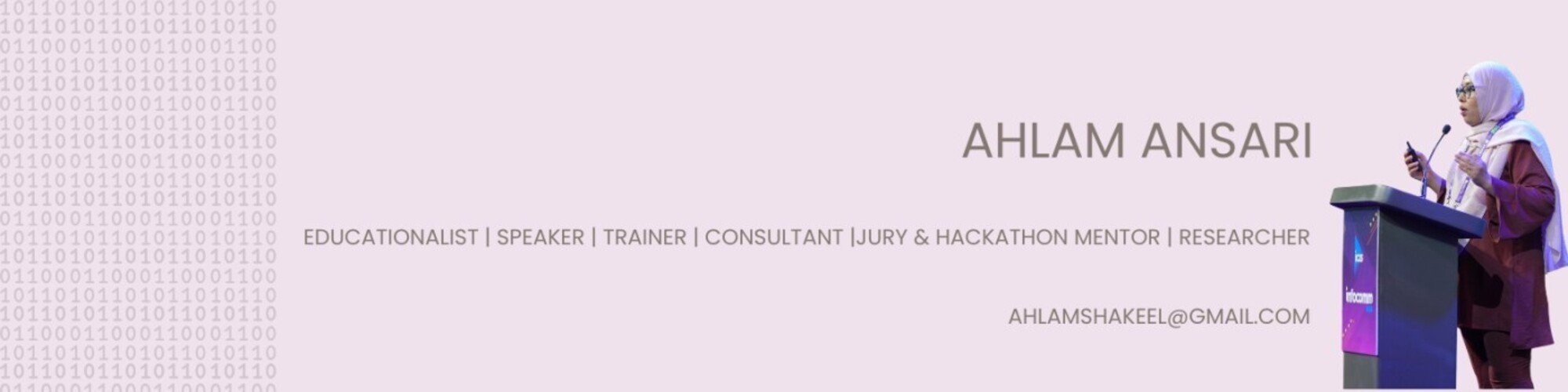

Ahlam Shakeel Ahmed
Transforming Education Through Ethical and Intelligent Technologies.
Mumbai, India
Actions
Ahlam Ansari has spent 17 years asking an uncomfortable question: Why do organizations trust AI systems they cannot explain? That question drives everything she does—from her PhD research in trustworthy and responsible AI to her work training professionals who have inherited AI tools they did not choose and do not fully understand. She is a member of MIT's Abdul Latif Jameel World Education Lab (J-WEL) and a Google Certified Educator, and her practice sits at the intersection of Explainable AI, data governance, and the kind of privacy-preserving design that actually holds up under GDPR scrutiny. Over 17 years she has moved between academia and applied technology—mentoring award-winning innovation teams, leading digital transformation efforts, and building methodologies for auditing AI outputs and tracing how automated decisions get made. The technical work matters, but what she is really doing is helping people stop taking AI on faith. Her sessions don't offer hype. They offer frameworks educators and leaders can use the week they return to school—grounded in research, tested in practice, and built around one belief: that AI is only as trustworthy as the people who understand it.
Area of Expertise
Topics
Trust Is Not a Feature: Proving Your Security AI Deserves the Authority You Give It
Security teams now rely on AI for detection, triage, and response. Few can show evidence that this trust is earned. Policies say "use AI responsibly," but auditors and incident reviewers want proof, and most teams can't explain why their AI flagged one alert and missed another.
This session turns AI trustworthiness into something a security program can measure and govern. We'll cover what to test before deployment (accuracy on your own data, drift, adversarial robustness), how to trace automated decisions back to their inputs, and how to document them so they hold up in an audit or post-incident review. We'll map these practices to NIST AI RMF, ISO 42001, and GDPR expectations, then look at where governance breaks down: unowned models, shadow AI, vendor black boxes, and checkbox reviews.
Takeaways: a trust scorecard for AI security tools; a model inventory and ownership template; an explainability checklist for vendors; metrics that show whether governance works.
LIGHTS, CAMERA, LEARNING:: HOW AI-DRIVEN AV IS SHAPING THE CLASSROOM OF TOMORROW
In every classroom, there are students no one can see entirely.
The non-talkative one who hears everything but never raises her hand. The student who fell behind because the lesson moved too fast. The learner whose first language isn't English, absorbing half the content and masking the rest. Teachers care — but traditional teaching was not built for them. One teacher and thirty students is a structural problem, not a personal failure.
AI doesn't solve this by replacing the teacher. It solves it by making every student seeable.
In this session, I share real findings from a classroom AI pilot that produced a 40% improvement in concept clarity and a measurable rise in student attendance — not through gimmicks, but through tools that personalised learning pace, offered multiple ways to engage, and gave teachers data they could use before a student slipped too far behind.
You'll walk away with five AI tools for personalised and inclusive learning, a simple implementation path that needs no big budget or tech team, and a blueprint for using AI data responsibly — so personalisation never becomes surveillance.
Every student deserves to be seen. This session shows you how.
Adversarial Opacity: Why Black-Box AI Defenders Create the Blind Spots Attackers Are Already Using
Ahlam Ansari has spent 17 years asking an uncomfortable question: Why do organizations trust AI systems they cannot explain?
That question drives her PhD research in trustworthy and responsible AI, her membership in MIT's Abdul Latif Jameel World Education Lab (J-WEL), and a practice built at the intersection of Explainable AI, data governance, and privacy-preserving design that holds up under real regulatory scrutiny.
A Google Certified Educator with 20+ published papers and 200+ citations, she has spent 17 years moving between academia and applied technology — mentoring award-winning innovation teams, leading digital transformation efforts, and building methodologies for auditing AI outputs and tracing how automated decisions get made.
Her sessions don't offer hype. They offer frameworks educators and leaders can use the week they return to school — grounded in research, tested in practice, built around one belief: AI is only as trustworthy as the people who understand it.
When the Algorithm Decides: Who's Responsible When AI Gets It Wrong?
An AI model screens job applications. A credit algorithm denies a loan. A diagnostic tool misses a diagnosis. In each case, the decision was fast, confident, and completely unexplained — and the human who pressed the button has no idea why.
As AI embeds itself into hiring, healthcare, finance, and education, the question of accountability is no longer theoretical. It's the most urgent governance challenge of 2026, and most organizations are not ready for it.
I've spent years researching Explainable AI and trustworthy systems — not to make AI slower, but to make it defensible. There is a practical path between blind trust and paralysis, and it starts with understanding what your model is actually doing when it fires.
In this session, you'll get a clear framework for identifying where explainability breaks down in real enterprise systems, a set of governance checkpoints that hold up under regulatory scrutiny, and a method for communicating AI decisions to the humans they affect — without a data science degree in the room.
AI won't slow down. The organizations that build trust into their systems now will be the ones still standing when the first high-profile failure hits their industry.
The question isn't whether to trust AI. It's whether you can prove it deserved that trust.
Deploy With Confidence: An AI Leader's Framework for Evaluating Tools Your Institution Can Trust
The pressure to adopt AI in education has never been higher. Vendors promise personalised learning, time savings, and closing achievement gaps. Most institutions say yes. Almost none have a repeatable process for deciding whether they should — or for knowing what to do when something goes wrong.
That gap between AI strategy and responsible action is exactly where institutions get hurt.
I research Explainable AI and trustworthy systems, and I've worked alongside education leaders navigating this decision in real time. The pattern is consistent: tools get deployed before the right questions get asked. Who audits the outputs? What happens to student data? What does the institution say to a parent, a board member, or a regulator when the AI makes a call no one can explain?
This session gives technology leaders a practical path from intent to implementation. You'll work through an AI evaluation framework built specifically for K–12 and higher education contexts — covering transparency, bias risk, and data accountability — and leave with a stakeholder communication strategy that brings faculty, administrators, and parents into AI decisions with clarity and confidence.
Strategy without a governance layer isn't leadership. It's risk. This session bridges the two.
Give Me Back My Fridays: How AI Can Return 6 Weeks of Teaching Time to Every Educator
Teacher burnout is not a personal failing — it is a structural crisis. A landmark 2026 Gallup survey found that most K–12 educators receive no formal guidance on using AI, yet research confirms that teachers who use AI tools regularly save nearly six hours per week — the equivalent of six full weeks per school year. This session closes that gap. Drawing on research in human-centred AI design and responsible technology adoption, Ahlam Ansari introduces the Time-Back Framework: a practical, research-informed model that helps educators identify exactly which tasks to delegate to AI, which to redesign with AI support, and which to protect as irreplaceable human moments in the classroom. Attendees will leave with a ready-to-use AI Task Audit template, a curated toolkit of classroom-tested AI tools mapped to real teacher workflows — from lesson planning and feedback to reporting and parent communication — and a clear ethical boundary-setting guide so AI supports rather than replaces professional teacher judgment. This is not a session about AI replacing teachers. It is about AI finally giving teachers back the time to be the educators they trained to be.
My AI Did That — But Should It Have? Teaching Students to Question, Verify, and Own Their AI Use
Your students are already using AI. The question is no longer whether — it is whether they are using it with intention, judgment, and integrity. This high-energy session gives K–12 educators a practical, research-informed toolkit for shifting students from passive AI consumers to active, critical AI users. Drawing on research in responsible AI and human-centred technology design, Ahlam Ansari introduces the AI Agency Framework — a five-step classroom model that teaches students to question AI outputs, verify claims independently, understand why an AI produced a particular result, and take genuine ownership of their learning. Attendees will leave with age-appropriate lesson starters for primary and secondary classrooms, a student self-assessment checklist for evaluating AI-generated content, and a clear, jargon-free vocabulary for talking about AI responsibility with young learners. Whether your school is embracing AI tools or navigating concerns about academic integrity, this session offers the language, the structure, and the confidence to lead that conversation — starting the week you return from GESS.
Can Your Students Trust Their AI? Teaching Trustworthy AI Literacy in the K–12 Classroom
AI is now inside every classroom in the MENA region, but can students and teachers actually trust the outputs it produces? This session translates cutting-edge research on trustworthy and responsible AI directly into K–12 practice, giving educators a clear, evidence-based framework for evaluating, using, and teaching AI tools with integrity. Drawing on PhD research in AI trustworthiness, this talk examines the five core dimensions of responsible AI: transparency, fairness, accountability, safety, and explainability and shows how each one applies to the tools already sitting in your school's LMS. Attendees will learn how to spot untrustworthy AI behaviour in classroom contexts, how to build age-appropriate "AI critical literacy" lessons for primary and secondary learners, and how to create school-wide responsible AI policies that go beyond surface-level acceptable use agreements. With 72% of students already using generative AI for assignments and fewer than 1 in 5 being taught responsible use, the cost of inaction is measurable. This session gives you the research and the ready-to-use tools to close that gap before your students trust an AI they shouldn't.
Trust and Transparency: Auditing Sitecore's AI Decisions for Explainability (XAI)
As Sitecore pivots heavily toward AI-powered personalization and content generation, the call for transparency and accountability grows louder. This session will demystify the "black box" of AI, focusing on practical strategies for auditing AI decisions within the Sitecore Digital Experience Platform (DXP). We will explore how to use existing Sitecore tools (CDP, Personalize, Content Hub) to understand, verify, and explain why specific content was generated or why a particular personalization variant was served. Attendees will leave with a clear framework for implementing "Explainable AI" (XAI) within their organizations, ensuring governance, maintaining compliance (GDPR/CCPA), and building vital customer trust.
Workplace Ninjas India 2026 Sessionize Event Upcoming
Mumbai Technology Meetup #mumtechup User group Sessionize Event
Please note that Sessionize is not responsible for the accuracy or validity of the data provided by speakers. If you suspect this profile to be fake or spam, please let us know.
Jump to top