
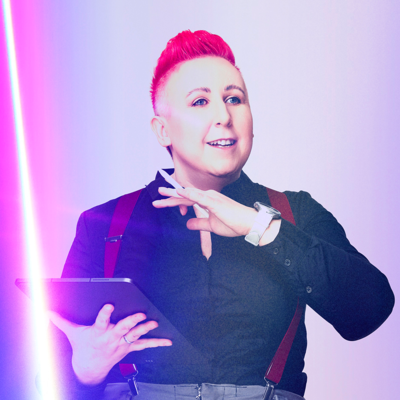
Alex Dziewulska
Product Expert, CEO @ House of Product
Wrocław, Poland
Actions
Alex Dziewulska is a product expert with over 20+ years of experience in design, research, and strategy. As founder of House of Product, Poland's first product studio, she provides consulting in research, design, product management, and strategy. Alex serves as president of Destare Foundation, teaches product management at SWPS University, and mentors professionals at various career stages. She shares insights through her Substack newsletters and leads mastermind groups, combining expertise in product strategy, user experience, and research operations to help teams transform ideas into actionable results.
Area of Expertise
Topics
Workshop Studio - product discovery accelerator
Workshop Studio: Product Discovery Accelerator
An intensive, hands-on workshop designed to mirror the complete product discovery process from problem identification to concept prototyping. Participants experience the full journey of understanding user needs, framing challenges, and developing innovative solutions through proven facilitation methods.
Workshop Flow:
The session begins with rapid research to quickly gather insights and identify key user pain points. Participants then engage in rapid persona creation to develop concrete user profiles that ground all subsequent work in real human needs.
Using the 1-2-4-All method, teams progressively build ideas from individual reflection to pair discussions, small group refinement, and full group synthesis. This ensures every voice is heard while maintaining momentum and focus.
3-6-5 ideation sessions generate diverse solutions rapidly, with participants creating multiple concepts in structured timeboxes that prevent overthinking and encourage creative flow.
SCAMPER techniques help teams systematically explore and enhance their concepts by substituting, combining, adapting, modifying, and reimagining elements to push beyond obvious solutions.
The workshop culminates in building concept prototypes that make ideas tangible and testable, giving participants concrete deliverables and experience with rapid iteration.
Key Outcomes:
Experience the complete product discovery cycle in compressed time
Master proven facilitation techniques for team innovation
Develop user-centered thinking and rapid prototyping skills
Create actionable concepts ready for further development
Perfect for product teams, designers, entrepreneurs, and anyone looking to accelerate their innovation process while learning industry-standard discovery methods.
Build Your Digital Twin: A Masterclass in Claude Code Skills
You write. You post. You publish. And somewhere along the way you realized AI could help — but everything it produces sounds like a LinkedIn influencer circa 2023. Generic. Off-voice. Not you.
This workshop fixes that. You'll build your own digital twin — a Claude Code skill that captures how you actually write, and drafts social posts, articles, or whatever you pick, in your real voice. Not a prompt. Not a project. A proper, composable, reusable skill.
The digital twin is the deliverable. The deeper thing you learn is how to build Claude Code skills properly — one of the most underused primitives in the Claude ecosystem, and the thing that separates people who play with AI from people who build with it.
What we'll do
Block 1 — Capture your voice
Most "voice training" fails because people feed AI five examples and hope. We'll do it properly: gathering your real writing, analyzing what makes it yours (structure, rhythm, vocabulary, what you never say), and turning that into explicit, usable patterns.
Block 2 — Build the skill
Writing a proper SKILL.md: how to structure it, how to scope it, what Claude actually reads and when, how skills compose, how to version them. You'll leave understanding skills as a primitive — not just this one skill, but the shape of skills in general.
Block 3 — Ship and iterate
Your skill in action. Draft a real post or article with it. See where it nails your voice, see where it misses, tune the skill, try again. Leave with something you'll actually use Monday.
What you walk out with
A working Claude Code skill that drafts in your voice, for your chosen format (social posts, long-form articles, or something you define during the session)
A reusable SKILL.md template and working patterns — so you can build the next skill (and the next) on your own
The mental model for when to use skills vs. projects vs. prompts — so you stop reaching for the wrong tool
A library of voice-analysis techniques that work for your own writing and for clients, team members, or brands
Who this is for
Product people, founders, and people who write regularly — emails, presentations, posts, articles, newsletters — and want AI help without losing their voice
Content creators and marketers who manage content for themselves or others and want to stop babysitting every draft
UX designers and PMs curious about Claude Code's deeper primitives, using a fun project as the vehicle to learn them
Anyone who's tried to "teach AI my voice" and ended up disappointed
Prerequisites (please take seriously)
This is a half-day workshop with real technical depth. To spend our 3 hours building — not installing — you'll want:
Claude account or Claude Code installed and working on your machine before arrival
A folder of your own writing (10+ samples of whatever you want to clone — posts, emails, articles)
Basic comfort working in Claude and editing text files
Laptop required
Lean Inception - pragmatic product discovery
Training + hands-on workshop · Full day (5h)
Most product discovery either takes weeks you don't have, or gets skipped entirely — and teams end up building the wrong thing, fast. Lean Inception is the pragmatic middle ground: a structured, time-boxed way to align a team around what to build, why, and for whom — in a single day.
This session blends focused training with a live, hands-on workshop. You'll learn the method, then immediately apply it. Come with a real product challenge from your work, or join a group tackling a shared case — either way, you leave with practiced skills and a concrete artifact: an MVP canvas you can actually use on Monday.
What you'll walk away with
A clear mental model of Lean Inception and when it beats alternatives (Design Sprints, Discovery workshops, full Dual-Track Agile)
Hands-on practice with the core canvases: product vision, personas, user journeys, features, and MVP scope
A completed MVP canvas for your own challenge (or the shared case)
Facilitation patterns you can reuse to run your own inceptions afterward
Who this is for
UX designers who want impact beyond Figma
Developers tired of building the wrong thing and want a seat at the discovery table
Founders who need to align co-founders, early hires, or investors on MVP scope
Product managers looking for a repeatable framework to cut scope without cutting value and ability to apply continuous discovery to their product
As a bonus I will show you how to meaningfully use AI in your product discovery practice
Its not only sticky notes and designers' fun, its actually created to host space for technical people, business people and designers to work together.
Format
The day is split into short training segments followed by group work. Groups of 6-8 work in parallel — bring your own product challenge and your group will focus on it, or join a group working through a shared case we'll build together. Either path gives you the full experience; both end with a real MVP canvas.
What to bring
A product challenge you're genuinely stuck on (optional but recommended) and a willingness to spar — this works best when you push back, question assumptions, and treat your groupmates as thinking partners, not audience.
Building a Product Team: Roles, Stages, and the Product Competence Map
"Product Manager." "Product Owner." "Product Designer." "Head of Product." "Growth PM." The titles multiply, the definitions blur, and somewhere along the way it becomes genuinely hard to answer a simple question: what actually makes someone a product person?
This talk tackles that question from two angles — one practical, one structural.
First, how to build a product team: what roles you actually need, when you need them, how to sequence hires as your company grows, and what processes glue them together. Hiring a Senior PM at seed stage is as wrong as hiring a Product Analyst at Series B — but most founders learn this the expensive way.
Second, the Product Competence Map: a framework covering 7 domain categories and 2 enabling categories that define product work across 18 distinct roles. It's the answer to "what is a product person, really?" — and a tool for both the people hiring them and the people becoming them.
What you'll take away
A clear model for which product roles matter at which stage — seed, growth, scale — and which ones are premature hires
How to set up the processes that let a product team actually function (not just exist on an org chart)
The full Product Competence Map: 7 domain + 2 enabling categories across 18 roles
Access to the proprietary Product Competence Map to self-evaluate your own competencies, identify gaps, and plan growth
A clearer answer to "am I a product person, and what kind?" — whether you're hiring them or becoming one
Who this is for
Founders and CEOs building a product team for the first time — or the second, after the first attempt didn't work
Product people at any level who want to understand where they sit on the map, what's adjacent, and where to grow next - designers, product managers, scrum masters, developers
Hiring managers and People ops trying to write job descriptions that actually describe the job
Design to Deployed: Ship a Real Product with AI in One Day
Hands-on workshop · Full day (5h) · No coding experience required
You've never opened a terminal. You've never deployed an app. By the end of today, you'll have a real, working product live on the internet at a URL you can share — built by you, with AI doing the coding under your direction.
This is not a "look what AI can do" demo. This is you, building your own thing, on your own machine, and deploying it. The same path I walked from non-coder to shipping products — taught the way I learned it.
What we'll do
Hour 1 — Decide what to build
Scoping a real product you actually want to exist. Not a toy example. We'll compress a product discovery session into a focused hour so you leave this block with a clear, buildable MVP — not a wishlist.
Hour 2 — Setup & directing AI properly
Your environment: Claude Code, Railway, Supabase, the opinionated stack that works. Then the part most people skip: writing a proper CLAUDE.md — the instruction file that turns AI from a random code generator into a disciplined coding partner that follows your rules.
Hours 3–5 — Build and ship
Working in pairs or small groups, you direct Claude Code to build your product. I rotate between groups. You'll learn what to ask for, how to review what AI produces, when to push back, how to debug when something breaks — and how to deploy it live.
What you walk out with
A deployed web app at a live URL — something real, that you made, that you can show people
A working Claude Code setup on your own machine, reusable for every future project
A battle-tested CLAUDE.md template and setup you can apply tomorrow to your next idea
The core skill: directing AI to build things, not waiting for a developer to find time for you
Who this is for
UX designers who are tired of handing off mockups and want to ship functional prototypes — or real products — themselves
Product managers who want to stop describing features in Jira and start building them
Founders who've been told "we'll build it when we hire a dev" and are done waiting
Anyone non-technical who suspects the old rule — "you need to hire engineers to build software" — stopped being true, and wants proof
What to bring
A laptop (any modern Mac or Windows machine)
A product idea you actually care about (optional but strongly recommended)
Willingness to be uncomfortable for the first hour — setup is the hardest part, and we'll get through it together
Soft prerequisites
Create free accounts at Railway, Supabase, and Anthropic before the workshop if you can. If you don't, we'll sort it on the day — but starting with accounts ready means more time building.
Why I can teach this
I came to coding through exactly this path — non-coder founder who learned to ship real products by directing Claude Code. What you'll learn isn't theory; it's the working method I use in my actual business, compressed into a day.
Please note that Sessionize is not responsible for the accuracy or validity of the data provided by speakers. If you suspect this profile to be fake or spam, please let us know.
Jump to top