

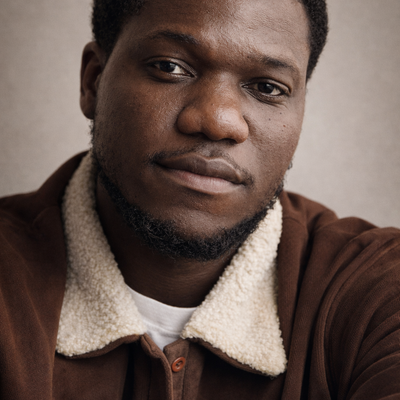
David Agbolade
Senior Data Scientist, | AI Researcher | SheerFit Founder
Birmingham, United Kingdom
Actions
David is a Senior Data Scientist working in UK Government, where he applies AI and machine learning to real-world public sector challenges. He holds an MSc in AI & Data Science (Distinction) and BSc in Software Engineering.
His research on deploying deep learning for automated radiology reports was published in the Journal of Informatics and Web Engineering (JIWE) and earned Best Presenter Award at NexSymp 2025 in Malaysia. Beyond government work, he founded SheerFit, an AI-powered wellness platform serving users across communities.
David's work focuses on building production AI systems that actually work in resource-constrained environments, not just in labs. He's passionate about honest conversations about what it really takes to deploy AI in the real world: the failures, the compromises, and the unglamorous solutions that actually ship.
Links
Area of Expertise
Topics
Deep Learning for Medical Report Generation: From Award-Winning Research to Production
Africa needs 1 radiologist per 40,000 people but has 1 per 1 million. Europe and North America face similar workforce pressures. Can deep learning bridge this gap without requiring million-dollar infrastructure?
This talk presents award-winning research (Q1 Springer publication, Best Presenter Award NexSymp 2025) demonstrating how to build and deploy automated radiology report generation systems on consumer-grade hardware—designed for real-world constraints, not research fantasy.
THE TECHNICAL STACK:
- CNN Architectures: ResNet-50 and DenseNet-121 for chest X-ray feature extraction
- Transformer-based Generation: Attention mechanisms for clinical report generation
- Multi-modal Fusion: Combining visual features with patient metadata
- Performance: 0.347 BLEU-4, 0.289 ROUGE-L on benchmark datasets
- Infrastructure: Single GPU deployment (<60 second inference)
- Training: ~10,000 image-report pairs (achievable in resource-constrained settings)
FROM RESEARCH TO PRODUCTION:
Unlike academic projects requiring massive compute, this solution runs on ~$1,500 hardware:
- Single consumer-grade GPU (RTX 3090 or similar)
- Standard server infrastructure
- Open-source frameworks (PyTorch, Transformers)
- Reduces radiologist report time by 90% (10-15min → 60sec)
CRITICAL CHALLENGES SOLVED:
- Data Scarcity: Strategies for training with limited medical datasets
- Model Interpretability: Building clinical trust through explainable AI
- Bias Detection: Ensuring fairness across diverse patient populations
- Regulatory Compliance: Navigating medical AI deployment requirements
- Production Deployment: Moving from Jupyter notebooks to production systems
CODE DEMONSTRATIONS:
The talk includes:
- Pre-written PyTorch code examples with detailed walkthroughs
- Real-time model inference demonstrations on sample X-rays
- Live demo of report generation (<60 second predictions)
- Attention mechanism visualizations showing what the model "sees"
- Docker deployment architecture
- All code will be made available in a GitHub repository
REAL-WORLD IMPACT:
This isn't theoretical—the approach is validated through:
- Q1 journal publication (Discover AI - Springer)
- International conference presentation (NexSymp 2025, Malaysia)
- Best Presenter Award recognition
- Featured in Scienmag Science Magazine
TAKEAWAYS:
Attendees will leave with:
1. Practical architecture for medical AI systems
2. Strategies for resource-efficient deep learning deployment
3. Framework for clinical validation and trust-building
4. Code patterns for production medical AI
5. Understanding of ethical considerations in healthcare AI
Perfect for developers, ML engineers, and data scientists interested in applying AI to high-stakes real-world problems especially those working in startups, NGOs, or resource-constrained environments.
Deploying Medical AI on a Budget: What We Got Wrong
Here's the truth about deploying deep learning in healthcare: everything costs more and works less than you expect.
We built a system to generate radiology reports automatically because Africa has 1 radiologist per 1 million people. The model worked great in the lab: 0.347 BLEU-4, sub-60-second inference, published research. Then came deployment.
The actual challenges weren't the ones in papers. How do you collect 10,000 medical images when hospitals can barely afford IT? How do you handle bias when your dataset is 90% one condition? How do you deploy when the budget is $1,500 total? How do you convince doctors to trust predictions they can't explain?
This talk covers what actually worked: single GPU consumer hardware (no fancy cloud infrastructure), Streamlit for the prototype interface (because we needed something fast and simple), PyTorch with aggressive optimization (cutting everything that wasn't essential), and building attention visualisations doctors could actually interpret (not fancy academic stuff).
I'll share the uncomfortable decisions: shipping a Streamlit prototype because building a "proper" web app would take months we didn't have. Using a single model instead of an ensemble because inference time mattered more than 2% accuracy gains. Training on whatever data we could find rather than waiting for the "perfect" dataset that would never exist.
You'll see real architectures, actual costs, and honest trade-offs. No enterprise platforms, no vendor solutions, just what you can build with PyTorch, a GPU, and determination to ship something that works.
Builders Foundry User group Sessionize Event Upcoming
DevBcn 2026 Sessionize Event
David Agbolade
Senior Data Scientist, | AI Researcher | SheerFit Founder
Birmingham, United Kingdom
Links
Actions
Please note that Sessionize is not responsible for the accuracy or validity of the data provided by speakers. If you suspect this profile to be fake or spam, please let us know.
Jump to top