
Davide Mantovani
Web & AI Engineering Manager, Senior Software Engineer
Web & AI Engineering Manager, Senior Software Engineer
Turin, Italy
Actions
Davide is an engineer with work experience in various IT fields: he worked around the world on medical research for a few years and now holds the position of Web/AI Platform Leader in Synesthesia as part of the CTO group. He loves creating teams and working with them, communicating and listening. He also has experience as a teacher, speaker and public speaking coach. He is (of course) a coffee addict, a piano player and a theatre director.
Davide è un ingegnere con esperienza lavorativa in diversi ambiti dell’IT: ha lavorato in tutto il mondo per alcuni anni nel campo della ricerca medica e ora ricopre il ruolo di Web/AI Platform Leader in Synesthesia come parte del gruppo del CTO. Ama creare team e lavorare con loro, comunicare e ascoltare. Ha anche esperienza come insegnante, relatore e coach di public speaking. È (ovviamente) dipendente dal caffè, un pianista e un regista teatrale.
Area of Expertise
Topics
Delivering a successful sport-oriented technological platform en
"Delivering a successful sport-oriented technological platform," emphasizes that success means achieving results, not just developing. It requires defining clear success metrics and tailoring solutions to specific audiences and contexts, especially in the sports industry, where timing and context are crucial due to fixed schedules and time-sensitive campaigns.
A case study of an Italian A-series football company illustrates the importance of understanding client requirements, both functional and non-functional, and user personas. Key activities include workshops, functional analysis, UX/UI design, feature prioritization, development, testing, and delivery.
Speech for an Official CONI (Italian National Olympics Commitee) conference day
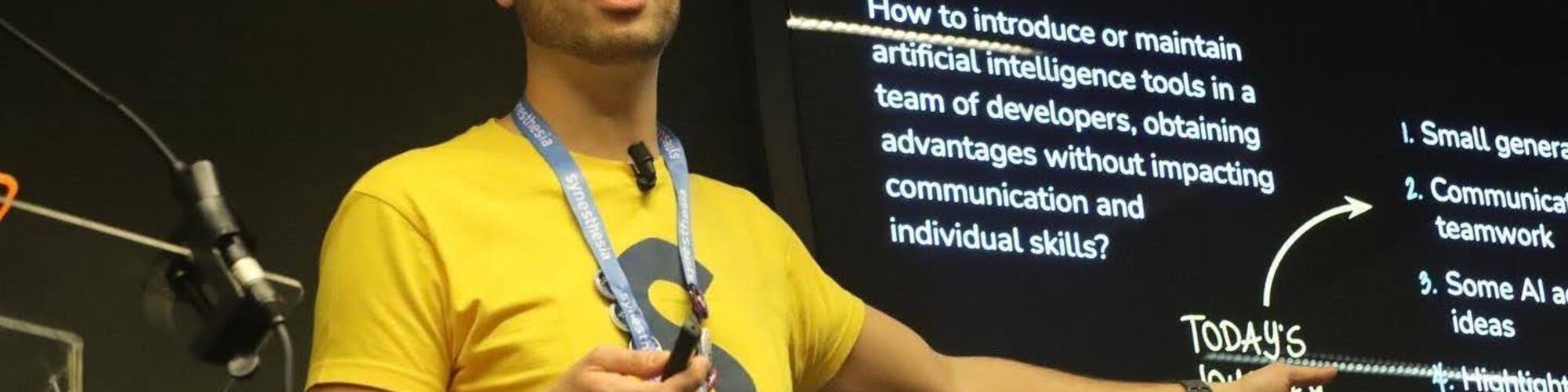
Be My Copilot - Your AI-driven pair en
This presentation, "be my copilot," explores how to effectively integrate AI tools into developer teams without sacrificing communication and individual skills, emphasizes that generative AI differs from traditional AI, and highlights both positive and negative aspects of AI-supported pair programming.
The presentation stresses that AI doesn't "think" or "feel," and that users are responsible for AI's choices.
It provides rules for team leaders and developers, focusing on training, collaboration, and skepticism towards AI suggestions. It also offers AI usage ideas, such as documentation generation, code review, and testing.
Speech created for AI Heroes
Update your AI - Super human intelligence or super artificial intelligence? en
This presentation touches on the rapid advancement of AI, highlighting the shift from "AI winters" to the current boom, marked by breakthroughs like ChatGPT.
It emphasizes that AI models are evolving to think independently, raising questions about bias, environmental costs, and the future of human and artificial intelligence.
The presentation also prompts reflection on the potential for AI to enhance human intelligence or lead to unforeseen societal impacts.
AI in Business and Clinical Researches en
This presentation explores the ethics and privacy concerns surrounding generative AI, particularly in business and medical research.
While generative AI offers benefits like faster processing and rapid prototyping, it also raises ethical concerns related to privacy, bias, and transparency. Ethics in AI are crucial for building trust, reputation, and ensuring legal compliance. Regulations, like the EU's AI Act, are essential to mitigate risks.
AI has enormous potential, but addressing ethical considerations is paramount to ensure its responsible use.
Sustainable and integrated AI en
Generative AI has seen exponential growth, offering benefits but also raising ethical concerns.
Collaboration and responsible adoption are crucial.
Team leaders should provide training, clarify AI's role as a support tool, and foster collaboration.
Users should approach AI with skepticism, focus on improving instructions, and utilize it for repetitive tasks.
Ethical implications need to be considered for responsible AI adoption.
Me and My Band - The Agent Era en it
The speech delves into the evolution of artificial intelligence, drawing a clear distinction between traditional chatbots, which are reactive and based on scripts or predefined models, and modern AI Agents. The latter are proactive systems, capable of acting, executing complex, goal-oriented tasks, coordinating multiple steps, and interacting autonomously with external systems and databases.
The core of the presentation explores in detail the intrinsic limitations of LLMs (Large Language Models), such as their nature as sequential and stateless "prediction engines," poor multitasking capabilities, "margin bias" (more weight on initial and final instructions), and "context rot," which compromises the quality of their responses as interactions increase.
To address these challenges, two key disciplines are introduced: Prompt Engineering, defined as the art of writing precise instructions to obtain correct answers, and the more advanced Context Engineering. The latter is the art of organizing and providing the AI with all relevant information—clearly structured using tags or titles—to enable it to make better decisions and act more consistently and accurately, especially in the operational realm of agents.
Approaches like Zero-shot, Few-shot, and Step-back Prompting are discussed. In closing, the ReAct (Reason & Act) reasoning structure was introduced, explaining how AI agents manage to plan, act, observe, and update their reasoning, demonstrating how agents can automate complex processes, while also emphasizing the importance of human supervision.
Finally, the speech highlights the importance of adopting AI agents to automate complex processes and improve efficiency, while also reaffirming the necessity for continuous human supervision, as agents still operate within defined boundaries.
As a bonus, a creation from scratch of a simple yet able to search and scrape the web, writing documents, reasoning and remembering agent is shown.
This speech can be translated in various languages and can be simplified or more technical. The bonus live code can be replaced by demonstration.
Me and My Band - L'Era degli Agenti en it
Lo speech approfondisce l’evoluzione dell’intelligenza artificiale, tracciando una chiara distinzione tra i chatbot tradizionali, che sono reattivi e basati su script o modelli predefiniti, e i moderni **AI Agents**. Questi ultimi sono sistemi proattivi, capaci di agire, eseguire compiti complessi orientati a un obiettivo, coordinare più passaggi e interagire autonomamente con sistemi esterni e database.
Il nucleo della presentazione esplora nel dettaglio i limiti intrinseci dei **LLM (Large Language Models)**, come la loro natura di “motori di previsione” sequenziali e senza stato, la scarsa capacità di multitasking, il **“margin bias”** (maggiore peso dato alle istruzioni iniziali e finali) e il **“context rot”**, che compromette la qualità delle risposte man mano che le interazioni aumentano.
Per affrontare queste sfide vengono introdotte due discipline chiave: la **Prompt Engineering**, definita come l’arte di scrivere istruzioni precise per ottenere risposte corrette, e la più avanzata **Context Engineering**. Quest’ultima consiste nell’arte di organizzare e fornire all’AI tutte le informazioni rilevanti — chiaramente strutturate tramite tag o titoli — per permetterle di prendere decisioni migliori e agire in modo più coerente e accurato, soprattutto nell’ambito operativo degli agenti.
Vengono discussi approcci come **Zero-shot**, **Few-shot** e **Step-back Prompting**. In chiusura viene introdotta la struttura di ragionamento **ReAct (Reason & Act)**, spiegando come gli agenti di AI riescano a pianificare, agire, osservare e aggiornare il proprio ragionamento. Questo dimostra come gli agenti possano automatizzare processi complessi, pur sottolineando l’importanza della supervisione umana.
Infine, il discorso evidenzia l’importanza di adottare agenti di AI per automatizzare processi complessi e migliorare l’efficienza, ribadendo al contempo la necessità di una supervisione umana continua, poiché gli agenti operano ancora entro confini definiti.
Come bonus, viene mostrata la creazione da zero di un agente semplice ma capace di cercare e fare scraping sul web, scrivere documenti, ragionare e ricordare informazioni.
Questo intervento può essere tradotto in diverse lingue e può essere semplificato oppure reso più tecnico. Il codice bonus mostrato dal vivo può essere sostituito da una dimostrazione.
AI Heroes 2025
Host and Expert
AI Heroes 2024
Host and Expert
AI Salon
Speaker
Progress Together Network
Speaker
Torino Digital Days
Speaker
AI Heroes 2023
Co-host, Expert and Speaker
Please note that Sessionize is not responsible for the accuracy or validity of the data provided by speakers. If you suspect this profile to be fake or spam, please let us know.
Jump to top