
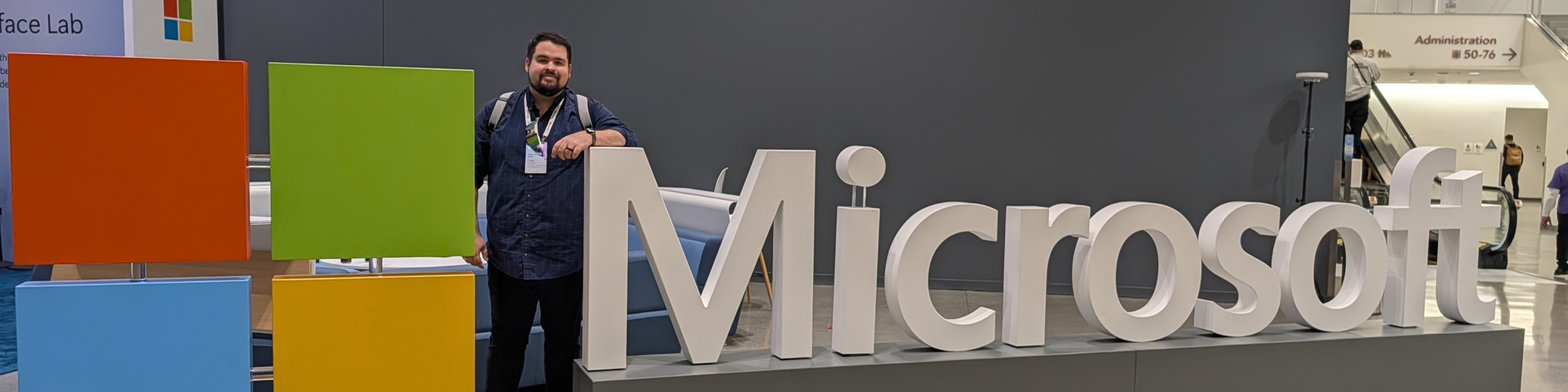

Chris Landtiser
Head of GenAI Adoption Strategy
Portland, Oregon, United States
Actions
Chris is a Microsoft MVP for M365 Copilot and Head of GenAI Adoption Strategy at Huron, where he leads enterprise Copilot adoption for roughly 10,000 employees across roles from interns to executives. His work balances hands-on AI architecture and the people side of AI rollouts: change management, champions networks, role-based enablement, and the systems that turn pilot-stage enthusiasm into sustained use.
He speaks regularly to enterprise audiences across healthcare, higher education, business advisory and more on practical AI literacy, story-led adoption, and building the infrastructure that makes AI tools stick. He writes at landtiser.com.
Off the clock, he's doing his best to keep up with his young boys and pretending he has time to play video games.
Area of Expertise
Topics
The Storytelling Gap: Why AI Adoption Fails When We Lead with Features Instead of People
The way we introduce AI tools to our teams almost perfectly predicts whether those tools will be used - and the dominant approach, leading with features and demos, almost perfectly predicts failure.
This presentation draws on direct experience leading AI adoption across a 10,000-person organization, scaling from a 300-user pilot to enterprise-wide deployment with sustained adoption metrics well above industry benchmarks. The central argument: the biggest challenge in AI integration isn't technological. It's narrative. The people being asked to change how they work aren't being given a story they can see themselves in. They're being given a product pitch.
Through two concrete before-and-after examples, you'll see what happens when the same tool is introduced to the same audience in two different ways - one feature-led, one story-led. The pattern is consistent: feature-led introductions spike and collapse; story-led introductions grow and sustain.
The presentation names three dimensions of this gap. Empathy: feature demos amplify anxiety instead of addressing it. Relevance: generic demonstrations don't connect to anyone's actual Tuesday. Agency: feature-led training positions people as consumers of technology; story-led training positions them as authors of their own professional development.
You'll leave with a practical framework for collecting adoption stories from within your own organization, structuring story-led training, and redesigning how your team introduces AI starting with your very next session.
30-minute presentation followed by group discussion. No technical background required. Draws on enterprise-scale AI deployment experience (Microsoft Copilot, Claude, ChatGPT, Gemini across 10,000 employees).
Target audience: change management leaders, L&D professionals, IT leadership, team leads, and anyone responsible for helping people actually use the AI tools their organization has already purchased. Includes a one-page takeaway framework for designing story-led AI introductions.
Copilot Personalized Playbooks: Building the One Size Fits All Adoption Agent
So many Copilot rollouts hit the same wall: you run the intro trainings, hand people a prompt library, and hope something sticks. You can tip those odds massively in your favor though, simply by ensuring every single member of your organization has an entirely custom playbook written just for them.
Users need to see what Copilot can do for their work, in their language, right now. In this session, I'll build a declarative Agent in Agent Builder that solves this at scale. By grounding it in Microsoft Graph - emails, chats, and documents - a single agent can brainstorm personalized Copilot use cases for every user in your org without a single change between deployments. You'll see how to configure knowledge sources, design a system prompt that acts like a creative coach instead of a search engine, and ship it so any champion or change manager can put it in front of their people tomorrow. One agent. One deploy. Thousands of personalized playbooks.
Three key take-aways:
How to build a single declarative Agent in Agent Builder that uses Microsoft Graph-grounded knowledge to generate Copilot use case recommendations tailored to each individual user's actual work—no per-user configuration required.
System prompt design patterns that turn an agent from an answer bot into a creative brainstorming coach, surfacing possibilities users wouldn't think to ask for.
A deployment playbook for getting this agent into the hands of every employee in your org so adoption becomes personal, not generic.
This session includes a live build in Agent Builder and can flex between 30 and 60 minutes. Demo depth is easily scaled to your audience's technical level, from first-time opening Agent Builder to deep dive understanding of the Instructions structure. Happy to coordinate on format.
From 300 to 10,000: The Journey of Scaling Copilot
Two years ago we handed Microsoft 365 Copilot to 300 people and called it a pilot. Today we're at roughly 10,000 Copilot users and almost none of that scaling was a tooling challenge. The thing that scaled was leader behavior, the way we routed people to the right kind of help, and the ravenous pace of change that kept changing under our feet - including the morning Microsoft shipped free Copilot Chat into the tenant and the playbook we'd written for an organized group of premium users stopped being nearly adequate.
This talk is the journey, told honestly. The director who missed the big meeting and then got it back. The consultant who demanded access just based on seeing peers in action. The weeks we realized our training was teaching the wrong thing. And the team whose 5x usage spike turned out to mean the opposite of what it looked like.
Format & Length
• Default: 45-minute keynote with 5-10 minutes Q&A.
• Extended: 60-minute version available with deeper Q&A and a workshop-style audience exercise.
• Cut-down: 30-minute version available on request, highlighting most relevant components contextual to the event and recent industry news.
Target Audience
M365 administrators, change-management leads, L&D and enablement leaders, mid-level IT and digital leaders, and CIO/CFO-track executives evaluating enterprise AI strategy. Designed to be useful to both the practitioner running adoption and the executive funding it.
Technical Requirements
Standard A/V — projector or large display, lapel or handheld microphone, presenter clicker. Speaker handles own click-through. No internet required for delivery. Live demo is optional and not included in default runtime.
The Goldilocks Problem: Copilot Studio, Cowork, and Scout Are Built for Three Different People
Microsoft now ships three ways to hand work to an AI agent. Copilot Studio wants you to build one. Cowork wants you to delegate to one. Scout wants to run on your machine while you're in a meeting. Every comparison article asks which one is best, and that's the wrong question. Goldilocks never asked which porridge was best. She asked which one was right for her.
I've led AI enablement for over 10,000 users, and can say that there is NO one-size-fits-all: true builders are rare, delegators are the vast majority (though few have ever received proper training for delegation to humans or AI), and the operators who'd thrive with Scout are a small crowd with very specific needs. Most stalled rollouts aren't capability problems. They're fit problems.
This session maps each product to the person it was really built for and gets honest about what's production-ready versus preview-grade.
45 minutes preferred; flexes to 30 or 60. Level 100–200, no prerequisites. Best fit: IT and adoption leads, enablement and L&D, Power Platform makers, and anyone deciding which agent tools to license. Delivers in person or virtual with no live-demo dependency.
The AI-Native Workplace Summit 2026 Sessionize Event
National Catholic Education and Artificial Intelligence Conference
Presenting two sessions:
"AI for the Rest of Us: Building Practical AI Literacy Without a Computer Science Degree" — Pre-conference workshop (60–90 minutes). A hands-on session for educators, administrators, campus ministers, and student affairs professionals who feel behind on AI. Covers demystification, guided practice with three everyday tasks (drafting communications, summarizing text, structuring ideas), and a facilitated discernment conversation about ethical use and personal boundaries. No technical background required.
"The Storytelling Gap: Why AI Adoption Fails When We Lead with Features Instead of People" — Themed presentation (20 minutes + group discussion). Draws on enterprise AI deployment experience to argue that the central challenge of AI adoption isn't technological but narrative. Identifies three dimensions of the storytelling gap — empathy, relevance, and agency — and provides a practical framework for designing story-led introductions that drive sustained adoption rather than two-week spikes.
School of Business - University of Portland Guest Speaker
Co-presented a 60-minute guest lecture with University of Portland CIO Greg Pitter for a School of Business class with students from a range of majors. The session was conversational and Q&A-driven, with both speakers sharing how applied AI fits into their professional spheres - enterprise AI adoption strategy and institutional technology leadership, respectively. Discussion focused on how students can stay on the cutting edge of applied AI during school and position themselves competitively as they enter the job market.
Shiley School of Engineering - AI as a Career Skill in Capstone Seminars
Presented "AI as a Career Skill" — a hands-on capstone workshop for graduating engineering students (mechanical, computer science, and interdisciplinary). The session taught prompting, grounding, and agentic thinking skills using the NCA (Narrate, Curate, Activate) framework. Included four live demos: prompt quality comparison, real-world constraint grounding, document-based trust verification, and building a custom onboarding agent with Copilot Agent Builder.
Please note that Sessionize is not responsible for the accuracy or validity of the data provided by speakers. If you suspect this profile to be fake or spam, please let us know.
Jump to top