

Marcelo Ancelmo
Lifelong learner. Tech Leader, Speaker, Trainer. Troubleshooter and Troublemaker - Head of Solution Architecture @ KPMG Switzerland
Zürich, Switzerland
Actions
Marcelo S. Ancelmo has 25 years (and counting) of IT experience and has done a bit (or would it be a byte) of everything. A good old-fashioned troublemaker, he started his professional career as a Java programmer, fell in love with architecture (a passion he still pursues today), dove into middleware (with no regrets), built high-performing teams, and explored infrastructure and operations. Deeply engaged in the tech community, Marcelo joins Meetups wherever he goes, teaming up with JUGs, helping organize events when time allows, and contributing to working groups and committees. Along the way, he’s delivered consulting, training, mentorship, and conference talks.
Today, he's Head of Solution Architecture at KPMG Switzerland, helping the company drive its digital transformation toward sustainable business agility, fueled by Architecture and DevOps, learning everything possible and enjoying the bumps along the ride.
Area of Expertise
Topics
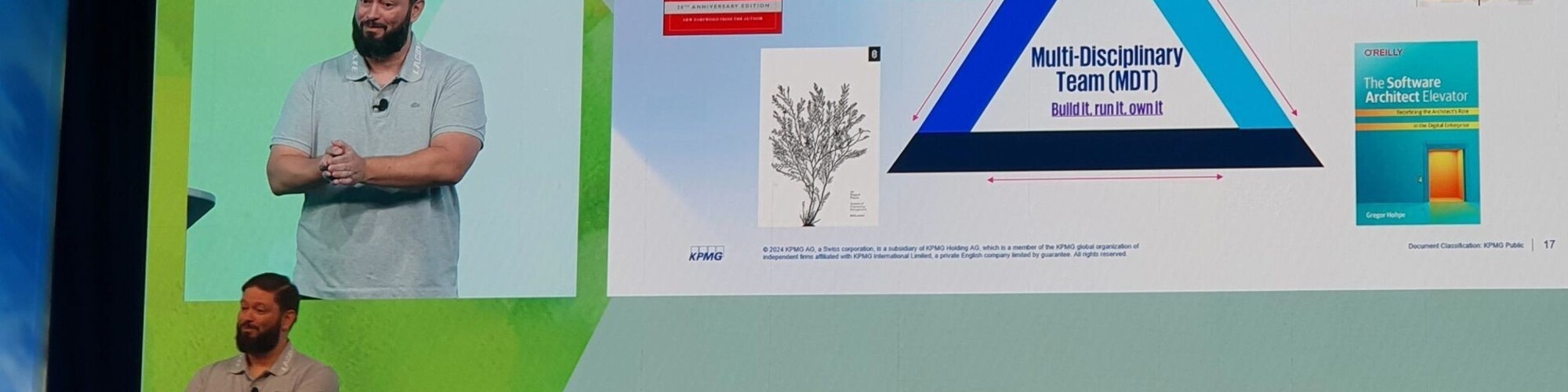
Matching Product Management, Engineering Management and Solution Architecture with Team Topologies
The alignment between product management, engineering management, and solution architecture is critical for the success of any organization. However, achieving this alignment can be challenging, especially when teams are structured in traditional silos, lack clear communication channels and are not product oriented.
In this talk, we show how introducing Team Topologies can be utilized to bridge the gap between product management, engineering management, and solution architecture, offering a structured approach to organizing teams and interactions within an organization, fostering collaboration, innovation, and agility.
We will demonstrate how to structure product management, engineering management, and solution architecture roles, and provide practical strategies for implementing and adapting Team Topologies within the organization and product teams.
The presentation will also explore some common pitfalls and challenges to watch out for, along with strategies for overcoming them, driving innovation, improving productivity and deliver value to customers.
Implementing Team Topologies
Team Topologies provides a powerful framework for shaping and optimizing team structures and interactions, enhancing your organizational agility and driving meaningful change within your teams. However, implementing Team Topologies can be challenging without the proper knowledge and guidance. In today's ever-evolving organizational landscape, it is crucial to adopt effective strategies that enable teams to thrive and deliver value consistently.
This presentation explores our experience with Team Topologies, providing valuable insights and practical tips to successfully apply Team Topologies and harness it's benefits. We will present how we structured the teams in order to enable close collaboration, make communication flow and driving change.
By attending this presentation, participants will gain the knowledge and confidence to successfully apply Team Topologies and unlock the full potential of their teams. They will be equipped with practical tips and tricks, along with a tutorial on how to successfully apply the Inverse Conway Maneuver, our lessons learned from implementing it, and which benefits we got.
Dare to Do - Multi-disciplinary Digital Ecosystem and DevOps at KPMG Switzerland
In this presentation, we take the audience on our Journey to bootstrap KPMG Switzerland's digital technology ecosystem to achieve our ambition of sustainable business agility.
We start by looking at how KPMG Switzerland IT landscape looked like when we started our journey (IT as back office support), presenting the challenges we had to overcome and sharing our lessons learned. We present, how we changed our identity and regained trust from our business colleagues. We also talk about what we had to change in order to grow, the techniques that worked for us, the ones we had to adapt or abandon (For now), and what we are going to experiment next. finally, we share some of our key takeaways for audience to reflect on.
We close the presentation by providing a glimpse of what's in our horizon for the future, and how we plan to evolve and grow our model.
Architectural Alchemy - Transforming Systems through AI-Driven Design
AI adoption is exploding and without a solid architectural foundation, it leads to chaos. How can enterprises scale AI adoption responsibly?
This presentation explores the interplay of Artificial Intelligence, Software Architecture, and DevOps practices. It demonstrates how to elevate systems by making AI a first-class architectural element for crafting intelligence-driven solutions. This approach redefines not only the structure and delivery of software, but also the very fabric of organizations, enhancing decision-making, user experience, and operational efficiency.
By unleashing the power of cognitive technologies, we can leverage, expand, and enhance systems by harnessing data from multiple sources (databases, storage systems, pipelines, logs, events, etc), unlocking systems to their full potential. However, with great power comes great responsibility, and inherent challenges. This session will share lessons learned from KPMG's journey as we navigated the complexities of AI-driven architecture, offering actionable insights to overcome these challenges to meet and exceed the expectations, including:
- The impact of AI-driven architecture on data privacy and quality
- Leveraging Generative AI for Intelligent Content Management—enhancing classification, generation, summarization, search, and compliance
- The fundamental role of Governance, Risk, and Compliance (GRC) in AI systems
- Addressing ethical considerations and their implications
- The importance of explainability to ensure that AI systems remain transparent, interpretable, and accountable
- Enforcing responsible AI practices across the organization
- Managing AI operations (AIOps) and AI model lifecycle management (MLOps) to ensure robust, up-to-date models aligned with business objectives
- AI's impact on business processes, people, security, and system integrations
By embracing AI responsibly, organizations can unlock unprecedented levels of efficiency, scalability, and innovation, all while managing risks and ethical concerns. This session provides actionable strategies to integrate AI into systems and leverage DevOps practices, helping organizations stay agile and competitive in an era where intelligence-driven software is not optional but essential for driving meaningful business outcomes.
Cultivating a Learning Culture - Unlocking the Power of Continuous Development
Organisations face the constant challenge of staying ahead and adapting to change. The key to thriving in this environment lies in creating and fostering a learning culture within the workplace.
This presentation aims to explore the significance of creating a learning culture and provide practical insights into how organizations can nurture a mindset of continuous development and continuous improvement.
By understanding the core elements and strategies we applied, attendees will be equipped with the knowledge and tools to build a dynamic learning culture and knowledge networks that focus on collaboration and on sharing deep knowledge, driving innovation, engagement, and long-term success.
Elevator Pitch (300 chars)
High retention isn't luck, it is culture!
By fostering a self-organized learning environment, backed by our CIO/CTO, we achieved 100x better retention. In this talk, I share the practical roadmap and techniques we used to empower teams, scale mentorship, and turn learning into a business win.
Architectural Resilience - Cybersecurity Strategies for AI-Driven Threats in a Cloud-First Era
Enterprise cybersecurity architecture must evolve from static defenses to intelligent, self-adapting systems, ready to address emerging challenges posed by AI-driven cyber threats. This presentation explores an approach that integrates Zero Trust principles, AI-driven threat intelligence, and strategic resilience models, transforming cybersecurity into a dynamic, robust, and integrated ecosystem.
In this session, participants will learn how to:
- Shift from static defenses to intelligent, self-adapting cybersecurity systems.
- Incorporate Zero Trust security models to enhance security frameworks.
- Leverage AI-driven threat intelligence to counter emerging attacks proactively.
- Design and build strategic resilience models to create dynamic and adaptive ecosystems.
- Prepare enterprise architectures for the unique challenges of AI-powered attacks.
By integrating these strategies into an actionable framework, organizations can streamline access control, enhance visibility and transparency, maintain compliance, and ensure that their cybersecurity architecture is not just a resilient defensive mechanism but a strategic business enabler.
AI Made Us Faster at Solving the Wrong Problems
You are in a meeting. Someone checks their Generative AI of choice mid-discussion and announces: "The AI says we just need to do X." Everyone nods and moves on. Congratulations, you have just solved the wrong problem.
Nothing is broken. Everything is faster, and yet something is wrong.
Generative AI has amplified our worst problem-solving habit: jumping to solutions before understanding the problem. It is System 1 thinking on steroids, magnified by the Dunning-Kruger effect: confident, fast, and increasingly wrong. We are racing toward solutions faster than ever, but they are brittle, disconnected, and often miss the point entirely.
This talk will teach you that one question changes everything: "What problem are we actually solving?" It sounds simple. It is not.
You will learn how to recognize when speed is hiding misunderstanding, how to distinguish symptoms from root causes, map consequences before committing, and slow down long enough to understand what you are actually solving for. This is not just theory; it is a practice you can apply in your next team meeting.
The best AI prompts, the smartest automation, and the fastest deployments are worthless if we are solving the wrong problem. It is time to stop optimizing for speed and start optimizing for understanding.
250 char Description:
AI didn’t make us smarter—it made us faster at being wrong. By turning answers into commodities, it rewards speed over understanding. This talk challenges teams to pause, question certainty, and ask: “What problem are we actually solving?”
Abstract:
Generative AI didn’t make us worse at problem-solving, it made us faster at exposing a habit we already have: jumping to solutions before understanding the problem.
By making answers instant and confident, it is amplifying shallow, short-term fixes that feel productive but simply hide or move problems elsewhere, creating an efficient inefficiency.
This talk engages the audience by challenging them to critically assess AI-generated content and introduces the simple practice of pausing to ask, “What problem are we actually solving?”, and how this helps uncover the root causes of underlying system issues. You’ll learn how slowing down briefly can prevent brittle solutions and lead to better outcomes, even in high-pressure environments.
Based on a real moment where moving fast with AI’s help led a team to solve the wrong problem, this talk introduces the simple practice of pausing to ask, “What problem are we actually solving?” You’ll learn how slowing down briefly can prevent brittle solutions and lead to better outcomes, even in high-pressure environments.
The Forgetting Machine - Why Your Organization Knows More Than It Can Remember
Every single day, modern organizations build a massive mountain of information; then immediately drop the context out of the window.
We hoard data, but lose the human reasoning behind it. The critical decisions, the hard-earned experiences, and the contextual "why" remain trapped in people's heads, isolated in digital silos, buried in forgotten repositories, or permanently lost when a project ends or someone leaves. Because this collective intelligence is so severely fragmented, knowledge vanishes faster than organizations can remember it.
The problem isn’t collecting information. The problem is converting it into knowledge that people can actually understand and reuse. We are scaling our mistakes far faster than we scale our insights. Without meaning to, we have engineered an incredibly efficient Forgetting Machine.
This session is a direct challenge to this systemic amnesia. We will move past outdated operational mindsets to explore the cultural and behavioral shifts required to stop the bleeding. It is time to dismantle the Forgetting Machine, rescue the human experience behind the data, build a robust knowledge ecosystem, and transform information into enduring organizational wisdom.
Every organization is a knowledge company. We produce enormous amounts of information every day, fragmented across systems, buried in disconnected repositories, trapped in people's heads, or simply lost when people and projects move on.
We have built an efficient Forgetting Machine.
We need to rethink Knowledge Management as strategic infrastructure. We need to turn information into knowledge, and turn that knowledge into wisdom: The ultimate source of competitive advantage.
Cloud Native Days Austria 2026 Sessionize Event
KPMG Group Digital Technology Days 2026
Presented the talk The Forgetting Machine - Why Your Organization Knows More Than It Can Remember at KPMG's internal technology event
DevOpsDays Geneva 2026
Presented Ignite talk: AI Made Us Faster at Solving the Wrong Problems
DevOpsDays Zurich 2026 Sessionize Event
KPMG Technology Days 2025
Presented the talk Architectural Alchemy: Transforming Systems through AI-Driven Design at KPMG's internal technology event
DevOpsDays Zurich 2025 Sessionize Event
Enterprise Technology Leadership Summit Virtual 2024 Sessionize Event
DevOps Enterprise Summit LAS VEGAS 2023 Sessionize Event
DevOps Enterprise Summit Amsterdam 2023 Sessionize Event
Marcelo Ancelmo
Lifelong learner. Tech Leader, Speaker, Trainer. Troubleshooter and Troublemaker - Head of Solution Architecture @ KPMG Switzerland
Zürich, Switzerland
Actions
Please note that Sessionize is not responsible for the accuracy or validity of the data provided by speakers. If you suspect this profile to be fake or spam, please let us know.
Jump to top