
Md. Mostafa Al Mahmud
AWS Community Builder, Senior software engineer, solutions architect, public speaker, and technical writer.
Bochum, Germany
Actions
I work with product and platform teams to shape systems that stay dependable under pressure. My focus is cloud-native architecture, secure-by-default engineering practices, and cost-aware design decisions.
As a solutions architect, I help organizations turn complex business requirements into secure, resilient, and cost-efficient cloud solutions. I specialize in designing scalable architectures across industries—from fintech and e-commerce to data analytics and IoT. I've conducted 20+ AWS Well-Architected Framework Reviews, identifying architectural risks and delivering remediation plans that improve security, operational excellence, reliability, performance efficiency, and cost optimization.
I enjoy writing detailed architecture narratives, sharing implementation lessons, and documenting trade-offs that matter in production environments.
I'm an AWS Community Builder (Serverless) and an international conference speaker, sharing practical knowledge on cloud architecture, infrastructure automation, and modern software patterns at AWS Community Days, tech summits, and conferences.
Outside platform work, I publish travel stories exploring place and systems.
Links
Area of Expertise
Topics
Solving Salesforce and SAP Silos with AWS Glue Zero-ETL
Enterprises often struggle with high-latency ETL pipelines when replicating data from Salesforce and SAP. Traditional batch-based approaches are brittle, frequently failing when source schemas evolve or when hitting API request quotas. In a data-driven organization, waiting hours for "yesterday's data" is no longer acceptable.
This session explores the architectural nuances of AWS Glue Zero-ETL for Salesforce and SAP. We will dive into how these managed integrations eliminate manual pipeline development while providing near real-time data availability in Amazon Redshift and S3 Tables (Apache Iceberg).
In this session, learn how to:
- Master the Hybrid API Strategy: How AWS Glue intelligently switches between Salesforce Bulk API and REST API to handle compound fields while maximizing throughput.
- Handle SAP Delta Tokens: Technical strategies for managing the Operational Delta Queue (ODQ) and timestamp-based watermarking for consistent incremental loads.
- Automate Schema Evolution: Leveraging the Iceberg table format to automatically propagate source system changes without breaking downstream queries.
The Payoff: You will walk away with the technical knowledge to accelerate enterprise data ingestion by up to 4.6x while reducing the maintenance burden of your ETL ecosystem.
AWS Modern Orchestration: Moving from Manual DAGs to Visual Workflows
In complex data analytics & automation projects, orchestrating dependencies across multiple accounts often leads to "DAG fatigue"—where engineering teams spend more time maintaining Python scripts in Apache Airflow than improving data quality. As data volumes grow, the overhead of managing infrastructure for these workflows becomes a bottleneck for agility.
This session provides an advanced look at the next generation of orchestration using Amazon SageMaker Unified Studio and Amazon MWAA Serverless. We will demonstrate how to replace manual orchestration code with a visual workflow experience that provides production-grade reliability without the operational burden.
In this session, learn how to:
- Automate Workflow Conversion: Technical details on how visual definitions are converted into Airflow-compatible definitions for MWAA Serverless.
- Implement Advanced Sensors: Using S3 Key Sensors and Glue Job Operators to create event-driven, "reactive" data pipelines.
- Manage Cross-Tool State: Handling state transitions between Visual ETL cleansing jobs and JupyterLab machine learning notebooks.
The Payoff: Attendees will leave with a practical framework for building collaborative, serverless orchestration environments that bridge the gap between data engineering and AI development.
Resilient Serverless Pipelines: Mastering Step Functions and Distributed Maps
For a data analytics & automation project, building serverless data pipelines is easy, but making them resilient at scale is not. Most production pipelines fail not due to logic errors, but due to hitting service limits—such as the 256KB payload limit in AWS Step Functions—or causing "thundering herd" issues on downstream databases.
This session focuses on advanced patterns for building high-performance, cost-effective serverless ETL using AWS Step Functions, AWS Glue, and Amazon S3. We will analyze real-world failure scenarios and apply production-hardened architectural patterns to solve them.
Key architectural patterns covered:
The Claim Check Pattern: Implementing S3 pointers to bypass payload limits when passing large metadata fragments between workflow states.
High-Performance Parallelism: Using the Distributed Map state to orchestrate millions of items in parallel while optimizing for cost through ItemBatching.
Resilience Mechanics: Implementing exponential backoff with jitter and sophisticated catch blocks for transient versus permanent service failures.
The Payoff: Attendees will walk away with a toolkit of reusable ASL (Amazon States Language) definitions and best practices to build "future-proof" pipelines that are cost-optimized for massive datasets.
Securing RAG Applications: Threats. Mitigations. Strategies
When a seemingly safe PDF surfaced malicious commands via an LLM, we realized the problem wasn’t just prompt injection—it was everything upstream. This session walks through how we secured a Retrieval-Augmented Generation (RAG) pipeline from ingestion to inference, using AWS-native tools to detect hidden threats, filter unsafe content, and protect sensitive data in real time.
Optimizing Cloud-Native Workflows with Event-Driven Architecture
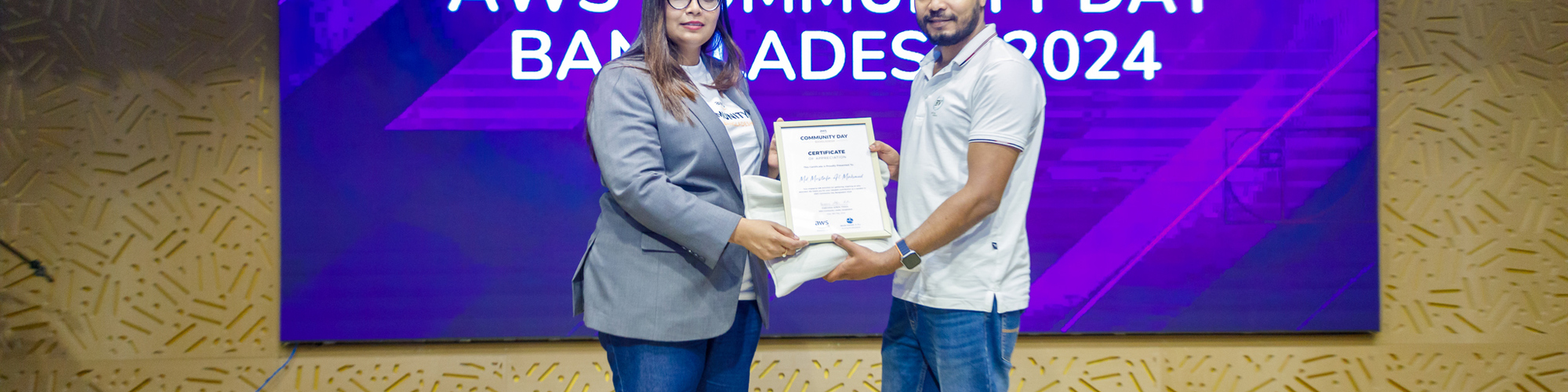
This is an in-person event named AWS Comunity Day Bangladesh 2024
Beyond Vibe Coding: Spec-Driven AWS Pipelines with Kiro IDE
Fragile, prompt-only code generation often introduces regression into production. This live-code session demonstrates specification-driven development on AWS using Kiro, the agentic IDE. The presenter walks through Kiro's three-step spec cycle—Requirement, Design, Task—to build an asynchronous AWS Lambda and DynamoDB pipeline. The demonstration covers how steering files and automated agent hooks enforce organization security standards directly in the workspace. It details how to connect local and remote Model Context Protocol (MCP) servers for secure resource exploration and use Kiro's automated CloudWatch log analysis to debug runtime execution errors live.
This presentation delivers raw developer craft, replacing slide-heavy presentations with an immersive live-coding session inside the Kiro agentic IDE. It demonstrates how to establish security-focused workspace rules using Kiro steering files and automates continuous integration validation on file save events.
Md. Mostafa Al Mahmud
AWS Community Builder, Senior software engineer, solutions architect, public speaker, and technical writer.
Bochum, Germany
Links
Actions
Please note that Sessionize is not responsible for the accuracy or validity of the data provided by speakers. If you suspect this profile to be fake or spam, please let us know.
Jump to top