
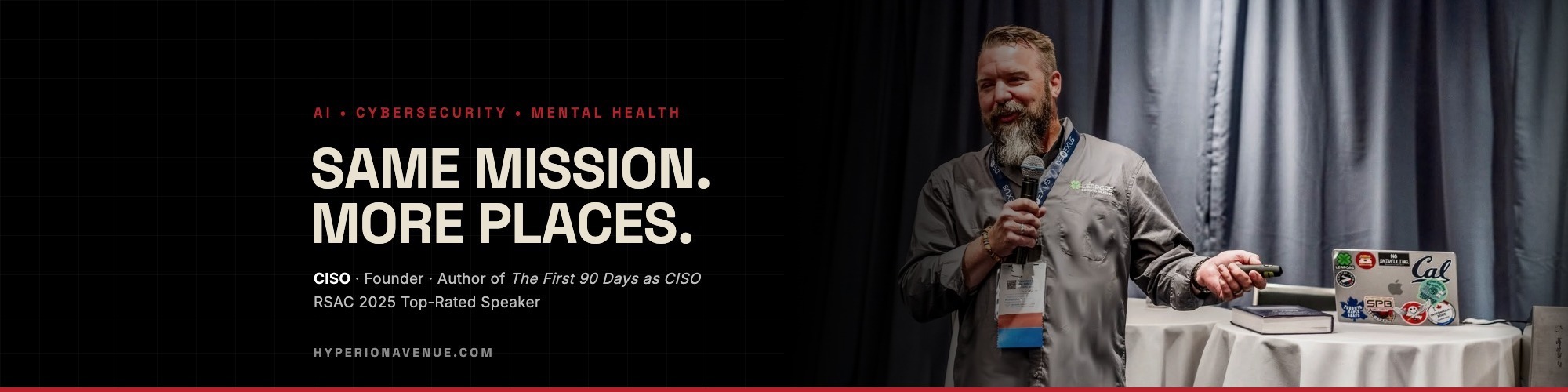
Patrick Kelley
CISO & Founder, Critical Path Security and Léargas Security | Author, The First 90 Days as CISO | RSAC 2025 Top-Rated Speaker
Atlanta, Georgia, United States
Actions
Patrick Kelley is a CISO and executive security advisor with nearly 30 years across information security, critical infrastructure, and network forensics. He is the founder and CISO of Critical Path Security and Léargas Security, where he architected an AI-driven detection platform that cut median alert resolution from 169 minutes to 12.
A frequent keynote speaker, Patrick delivered a top-rated session at RSAC 2025 and speaks across the U.S. and Canada on OT/ICS security, AI in security operations, and burnout as operational risk. He has spoken on panels alongside the FBI, CIA, and NSA, trains for NERC, CISA, CRISP, and E-ISAC, and has lectured in cybersecurity master's programs at CUNY, Kennesaw State University, and Georgia State University. His commentary has appeared in Fortune, CNN, NBC News, The Guardian, and Krebs on Security.
He is the author of The First 90 Days as CISO and co-author of CBI-CS: An Introduction to Burnout Intelligence, and holds the CISSP and CEH certifications.
Area of Expertise
Topics
Mental Health in Cybersecurity: Balancing the Scales
Security teams do not fail only from missing tools. They fail when exhaustion, cynicism, and lost efficacy go unread until someone quits or misses the alert. This talk turns the Maslach Burnout Inventory into a management method: what to measure, what to change in the next week, six weeks, and six months, and what a wellness poster will not fix. It is built for CISOs, SOC leads, and the accidental security lead: the IT manager or engineer who inherited the job and still has to keep detection and response running when the team is tired.
You will learn how to read exhaustion, cynicism, and reduced professional efficacy in ordinary security work, without a clinical claim and without turning a shift briefing into a therapy session. The examples come from security operations and critical infrastructure, where the cost of a tired miss is not a ticket. It is a plant, a cooperative, or a client who expected a human to still be paying attention.
Then the practical part: one escalation and coverage change that does not need a new hire, one thing leaders do with a short check that makes it worse (including putting scores in a performance file), and one scope cut that is more honest than a wellness app. And what fails: buying a program and announcing the culture is now healthy, or asking people to be resilient while the rotation stays impossible.
No product pitch. This material ran at RSAC 2025, where it was rated a top session, and at GridSecCon 2025.
Human Still Required: Treating Burnout as the Security Risk It Actually Is
We automate detection, orchestrate response, and hand more of the SOC to machines every year. The human is still required, and the human is exhausted. Burnout is not a wellness footnote. It is dwell time, alert fatigue, missed signals, and the quiet attrition that walks institutional knowledge out the door. This talk reframes burnout as measurable operational risk, drawing on nearly thirty years in security operations and on validated tools like the Maslach Burnout Inventory. You will leave knowing how to baseline fatigue across a team, catch the warning signs before resignation letters land, and build prevention into on-call, staffing, and incident response. In an AI accelerated world, defending the defenders is how we keep the humans who are still required in the fight.
From 169 Minutes to 12: Where AI Pays Off in the SOC, and Where It Quietly Manufactures Risk
Every security vendor now claims AI. Few can show what it changed on an ordinary Tuesday. At Léargas Security, we built AI-assisted alert enrichment and triage into a detection platform that unifies endpoint, cloud, identity, network, and threat-intelligence data, and cut median alert resolution from 169 minutes to 12 across more than 20,000 alerts a month. This session is the field report: what we automated, how we measured it, and where a human still has to stay in the loop.
It is also the cautionary half. Automation can hide detection gaps, deskill analysts who stop reading raw evidence, and open new attack surface as AI agents gain tools, data access, and identities of their own. Drawing on ongoing research into agentic AI abuse and detection chaining, I will walk through the failure modes worth testing for and the guardrails that matter, from prompt injection and data leakage to identity boundaries for autonomous agents.
Attendees leave with a practical scorecard for evaluating AI in security operations, a short list of metrics that prove value without hiding risk, and governance language leadership will actually follow. No product pitch.
Burnout Is a Security Risk: A CISO's Playbook for Measuring Fatigue Before It Becomes an Incident
We model threats against our networks with rigor, then ignore the most predictable failure mode in the building: the exhausted human holding the pager. Burnout is not a wellness footnote. It is dwell time, alert fatigue, missed signals, and attrition that walks institutional knowledge out the door. In this session I draw on nearly thirty years in security operations and on validated instruments like the Maslach Burnout Inventory to show how to treat burnout as measurable operational risk. You will see how to baseline fatigue across a SOC, spot the leading indicators before resignation letters arrive, and build prevention into staffing, on-call, and incident response rather than bolting it on after a crisis. The goal is a security program that stays sharp under sustained pressure, because resilient systems depend on resilient people.
Learning objectives for attendees:
1. Frame burnout as quantifiable operational risk tied directly to detection, response, and retention outcomes.
2. Baseline and track fatigue across a security team without invasive surveillance.
3. Identify the leading indicators of burnout early enough to intervene.
4. Build prevention into on-call rotations, staffing, and incident response playbooks, with board-ready language to fund it.
Patrick Kelley
CISO & Founder, Critical Path Security and Léargas Security | Author, The First 90 Days as CISO | RSAC 2025 Top-Rated Speaker
Atlanta, Georgia, United States
Actions
Please note that Sessionize is not responsible for the accuracy or validity of the data provided by speakers. If you suspect this profile to be fake or spam, please let us know.
Jump to top