
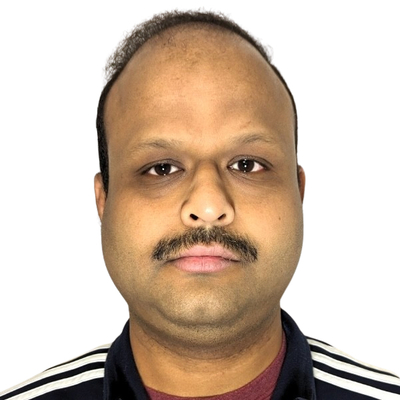
Priya Ranjan Sahoo
Principal Engineer, Oracle America Inc.
San Francisco, California, United States
Actions
Priya Ranjan is a seasoned software and cloud developer with over two decades of experience designing distributed systems and scalable multicloud solutions. At Oracle, he leads initiatives that integrate Oracle Databases with AWS, Azure, and Google Cloud — enabling seamless data movement and application interoperability. His current focus is helping developers and architects design efficient, secure, and cost-optimized multicloud architectures that turn complexity into opportunity. He is a seasoned speaker and has spoken at multiple IEEE conferences and meetups in the past.
Area of Expertise
Topics
Observability Is Not Enough: Reliability Engineering Using Digital Twins for AI-Native Systems
Current SRE practices were designed for human scale systems, where changes were infrequent and engineers could reason about failures after they occurred. That world no longer exists. AI coding assistants and automation pipelines now generate code and infrastructure changes at machine speed, while our reliability tooling remains fundamentally reactive. Observability tells us what happened, but it cannot tell us why it happened, or what will happen next.
In this talk, I will present why observability alone is insufficient for AI-native systems. Drawing on causal reasoning and Judea Pearl’s Ladder of Causation, I will talk about digital twins as executable world models for Reliability engineering. These twins integrate telemetry, infrastructure state, configuration, and policy into a causal graph that can be simulated before changes reach production. By moving reliability validation from post-incident analysis to pre-deployment simulation, SRE teams can predict blast radius, validate safety, and reason counterfactually about failures.
The future of SRE is not better dashboards, but rather simulation-driven, autonomous reliability.
Designing Multicloud Solutions with Oracle Database@Hyperscalers
As enterprises embrace multicloud strategies, the challenge is no longer whether to use multiple clouds — it’s how to make them work together effectively. Oracle’s partnerships with leading hyperscalers — Microsoft Azure, Google Cloud, and Amazon Web Services — now allows organizations to deploy Oracle Databases natively across these platforms, combining the power of Oracle’s enterprise-grade database services with the scale and flexibility of each hyperscaler.
Mastering Multicloud: Strategies, Architecture, and Operational Excellence in a Multicloud Era
Organizations today are rapidly adopting cloud computing, yet reliance on a single cloud provider brings risks: vendor lock-in, limited service choice, and constrained agility. A well-designed multicloud strategy—using services from multiple cloud providers—is emerging as the preferred architecture to maximize flexibility, resilience, and best-of-breed functionality. This talk explores what multicloud means in practice, its benefits and challenges, how to architect it for success, and what operational disciplines are required to manage it effectively. Drawing from real-world examples and best practices, we’ll guide practitioners and architects in crafting and executing a multicloud strategy that delivers value across cost, performance, security, and governance dimensions.
By the end of this session, attendees will be able to:
1. Define what constitutes a true multicloud architecture (versus hybrid or single-cloud) and understand its business and technical drivers.
2. Articulate the key benefits of multicloud—flexibility, best-of-breed services, cost optimisation, resilience, geographical reach—and map them to real scenarios.
3. Identify the principal challenges of multicloud (complex management, security & compliance, interoperability, cost tracking, skill gaps) and propose mitigation approaches.
4. Outline a robust multicloud architecture and strategy: workload placement, data movement, orchestration, service integration, and vendor-ecosystem considerations.
5. Recommend operational and governance practices for successful multicloud deployment: monitoring, common tooling, API and identity strategy, governance, data-residency, cost-visibility.
Achieving End-to-End Observability in a Multicloud World: Architecture, Patterns, and Best Practices
As enterprises expand across AWS, Azure, GCP, Oracle Cloud, and private cloud platforms, observability becomes exponentially harder and more critical. This session provides a practical roadmap for building unified observability in multicloud environments. Attendees will learn architectural patterns, distributed tracing strategies, cross-cloud log analytics, metrics standardization, and AI-driven incident detection. We will explore vendor-neutral tools (OpenTelemetry, Prometheus, Grafana), cloud-native services, and reference architectures that ensure reliability, performance, and security across heterogeneous cloud ecosystems.
Multicloud adoption is accelerating, driven by the need for resiliency, cost optimization, workload portability, and regulatory flexibility. But with this shift comes a new operational challenge i.e. visibility fragmentation. Each cloud provides its own observability ecosystem, CloudWatch, Stackdriver, Azure Monitor, Oracle Logging, and more, thus creating silos that make troubleshooting slow, multi-step, and error-prone.
The session will addresses the central question: How do we achieve consistent, real-time observability across multiple clouds?
The talk will introduce a vendor-neutral observability blueprint built on open standards such as OpenTelemetry, Prometheus, and OpenMetrics, enabling consistent instrumentation across clouds. We will discuss architecture patterns for distributing traces, correlating logs, unifying metrics, and integrating cloud-specific telemetry into a single, coherent view. Participants will learn how to design cross-cloud telemetry pipelines, evaluate ingestion strategies, and leverage AI/ML for anomaly detection and performance optimization.
The session will include reference architectures, real-world use cases, and examples of multicloud observability maturity, from basic log aggregation to predictive analytics and self-healing systems. We also cover governance, data retention strategies, cost considerations, and common pitfalls in multicloud observability deployments.
Attendees will leave with a clear understanding of how to build a scalable, resilient observability platform that spans AWS, Azure, GCP, Oracle Cloud, and on-premise systems.
Key Takeaways for Attendees:
1. Understand why observability becomes harder and more essential in multicloud environments.
2. Learn open standards and tools that enable cross-cloud instrumentation (OpenTelemetry, Prometheus, Grafana, Elastic).
3. Explore architectural patterns for unified logging, distributed tracing, and metrics correlation.
4. Learn to integrate cloud-native telemetry systems (CloudWatch, Azure Monitor, Stackdriver) into a single pane of glass.
5. Understand governance, cost control, and data residency considerations for multicloud observability.
6. See real-world multicloud observability designs and maturity models.
The views expressed here are my own and do not necessarily reflect the official policy or position of my employer
Please note that Sessionize is not responsible for the accuracy or validity of the data provided by speakers. If you suspect this profile to be fake or spam, please let us know.
Jump to top