
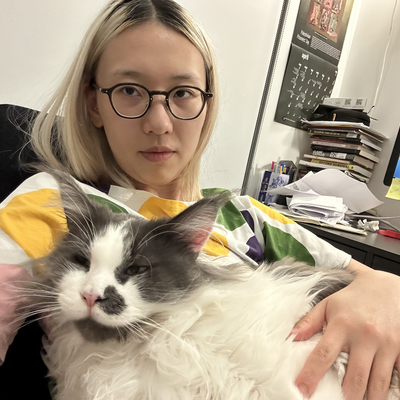
Rui Liu
PhD candidate at NYU American Studies
Actions
Rui Liu is a PhD candidate in American Studies at New York University. They work across transnational feminist and queer studies, global Asias, and critical ethnic studies, with a focus on Asian diasporic literature, visual art, performance, and film. Her dissertation examines how Asian diasporic aesthetic practices emerging from Sinophone and Inner Asian geographies contend with colonial intimacies across Cold War geographies and map anti-imperial modes of affiliation across geopolitical fault lines. Rui holds a BA and MA from the Women and Gender Studies Institute at the University of Toronto.
Waiting for Haven: Queer Temporalities and Asian American Relationality
Bringing together documentary aesthetics of idleness, literary mediations of planetary times, and multimedial performances of attunement across spaces, times, ecologies, and social differences, this panel joins queer temporal perspectives––anachronisms, loss, waywardness, the “not yet”––with critiques of speculation and accumulation, settler time and temporal dispossession, and chrononormativity to analyze the critical possibilities that queer temporalities afford to the analysis of Asian American relationality.
Resistance & Resurgence from the Archival Margins: Asians Discuss SWANA Art, Solidarity, and...
Informed by a transnational, transimperial nexus of Indigenous, refugee, and diasporic relationalities, this panel works together to advance an ethic of SWANA solidarity that centers, advocates, and actively participates in securing the liberation and futurity of SWANA subjects, lands, and peoples that have heretofore been Othered and excluded in many historical and political contexts besides Asian American studies. Each scholar’s literary, cultural, and state archives traces the afterlife of multiple waves of imperial war and colonization across SWANA through diverse genres of writing and multimedia forms: such as the 2005 Iraqi Constitution and the Kurdish Constitution Writing Committee; an Iranian-Kurdish refugee’s experimental prison life narrative and an Afghan artist’s art performance that attempts to return 20 tons of military waste from Afghanistan to America; a Singaporean dissident surgeon’s memoir and field surgical manual written in the aftermath of massacres in the 1982 Israeli invasion of Lebanon juxtaposed against Singapore’s role in the American and Israeli military industrial complex; and the traditional fibre art of Palestinian embroidery. Together, this panel of scholars juxtaposes Indigenous, refugee, diasporic, and marginalized Asian perspectives, memories, bodies, creative praxes, and knowledges to counter their erasure and complicity in imperial and colonial discourses and knowledge formations within a global context.
Relationality and solidarity in critical refugee and migration research
This interdisciplinary roundtable will discuss emerging lines of inquiry within critical refugee and migration studies on alternative modes of practice and research in the context of increasingly complex positionalities of oppression and privilege–pushing the boundaries of how we conceptualise “Asia” and “Asian American.” Critical Refugee Studies challenges us as a field to take up the “refugee” as an analytic and ask what conditions of knowing are made possible when we treat the refugee as an ideological construct in producing meaning (Espiritu, 2014), who perform critical ideological work for refugee-saving enterprises which serve global imperial and settler colonial interests (Ngo, 2019; Phu & Nguyen, 2021). As “knowledge producers in life-making” (Espiritu & Duong, 2018), people with refugee and migration experience possess a feminist refugee epistemology that disrupts the refugee/migrant binary and the settler/Indigenous binary and considers the interrelating oppression of migrants with precarious state status, racialized populations with histories of enslavement, and precariously employed migrant labourers (Adese & Phung, 2021; Kouri-Towe & Mahrouse, 2023; Walia 2021). In a context in which refugees, despite being overrepresented as subjects in research, are underrepresented as producers and creators of that research, the need for new frameworks for being in relation and solidarity with refugees in the act of writing, viewing, and listening has become urgent. Research fatigue among refugee peoples and the ethics of refusal (Tuck & Yang, 2014) mean that there is a need to reconceptualize research in and of itself, to reconsider the marginalization and oppression that happens within research, and to seek alternative ways of being and knowing.
Our intervention in this roundtable, which consists of members of the Critical Refugee and Migration Studies Network in Canada, is to examine how we enact our relationality and solidarity to the refugee and migrant communities we work with while firmly grounding our allyship within and beyond our communities. We ask: What are some critical ways we must re-envision research within complex positionalities of marginalization and privilege? How might centering refugee and migrant perspectives intervene in Asian American studies by providing insight into intersectionally-informed gendered, sexualized, and racialized histories of oppression in forced migration? At the same time, how might this be done in such a way that complicates and nuances migrant settler positionalities and responsibilities within contested settler colonial lands?
We engage in community based research that strives for accountability systems which acknowledges and embraces multiple positionalities and stakes whilst bringing people together across differences. This includes the reclaiming of and returning to knowledges beyond colonial frames of knowing (Kumsa, 2022; Mignolo, 2011; Taiaiaki, 2004), foregrounding place-based concepts to unearth rich and diverse epistemologies and ontologies that remakes and retraces connections beyond colonial separations through Earth bound and constellational relationships (Aguilera-Moradipour, 2023); and enacting a feminist ethics of care that centers relationality in liberatory archival practice (Caswell & Cifor, 2016; Caswell, 2021; Collier & Sutherland, 2022) that requires us to work in community at the “speed of trust” (Bailey, 2021). We offer examples of how we enact these ethical practices in our various community-based and participatory research projects using critical and counter-archives (Collier et al., 2022; Haritaworn et al., 2018); storytelling research within one’s own families (Dodds & Hess, 2020; Norton, 2006); the critical use of everyday stories and visual images to transform embodied norms and reveal invisible relations of power (Campt, 2017; Phu 2018), and a relational approach to refugee and migrant cultural production in literary analysis. We are inspired by critical scholar and author, Y-Dang Troeung (2023), who gently challenged us all in her own search for “regenerative possibilities of speaking”, to deeply consider what stories might be elicited and created when refugees are supported and enabled to define their own narratives of their migration process and resettlement.
Queer Aesthetics on Violence In Asia/America
This panel responds to the problematic of liberal Asian American attachments towards the state, law, and citizenship by bringing to the fore alternative histories, geographies, and encounters in Asian North America. The renewal of anti-Asian violence activated by the Covid-19 pandemic, alongside the resurgence of Asian North American community organizing, present new opportunities to interrogate the disavowal of anti-Asian racism by the liberal, multicultural settler state. This panel departs from the understanding that anti-Asian violence is both a site of foreclosure and unknown possibility. We posit anti-Asian violence as a category of knowledge that shifts and transforms. Drawing from Simeon Man’s articulation of anti-Asian violence as a function of settler colonialism and racial capitalism (2020, p. 25), our panel interrogates and responds to liberal formations of anti-Asian organizing that demand exceptionalism and recognition of anti-Asian racism as separate from imperialism. Our aim is to bring contestation and dissensus to what we readily name as anti-Asian violence. The art objects and performance-based works examined in this panel investigate how Asian North American art and cultural production can disrupt liberal framings of anti-Asian hate that continue to reinforce carceral, antiblack, and settler colonial violences. Our assembling of cultural texts and topics draws from Gayatri Gopinath’s method of queer curation, which aims to disrupt normative ways of seeing and make sensible submerged affiliations and embodiments by juxtaposing seemingly unrelated objects, histories, and geographies. In queer of colour media arts collective Love Intersections works, The Haunting of Hulijing and Yellow Peril: Queer Futures, the artists draw on different Chinese art and medicine traditions, alongside the aesthetics of horror and macabre to explore the notion of transgressing homonationalism, and the enforcement of biopolitics and racial capitalism by the nation-state. Alternately, the documentary film All Our Father’s Relations challenges framings of anti-Asian violence as separate from settler colonialism by recuperating Indigenous and Asian intimacies on unceded Musqueam land. For a protest rally in New Jersey, we turn to the sonic as we present a song Piglas—curated from chants, speeches, and performances—as a creative-critical reflection that resonates with the call for social justice on Anti-Asian violence. Lastly, a queer Asian archive of performance and poetry borne out of the HIV/AIDS epidemic offers to bring the past into the present in order to complicate the present and work towards alternative futures. Our panel seeks to highlight the ways that artists offer us frameworks that recalibrate and gesture towards different modes of seeing, feeling, and naming intersectional workings of power in Asia North America that ultimately aim to transform and reinvigorate diasporic Asian commitments to racial justice.
Colonial Visualities of Race and Indigeneity Across Chinese/American Empires
Informed by transnational, decolonial, and feminist methods, this panel responds to the resurgence of Asian American cultural nationalism, Chinese ethnonationalism, and right-wing authoritarianism across Asia and the West by investigating transimperial conceptions of race and indigeneity across China and the U.S. Drawing from literary and cultural archives, each scholar examines how visual culture can function as both sites of racialization and colonization and as tools for imagining counter-histories and decolonial political relations. Centering the “minor” transnationalisms of Uyghur, regional Han, and Black diasporic movements (Lionnet & Shih 2005), this panel unsettles romantic constructions of third-world internationalism and Chinese anti-imperialism—repeated within certain strands of Asian American identity politics—that obscure historical and emergent forms of Asian colonialism. Using blackness as an analytical category, Feng’s paper examines how American racial ideas and aesthetics of blackness/whiteness were incorporated into Chinese mass consumerism since the 1930s through a case study of the “Darkie” toothpaste. Feng’s analysis of commodity culture reflects on the simultaneity of anti-Black and anti-Indigenous formations in the twentieth century. Moving to the present, Liu’s paper analyzes Jenny Xie’s poetry collection The Rupture Tense (2023) to consider how diasporic re-visions of Li Zhensheng’s photographs of the Chinese Cultural Revolution can trouble Cold War binaries of victim and perpetrator and campist conceptions of U.S. dominance. Alternately, Imin centers diasporic Uyghur visual culture as a site of both colonial exploitation and indigenous resilience where the politics of power, identity, and memory are actively negotiated. In close connection with Imin’s work, Luo’s paper explores how diasporic Uyghur poetry and sculpture forward powerful anti-colonial critiques of Han Chinese state surveillance in occupied East Turkestan and of Uyghur diasporas. Tracing connections and divergences across postcolonial, area, Indigenous, and Black studies, this panel aims to orient Asian/American studies to the entanglement of multiple imperialisms to map alternative itineraries of transnational anticolonial solidarity.
Rui Liu
PhD candidate at NYU American Studies
Actions
Please note that Sessionize is not responsible for the accuracy or validity of the data provided by speakers. If you suspect this profile to be fake or spam, please let us know.
Jump to top