
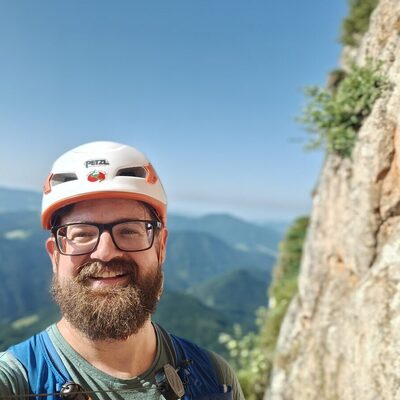
Simon Schrottner
CNCF Ambassador | OpenFeature Maintainer
Pernegg an der Mur, Austria
Actions
I build durable standards and practices so teams can learn, grow, and operate without depending on any single vendor, tool, or person.
I am passionate about developer experience, open standards, and building communities where people help each other grow. I regularly speak at conferences and mentor individuals taking their first steps in the open source world.
Open to conversations about open source, feature flagging, observability, and what comes next.
Badges

Area of Expertise
Topics
Two Standards Walk Into an Agent: Runtime Agent Control with OpenTelemetry and OpenFeature
Autonomous agents are being deployed without runtime control. No open, vendor-neutral way to change what they do. No visibility into why they decided. We can fix that. A physical party game. A Raspberry Pi. An agent that adapts and evolves the game in real time. Without a single proprietary platform.
Sounds fun. But it's also the argument. We've been here before.
Every vendor built their own observability stack. We paid the price - so we built OpenTelemetry. Same with feature flags - we built OpenFeature.
Now agents are here. The control layer is emerging again, often as vendor-specific infrastructure.
Nobody designed OpenTelemetry to be an agent's eyes. Nobody designed OpenFeature to be its conscience. Turns out they work anyway: OpenTelemetry becomes observation, OpenFeature becomes control.
This talk explores agent control on open standards — physical system control, infrastructure management, live model switching, permission changes, and rollback without redeployment.
Every autonomous agent needs a control layer. Vendors are racing to own it. You already have it.
OpenFeature as a Control Plane for OpenTelemetry
Most observability configurations are static. We decide upfront which spans to emit, which attributes to record, and how much telemetry is worth collecting. But production systems are not static. When everything is healthy, detailed telemetry creates unnecessary cost and noise. When incidents happen, the telemetry we need often is not being collected.
What if telemetry verbosity could adapt automatically?
In this talk, we combine OpenTelemetry and OpenFeature to dynamically control instrumentation at runtime. Services can switch between lightweight traces and deep diagnostic telemetry without redeployments or restarts. Feature flags drive observability decisions based on runtime conditions, enabling richer spans, additional attributes, and higher-cardinality signals only when they are needed.
We will demonstrate how OpenTelemetry semantic conventions can act as a standardized control surface, enabling adaptive and vendor-neutral observability across services and environments.
Your Open Source Standard Is Just Another Lock-In
Open source standards promise freedom, vendor neutrality, interoperability and no single company pulling the strings.
But swap one proprietary API for OpenTelemetry, OpenFeature, or Kubernetes - and ask yourself honestly: how easy is it to leave?
In this session, two independent practitioners take the stage on opposite sides of that question. One argues the lock-in is real - migration costs, governance slowdowns, specs shaped by committee rather than conviction. The other argues the opposite: that community-owned consensus is exactly what makes innovation possible, ecosystems diverse, and startups viable without building their own moat.
No vendor slides. No easy answers. Just the argument your architecture deserves.
The Software Organism: Designing for Evolution
We don't build software anymore. We grow it — poorly, slowly, and mostly by accident.
Every pull request is a mutation. Every deployment is a generation. Every incident is selection pressure. We've been running evolution without knowing it, with humans as the bottleneck in a feedback loop that should close in milliseconds.
Living organisms solved this differently. They separated mutation from adaptation. They built nervous systems — layers that sense, layers that act, layers that maintain stability without conscious intervention. And they developed proprioception — the organism's awareness of its own state. Where its limbs are. What's alive and what isn't.
Your business doesn't have that. You have dashboards. You have flag states nobody queries. You have business outcomes disconnected from the behaviors that caused them.
This talk doesn't show a working system. It asks whether the primitives we've already built — observability, feature flags, platform engineering, the track API — are quietly assembling themselves into something we haven't named yet. And whether we're designing toward it or stumbling into it.
Polyglot Testing Unleashed: How OpenFeature's Reference Implementation Validates Across Languages
How do you ensure a cloud-native reference implementation behaves consistently across Python, Go, .NET, JavaScript, Java, and beyond? Discover how the flagd-testbed project validates both the core flagd service and its language-specific integrations through a single, unified test suite. Leveraging Gherkin specifications as behavioral contracts, Testcontainers for real-world integration testing, and Renovate for automated testbed synchronization, this approach delivers reliable feature flagging across diverse environments. Reusable Gherkin steps and clear step mapping streamline bug identification, instantly pinpointing whether failures stem from the core service, language implementations, or integration layers—catching subtle bugs before they reach production. Learn practical strategies for scalable polyglot testing, reusable test specifications, and building infrastructure that grows with your ecosystem. Join us for actionable insights and real-world lessons from the flagd testbed!
18 Bluetooth Controllers Walk Into a Bar: Observability & Runtime Configuration with CNCF Tools
What happens when your "distributed system" is 18 PlayStation Move controllers on Bluetooth? Observability challenges web developers never face.
JoustMania is an open-source party game where players jostle motion controllers. Complex execution: multiple Bluetooth adapters, battery-powered devices, sensors at 100Hz. When a player complains their controller "felt different" - how do you debug it?
Challenges:
- Sampling data from 18 controllers without overwhelming telemetry
- Correlating hardware events with gameplay
- Managing high-cardinality data
- Debugging problems at 2 AM conventions
Solutions:
- Context-aware flags responding to battery, skill, system load
- Intelligent sampling capturing critical events, dropping noise
- Trace correlation between hardware and game logic
- Using OpenTelemetry to prove games are "rigged" (or not)
Demo: Change behavior via GitHub-synced flags, show real-time controller telemetry, reveal emergent behavior in physical systems.
OpenFeature’s Positive Impact on Confidence at Dynatrace
At Dynatrace, feature flags have been integral to our workflows for years. However, our homegrown solution has increasingly become a fragmented collection of flags rather than a comprehensive management tool. This has led to challenges such as unclear use cases, legacy flags with unknown or unintended uses, and complexity compounded by team transitions and shifting assignments.
To address these issues, we embraced OpenFeature to standardize and enhance feature flag observability—not just for our benefit but for the broader developer community. By integrating OpenFeature with OpenTelemetry, our Site Reliability Engineers (SREs) now have actionable insights, enabling them to confidently assess potential impacts and side effects across our systems.
Join us as we share our journey with OpenFeature at Dynatrace and how it’s transforming the way we manage feature flags.
Fun with Flags: How OpenFeature Solves Your Feature Flag Headaches
Feature flags have revolutionized the software delivery lifecycle, enabling teams to decouple releases from deployments and create a more agile development process. They're often hailed as one of the key practices in modern software development—at least in theory.
However, as systems grow in complexity, so do the challenges associated with feature flagging. From supporting multiple languages and managing targeted evaluations to avoiding vendor lock-in and safely decommissioning obsolete code, what initially seems like a straightforward problem can quickly become daunting.
The OpenFeature community is tackling these challenges head-on by providing vendor-agnostic SDKs and a suite of powerful tools designed to simplify the feature flagging experience. Join me as we explore the common pitfalls of feature flagging and discover how OpenFeature can help bring the fun back into this critical aspect of software development.
Target audience: Everyone within the SDLC can profit from feature flags, basic overview, entry into feature flagging
Cloud Native AI Summit - EUROPE 2026 Sessionize Event Upcoming
Cloud Native Denmark 2026 Sessionize Event Upcoming
KubeCon + CloudNativeCon North America 2026 Sessionize Event Upcoming
Dutch Cloud Native Day 2026 Sessionize Event Upcoming
My Coding Zone - 2026 User group Sessionize Event
KCD Sofia 2026 Sessionize Event
ContainerDays Hamburg 2026 Sessionize Event
WeAreDevelopers - Online - 2026 Sessionize Event
JNation 2026 Sessionize Event
Devoxx.uk
Fun With Flags
KubeCon + CloudNativeCon Europe 2026 Sessionize Event
JavaCro'25 Sessionize Event
Cloudland 2025
Fun with Flags
MakeIT 2025 / JCON OpenBlend Slovenia 2025 Sessionize Event
CNCF-hosted Co-located Events Europe 2025 Sessionize Event
Please note that Sessionize is not responsible for the accuracy or validity of the data provided by speakers. If you suspect this profile to be fake or spam, please let us know.
Jump to top