
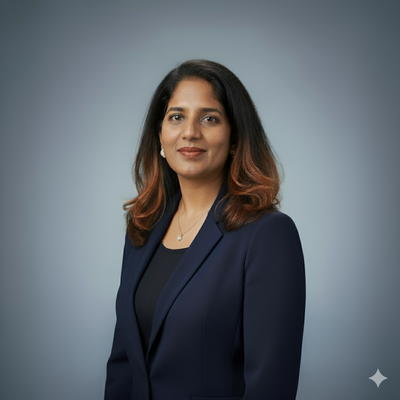
Tuesay Singh
Deloitte Consulting, AI Engineering as a Service
San Francisco, California, United States
Actions
Tuesay Singh is a seasoned technology leader with over a decade of experience at the intersection of AI, fintech, and cloud engineering. She is currently a Product Lead at Deloitte Consulting in San Francisco, and provides AI Engineering as a Service to banking clients. Prior to Deloitte, she was as a Senior Technical Product Manager at Amazon's Hazardous Goods Compliance vertical, leading OCR optimization across Seattle and European Union. She has an MBA from the Kelley School of Business and an MS from the University of Southampton. Outside of her professional role, she is a Board Advisor, Chapter Lead for Girls Who Code, member of Women in Product.
Links
Area of Expertise
Topics
Closing the Geospatial Gap in Cybersecurity
Every enterprise security stack has a blind spot: location. While organizations invest heavily in endpoint detection, SIEM correlation, and threat intelligence feeds, adversaries are exploiting geospatial attack vectors such as GPS spoofing, cellular tower hijacking, and geofenced malware that traditional IP-based attribution methods simply cannot see. Standard IP geolocation achieves roughly 61% accuracy in identifying attack origins, leaving defenders guessing about the geographic dimension of threats targeting their critical infrastructure.
This talk presents the architecture, implementation, and measurable results of a Geospatial Threat Intelligence Platform I built and deployed in production for financial services infrastructure protection. The system fuses GPS telemetry, cellular triangulation (Wi-Fi + cell tower), and network flow data through a multi-stage pipeline that correlates cyber indicators of compromise with precise geographic coordinates—achieving 94.3% accuracy in geographic threat attribution, a 33-percentage-point improvement over industry baselines.
I will walk attendees through four technical pillars of the system:
(1) Geospatial Signal Ingestion and Fusion
(2) The Geospatial Cyber Kill Chain Analysis Engine
(3) Real-Time Threat Attribution Pipeline
(4) Integration with Enterprise Security Infrastructure
Attendees will leave with documented architectural patterns, specific algorithm choices with performance benchmarks, and a practical evaluation framework they can apply to assess whether geospatial intelligence would strengthen their own security posture. The session includes a live demonstration of geographic threat clustering detection using anonymized production data.
This talk bridges a gap that few practitioners are addressing: the intersection of geospatial AI and cybersecurity. With the NGA projecting a tripling of geospatial data in the next five years and CISA identifying location-based infrastructure protection as a strategic priority, this capability is moving from novel to essential.
Building GenAI-Native Financial Products
I propose a talk titled: "Building AI Agent to Agent in Regulated Industries, such as Private Wealth Asset Management" This session will cover approach and outcomes that I recently delivered to my clients at Deloitte Consulting within AI Engineering as a Service domain. Some key areas that I think would be useful in the Data Global Hub talk are:
1. Architecting GenAI-native systems within cloud-based data ecosystems. Here I can talk about data profile, data transformation, and solution architecture required before deploying GenAI solutions.
2. Implementing explainable AI for regulatory compliance in financial services. In my org, I own quarterly complaint report submit to FINRA, where I led the tech to architect automated reporting pipelines.
3. Strategies for deploying privacy-preserving distributed machine learning (DML) models
4. Case studies on scaling AI solutions in enterprise FinTech environments. Here I will talk about how my contribution to help Bank of America navigate supply chain blockages during Suez Canal crisis, support Goldman Sachs in creating Trade Finance global ecosystem, etc.
I am happy to partner with existing teams if the organizers see my topics will fit theirs. Thank you and looking forward to hearing from you.
Best Regards,
Tuesay Singh
(tuesaysingh@gmail.com)
Tuesay Singh
Deloitte Consulting, AI Engineering as a Service
San Francisco, California, United States
Links
Actions
Please note that Sessionize is not responsible for the accuracy or validity of the data provided by speakers. If you suspect this profile to be fake or spam, please let us know.
Jump to top