
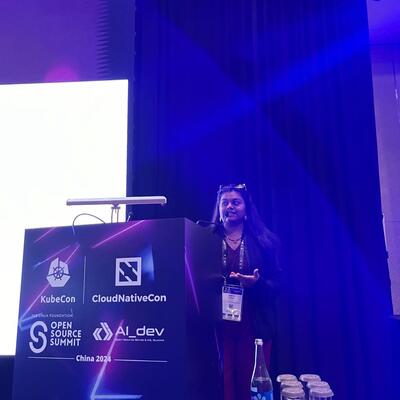
Nikita Verma
Cloud Native Contributor
Bengaluru, India
Actions
Nikita Verma is an active contributor to the open-source community with a strong focus on Kubernetes and cloud-native technologies. She worked on developing forest growth simulations, automating configuration generation, and integrating CI/CD workflows. Nikita has volunteered at KubeCon events, showcasing her commitment to the Kubernetes ecosystem. Her technical expertise spans Python, Golang, AWS, and FLINT.Cloud, complemented by her contributions to initiatives like Girlscript Summer of Code
Badges

Area of Expertise
Topics
How Your Code Becomes a Kernel
We all use torch.compile, but for many of us, it’s a "black box" that magically makes code go fast. This poster is designed to turn that magic into a mental map. I’ve distilled the complex journey of a PyTorch tensor—from the Python frontend through TorchDynamo, into the AOTAutograd, and finally being lowered into a Triton kernel.
Instead of dense code blocks, I’m using visual flowcharts to show where the "graph breaks" happen and how to avoid them. If you’ve ever wondered why your model isn't as fast as the benchmarks promised, this poster will give you the diagnostic tools to look under the hood and fix it yourself. This isn't just a talk; it's a "cheat sheet" for the modern PyTorch developer.
The "Open" SOC: Architecting a Free Security Lab for 10,000 Students
The biggest barrier to entering the cybersecurity field isn't talent; it's the cost of tools. Proprietary SIEMs (Security Information and Event Management) are expensive, leaving students with "theory" but no "practice." As a community leader who has mentored over 10,000 aspiring engineers, I realized we needed a better way.
This session explores how we used OpenSearch to build a scalable, open-source Security Operations Center (SOC) for education. We will step through the architecture of a "Training Lab" where students can ingest real attack logs, visualize threats, and practice threat hunting—all without a corporate budget.
We will discuss:
The "Free Tier" Architecture: How to deploy a multi-tenant OpenSearch cluster on Kubernetes that scales to thousands of student workloads cost-effectively.
Gamification: Using OpenSearch Dashboards to build "Capture The Flag" (CTF) scoreboards that track student progress in real-time.
The Talent Pipeline: How this open-source approach creates a generation of engineers who are "OpenSearch Native" from day one.
Hunting Shadows: Detecting Kubernetes Botnet Behaviors with OpenSearch
Containerized botnets are ephemeral; they vanish before traditional forensics can catch them. To detect modern threats like "Crypto-jacking DaemonSets" or "Git-Native C2 channels," we need to move beyond static analysis and embrace real-time behavioral observability.
In this session, we will demonstrate how to use OpenSearch as a high-speed SIEM for Kubernetes. We will construct a threat-hunting pipeline that ingests Kubernetes Audit Logs and Cilium Network Flows to visualize the specific signatures of a compromised cluster.
Attendees will learn how to build OpenSearch Dashboards that flag:
Anomalous User Agents: detecting "imposter" Git clients and non-standard API calls.
Repo Jitter: visualizing the mathematical beaconing patterns of C2 traffic.
Privileged Pod Creation: alerting on unexpected DaemonSet deployments in the kube-system namespace.
Hunting Shadows: Detecting "Git-Native" Botnets with OpenSearch Anomaly Detection
Traditional firewalls are useless against modern botnets. Why? Because today's malware doesn't talk to a suspicious IP; it talks to github.com. I classify these as "Git-Native" botnets, and they blend perfectly into your developer traffic. To catch them, we don't need signature matching; we need behavioral mathematics.
This session demonstrates how to turn OpenSearch into a next-generation SIEM for Kubernetes. We will ignore standard logs and focus on high-fidelity "Meta-Signals."
We will build a live detection pipeline that flags:
"Repo Jitter": Using OpenSearch Aggregations to detect the mathematically precise "heartbeat" of a bot polling a Git repository (e.g., exactly every 600s), which looks distinct from human jitter.
User-Agent Anomalies: Correlating API Server logs to spot "Imposter" Git clients (like go-git or libgit2) running inside pods that should not be pulling code.
The Kill Chain: How to visualize the correlation between a "Git Pull" event and a sudden spike in CPU usage (mining), using OpenSearch Dashboards to prove the infection timeline.
Beyond Unit Tests: Chaos Engineering for Data Pipelines
Data pipelines are often the most brittle part of our infrastructure, yet they are rarely tested for real-world failure. This talk introduces a production-proven SRE practice, Chaos Engineering, as a new standard for data quality and pipeline reliability. We will move beyond traditional data validation and explore how to proactively inject failures into our data stack. This session provides a practical framework for designing and executing controlled chaos experiments against critical data infrastructure, including ETL/ELT jobs, streaming processors, and data stores. We will cover how to simulate failures like network partitions, sudden data corruption, and resource exhaustion in orchestration systems. By discovering these hidden bottlenecks and single points of failure in a controlled setting, we can build truly resilient, production-grade data platforms. This talk is for engineers who want to move from a reactive to a proactive approach to data infrastructure.
Your Tests Are Lying to You: From Brittle Assertions to True Observability
Your test suite is all green. But is your application actually healthy? Traditional pass/fail test results are a dangerously incomplete picture of your system's quality. This session challenges us to rethink the purpose of our automated tests: they are not just for validation; they are a rich source of observability data. I will demonstrate how to instrument your test automation suite (using tools like OpenTelemetry) to emit valuable telemetry with every run. We will explore how to capture performance metrics, generate traces to understand how your services interact under test, and pipe this data into platforms like Prometheus and Grafana. It’s time to stop asking "did the tests pass?" and start asking "what did our tests teach us?"
Anatomy of a Container Breach: A Live Hacking and Defense Demo
How secure are your running containers? In this session, we will find out by putting them to the test. This talk is a live, two-part demonstration of a real-world container breach.
Part 1: The Attack. I will exploit a common misconfiguration in a Kubernetes-deployed application to gain initial access, escalate privileges, and attempt to break out of the container.
Part 2: The Defense. I will then show how a modern runtime security tool like the open-source project Falco can detect this malicious activity in real-time, generate alerts, and give you the visibility you need to stop an attacker in their tracks.
Untangle the Legacy: Modernizing Monoliths with Cloud-Native Strategies
most of us aren't building greenfield applications from scratch. We're living with monoliths, navigating spaghetti code, and battling the accumulated weight of technical debt. Modernizing these legacy systems to leverage the agility and scalability of cloud-native architectures can feel like an impossible task – a journey fraught with risk and complexity.
This session is for every developer, architect, and team lead grappling with the challenge of evolving existing systems. We'll cut through the hype and provide a pragmatic, technical roadmap for strategically untangling monoliths and gradually migrating to a more flexible, cloud-native future. We'll focus on techniques that allow for incremental change, minimizing risk while maximizing the impact of your modernization efforts.
You'll discover how to identify the right seams in your legacy codebase, extract services effectively, and integrate them into a modern cloud-native ecosystem without a complete rewrite. This isn't just theory; we'll discuss real-world patterns and pitfalls, empowering you to start your own modernization journey with confidence.
Key Takeaways for Attendees:
Strategic Monolith Decomposition: Learn techniques like the "Strangler Fig Pattern" and "Bounded Contexts" to incrementally extract services from a monolithic application.
Identify Effective Seams: Understand how to analyze a legacy codebase to find natural boundaries for microservices, minimizing coupling and maximizing refactoring safety.
Data Migration & Consistency: Explore strategies for handling shared databases and ensuring data consistency during a phased migration from monolithic to distributed data models.
Hybrid Deployment & Communication: Discover patterns for smoothly integrating new cloud-native services with existing legacy components (e.g., API Gateways, event-driven architectures).
Minimizing Risk & Maximizing Value: Learn how to prioritize modernization efforts to deliver tangible business value quickly while managing technical debt and maintaining system stability.
Join us to turn the daunting task of legacy modernization into an achievable and rewarding journey. You'll leave with actionable strategies to transform your existing applications into agile, cloud-native powerhouses.
Failure is Inevitable: Engineering for Resilience in Distributed Systems
In the cloud-native world, we often talk about "uptime" as the ultimate goal. But what happens when failure isn't just a possibility, but an inevitability? Distributed systems are inherently complex and prone to hiccups. The real challenge isn't preventing every single failure, but building applications that can gracefully withstand and recover from them – moving beyond mere uptime to true resilience.
This session is tailored for developers and architects keen on understanding how to bake resilience directly into their applications from the very first line of code. We'll explore practical patterns and design philosophies that move beyond basic error handling, helping you create robust systems that not only survive chaos but thrive in it.
We'll dive into technical strategies and demonstrate how applying specific patterns can significantly improve your application's fault tolerance and graceful degradation. This isn't just about operations; it's about empowering developers to design for the messy reality of production.
Key Takeaways for Attendees:
Understand Resilience Patterns: Explore common distributed system resilience patterns like Circuit Breakers, Bulkheads, Retries with Exponential Backoff, and Throttling, and when to apply them.
Code for Failure Scenarios: Learn practical coding techniques and library choices (e.g., Polly for .NET, Resilience4j for Java, Go's context package) to implement these patterns effectively.
Graceful Degradation Strategies: Discover how to design your application to shed non-essential load or provide reduced functionality during partial outages, maintaining core user experience.
Test for Resilience (Chaos Engineering Light): Get an introduction to developer-friendly approaches to testing resilience, including basic chaos engineering principles you can apply without a dedicated team.
Observability for Resilience: Learn how robust observability (metrics, logging, tracing) becomes the cornerstone for verifying and understanding your application's resilient behavior in real-time.
Join us to empower yourself with the knowledge to build applications that are not just functional, but truly antifragile – ready to face the inevitable storms of cloud-native production environments.
Why Breaking Things is a Good Idea: A Practical Introduction to Chaos Engineering
We build our systems with the hope that they will never fail, but hope is not a strategy. This session is a practical introduction to Chaos Engineering—the discipline of deliberately experimenting on our systems to build confidence in their ability to withstand failure. Based on my hands-on experience building a chaos experimentation platform, I will demystify this powerful practice. We'll explore the core principles of forming a hypothesis and running controlled experiments to proactively discover weaknesses. I will also walk through a prepared offline demo using an open-source tool to show how you can safely simulate real-world failures and build more resilient, trustworthy systems.
DevOps in Action: Automated CI/CD and Environment Management for Business Central Extensions
Accelerate your Business Central development lifecycle with robust DevOps practices tailored for Power Platform integrations. In this interactive workshop, you’ll build and deploy Business Central extensions through end-to-end CI/CD pipelines, manage multiple environments, and enforce quality gates—all within Azure DevOps.
Hands-On Lab: YAML-Driven Builds
– Author YAML build pipelines to compile AL code and package Business Central extensions
– Implement automated unit tests using Test Runner and SonarCloud quality analysis
– Publish artifacts to Azure Artifacts feeds and prepare release definitions
Environment Deployment & Release Gates
– Create multi-stage release pipelines: dev → test → production
– Apply approval gates and automated smoke tests
– Use Infrastructure as Code (Bicep) to provision sandbox and production environments
Monitoring, Rollback & Best Practices
– Integrate Azure Monitor and Application Insights for deployment telemetry
– Define rollback strategies using deployment history and feature flags
– Share tips for scaling pipelines and managing solution lifecycle
Key Takeaways
Production-ready YAML pipeline templates for Business Central ALM. Automated testing and quality-gate configurations to ensure stable releases .Environment provisioning with IaC for consistent sandbox and production setups. Monitoring dashboards and rollback patterns to maintain 99% deployment reliability
From Noise to Clarity: Humanizing Observability in Cloud-Native Systems
As cloud-native environments scale in complexity, observability is no longer just about collecting logs, metrics, and traces—it’s about making sense of them. While modern observability stacks deliver a wealth of data, the real challenge is translating this information into actionable insights that everyone on the team can understand and use, from SREs and developers to business stakeholders.
This talk explores the next evolution: From Noise to Clarity. We’ll dive into practical strategies and open source tools (like OpenTelemetry, Prometheus, and emerging AI/LLM-powered solutions) that help demystify observability data. Attendees will learn how to:
Correlate signals across distributed systems for a unified view
Use AI and LLMs to generate human-friendly explanations of complex incidents
Build dashboards and alerts that surface root causes, not just symptoms
Empower teams to act quickly and confidently—regardless of their observability expertise
We’ll showcase real-world examples.
Invisible Shields: Runtime Security and Virtual Patching in Kubernetes
Traditional patch management is insufficient for mitigating rapidly evolving threats in dynamic Kubernetes environments, where zero-day vulnerabilities can be exploited before official patches are available. This session presents a technical exploration of virtual patching—deploying runtime security controls at the kernel level to intercept and neutralize exploits without modifying application code or requiring downtime. Leveraging open source solutions such as KubeArmor, which utilizes eBPF and Linux Security Modules (LSM) for inline mitigation, and Kyverno for declarative policy enforcement, this talk demonstrates the orchestration of layered security policies that provide defense-in-depth against advanced threats. Attendees will see how to implement granular process, file, and network access controls, automate vulnerability detection and response workflows, and integrate virtual patching into CI/CD pipelines for continuous protection. Real-world use cases will illustrate how these controls block exploitation vectors in real time, ensuring workload integrity while maintaining operational agility
Bringing Cloud Native to the Classroom: Empowering the Next Generation of Technologists
Cloud native technologies are reshaping the tech industry, yet they remain underrepresented in academic curricula. In this talk, we’ll explore why teaching cloud native concepts in academia is essential for preparing students to meet industry demands. I'll address key challenges, such as the overwhelming complexity of the CNCF Landscape and the rapidly evolving best practices that make curriculum design difficult.
To bridge these gaps, I’ll present actionable solutions, including starting with foundational tools like Docker, simplifying Kubernetes learning through hands-on projects, and structuring topics into manageable modules from containers to CI/CD pipelines. I’ll also highlight free resources, such as the CNCF Playground and online tutorials, and the transformative impact of community engagement through platforms like Slack, GitHub, and meetups.
CNCF-Hosted Co-located Events North America 2026 Sessionize Event Upcoming
PyTorch Conference North America 2026 - POSTER SESSIONS Sessionize Event Upcoming
Open Source Summit Korea 2026 Sessionize Event
SeleniumConf & AppiumConf Valencia 2026 Sessionize Event
Data Makers Fest 2026 Sessionize Event
OpenSearchCon Europe 2026 Sessionize Event
PyTorch Conference Europe 2026 Sessionize Event
OpenSearchCon China 2026 Sessionize Event
Container Days London Sessionize Event
Posadev 2025 Sessionize Event
DDD Brisbane 2025 Sessionize Event
Directions Community Dubai BC Day Sessionize Event
KubeCon + CloudNativeCon North America 2025 Sessionize Event
OpenSSF Community Day Europe 2025 Sessionize Event
CNCF-hosted Co-located Events Europe 2025 Sessionize Event
Please note that Sessionize is not responsible for the accuracy or validity of the data provided by speakers. If you suspect this profile to be fake or spam, please let us know.
Jump to top