
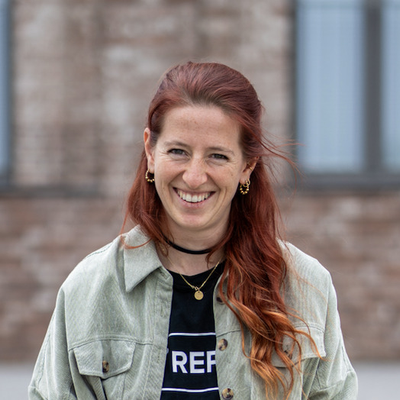
Beija Nigl
Comsysto Reply, Senior Software Engineer & Workshop Facilitator
Comsysto Reply, Senior Software Engineer & Workshop Facilitator
Munich, Germany
Actions
Having worked in many different roles from Software Engineer to Product Owner and Project Manager, Beija has held numerous formal and informal leadership roles in diverse teams with varying levels of knowledge and experience (readiness and maturity). With her technical background and experience as a Software Engineer she is able to effectively support her teams in architectural decisions. Along her technical interests her passion for leadership topics and team dynamics has already been nurtured during her studies as she was part of the Femtec Career Building Program and later joined the Female Leadership Academy. With this broad skillset Beija is able to create environments where both technical and interpersonal challenges are addressed and collaboration is fostered. This also makes her a valued mentor and coach to both junior and senior colleagues, empowering them best guide and support their teams. Furthermore, she is an experienced facilitator of EventStorming and other collaborative modelling (CoMo) methods and offers a variety of internal soft skills workshops like handling criticism or mastering nonviolent communication.
Von Softwareentwicklerin über Product Ownerin, bis hin zur EventStorming-Moderatorin und Trainerin für Soft Skills hat Beija bereits in diversen Rollen gearbeitet. Dabei setzt sie in ihren Projekten als IT-Beraterin gezielt kollaborative Modellierungsmethoden (CoMo) ein und schult sowohl Kunden als auch Kollegen. Zudem moderiert sie regelmäßig EventStorming + X Workshops in unterschiedlichen Branchen. Mit ihrer Fullstack Erfahrung und dem Wirtschaftsingenieur Hintergrund ist sie in der Lage, die Lücke zwischen technischen Lösungen und fachlichen Anforderungen zu schließen und so einen ganzheitlichen Ansatz zu gewährleisten. Ihre Leidenschaft für Führungsthemen und Teamdynamiken wurden bereits während ihres Studiums durch die Teilnahme am Femtec Careerbuilding Programm geweckt, später setzte sie diesen Weg in der Female Leadership Academy fort. Heute führt sie diverse Inhouse-Trainings zu Themen wie Gewaltfreie Kommunikation und Kritikfähigkeit durch.
Area of Expertise
Topics
Software Design Accelerator: Surviving Complexity
(This is a hands-on lab with limited capacity)
In a world where 75%+ software projects still fail, what is going wrong? Failure means the system doesn't meet customer and/or business needs. This workshop allows you to super-charge your design learning, combining technical skills, team-working, conflict resolution, and complexity-management techniques.
Let’s break this cycle of failure; take these skills and apply them straight away to your work. The Software Design Accelerator is about increasing your velocity towards successful outcomes.
This workshop is based around a problem statement, where you will exercise a variety of software design techniques within a supportive environment. We'll take a step back to think about designing the system that builds the system, and have fun creating a design together.
Join this workshop to:
- Get your teeth into an interesting problem with practical activities
- Explore and share techniques for breaking down the problem and designing a solution
- Practise strategies to manage complexity in software development
- Explore the social-technical aspects of creating a software system
This is a fun and mostly practical workshop for anyone working in software development.
Situational Leadership in Software Development
In dynamic and evolving engineering environments, individuals often find themselves in leadership roles, whether formally appointed as tech leads, architects, or informally influencing decisions due to experience or expertise. Especially senior developers who might suddenly realise their influence or former techies who were promoted to a formal leadership position without further training often struggle in best supporting their team. But what is the secret to success in these demanding roles? Why is it intuitive in some situations and harder in others?
This talk on Situational Leadership in software development explores how P. Hersey and K. Blanchard's model applies to typical engineering team challenges. We will examine various aspects of Situational Leadership and apply them to situations like introducing new technologies, fostering team dynamics, or solving complex architectural problems. You will learn how to adapt your leadership style to your team’s needs and maturity, enhancing project efficiency and improving motivation and teamwork. We dispel the common myth that leadership is rigid and illustrate how the concept of Situational Leadership (II) is practical. Whether you hold a formal leadership position or influence through expertise and experience, this talk is relevant for anyone looking to successfully navigate their teams through the challenges of modern software projects and create the conditions for successful collaboration in your team.
Last but not least, leadership is not only a push principle and sometimes, we find ourselves without the leadership style we need. The Situational Leadership theory also helps you in assessing your situation and proactively seeking the support necessary to tackle your challenge.
Preparation - The underrated potential for CoMo workshops
When it comes to Collaborative Modelling (CoMo), simplicity and adaptability are often perceived as defining strengths, but this notion of "just adapting on the fly" can be misleading. Many CoMo methods are deceptively simple, creating false confidence in their effortless adaptability across various scenarios. However, the high level of collaboration and intrinsic motivation required from participants demands meticulous preparation.
This talk will provide valuable insights on how to prepare for collaborative modelling workshops especially when dealing with big groups and/or environments where the goal is hard to pinpoint, politics are involved or resistance to change can be expected. Throughout the talk you will learn how to find a shared understanding of the workshop's goal, what it means to be aware of hidden agendas and group dynamics, and how to make sure all relevant stakeholders are on the same page. The presentation will further cover how to design a fitting storyline across the different formats or methods being used.
Furthermore, the talk will introduce the “CoMo Prep Canvas” - a tool developed in collaboration with Michael Plöd - to guide both new and experienced facilitators through a structured preparation process. You will learn how to use the canvas not only to ask the right questions to important stakeholders but also to make your own assumptions tangible during the preparation.
AI Needs Context It Can't Build Alone - AI, Legacy Code, and the Messy Road to Domain Knowledge
We took over a legacy codebase with a one-month handover, no tests, unclear architecture, and a mandate to use AI for everything. Some of our stakeholders just expected magic, but here's the catch: AI is most useful when you already understand the domain well enough to assess its output. And we didn't. Not yet. We were just learning the domain, the technology, and AI tooling all at the same time, under pressure.
This talk is about making the implicit explicit, step by step. And in this system everything was implicit: the domain knowledge, the design decisions, the boundaries. We generated documentation to evaluate the current implementation and to create a shared picture, modelled the domain together, wrote assumption tests to understand what the code actually does and created instruction files, skills and agents to define guardrails for the AI (or Harness Engineering as it's called nowadays).
We learned that AI doesn't replace domain understanding, it amplifies it in both directions. It needs context it can't build on its own. When we knew what we were doing, it was a multiplier. When we didn't, it confidently led us astray. And yes, our AI setup also broke production along the way.
But also on a personal level we faced some challenges, not everyone in the team was convinced by the hype and some maybe even too much. It forced us to have some honest conversations about what AI can and can't do and to align our expectations.
KanDDDinsky 2026 Sessionize Event
Domain-Driven Design Europe and Data Mesh Live 2026 Sessionize Event
Agile meets Architecture 2026 Sessionize Event
Build Stuff 2025 Lithuania Sessionize Event
NewCrafts 2025 Sessionize Event
KanDDDinsky 2025 Sessionize Event
DDD Europe, EventCentric, Data Mesh Live - 2025 Sessionize Event
Please note that Sessionize is not responsible for the accuracy or validity of the data provided by speakers. If you suspect this profile to be fake or spam, please let us know.
Jump to top