
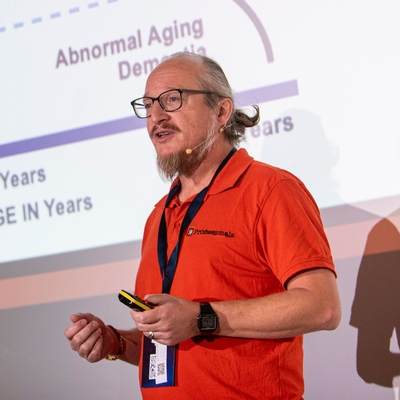
Erik de Bos
Agile Leader at Alliander
Líder de Ágilidad
Flow Master bij Scrum Professionals
Amersfoort, The Netherlands
Actions
Erik de Bos is an Agile Leader, Scrum Master, and Agile Coach with over a decade of experience helping organisations improve their effectiveness, foster employee well-being, and adapt to a complex world. He is an expert in enhancing team performance, fostering continuous learning, and aligning daily work with strategic goals.
Erik shares insights through talks and articles and has developed several tools, including "The Purpose & Roadmap Template" and "The Sprint Goal Template," and co-created "James the Evil Stakeholder," a card game designed to help teams learn how to deal with difficult stakeholders.
Erik also enjoys jogging, cooking, photography, and music, hobbies he sees as a way to express creativity and find flow.
Erik de Bos es un Agile Leader, Scrum Master, and Agile Coach con más de una década de experiencia ayudando a las organizaciones a mejorar su efectividad, fomentar el bienestar de los empleados y adaptarse a un mundo complejo. Es un experto en mejorar el rendimiento de los equipos, fomentar el aprendizaje continuo y alinear el trabajo diario con los objetivos estratégicos.
Erik comparte sus conocimientos a través de charlas y artículos, y ha desarrollado varias herramientas, incluyendo la plantilla Purpose & Roadmap y la plantilla de Sprint Goal, y co-creó "James the Evil Stakeholder", un juego de cartas diseñado para ayudar a los equipos a aprender a lidiar con los stakeholders difíciles.
A Erik también le gusta correr, cocinar, la fotografía y la música, pasatiempos que considera una forma de expresar la creatividad y encontrar Flow.
Erik de Bos is een Agile Leader, Scrum Master en Agile Coach met meer dan tien jaar ervaring in het helpen van organisaties om hun effectiviteit te verbeteren, het welzijn van medewerkers te bevorderen en zich aan te passen aan een complexe wereld. Hij is een expert in het verbeteren van teamprestaties, het stimuleren van continu leren en het afstemmen van het dagelijkse werk op strategische doelen.
Erik deelt zijn inzichten via lezingen en artikelen en heeft diverse tools ontwikkeld, waaronder de "The Purpose & Roadmap Template" en de "The Sprint Goal Template". Hij is ook mede-ontwikkelaar van "James the Evil Stakeholder", een kaartspel dat is ontworpen om teams te leren omgaan met lastige stakeholders.
Daarnaast houdt Erik van hardlopen, koken, fotografie en muziek, hobby's die hij ziet als een manier om creativiteit te uiten en in een staat van flow te komen.
Links
Area of Expertise
Topics
How to measure Business Value - a pragmatic approach to metrics in a complex environment
With Agile the focus is always on Value, but how to measure it? Simple metrics like lead time and the like are easy to measure but unreliable approximations, so instead we turn to more and more complex metrics like NPS, but are these truly more effective?
In this talk we will discuss the huge caveat when using empiricism that nobody seems to notice. We will explore the consequences it has and how being aware of it makes us better at measuring stuff, the right way.
I will show how, by applying an Agile approach, we can radically reconsider the way we measure things, something which presents a huge opportunity for your organisation.
Takeaways:
- why empiricism is not the superpower it is made out to be.
- why grand metrics are a terrible idea in a complex system.
- a new approach to measuring value effectively.
A Systemic Approach to Organisation Design and Change Management
130 years since Taylor took the first steps in our quest to figure out how to design organisations and we are still struggling. It is time for us all to take the lead - no more excuses! The world is waiting.
In this talk, I will describe how we need to stop talking about frameworks, manifestos and the newest fad. Together we will explore the basic principles that are the foundation of all those frameworks and methodologies we are so much in awe of.
We will discover how to use them and how to start developing our own frameworks and methodologies rooted in our own particular context.
Join me in discovering what Agile was always supposed to be: an extremely effective approach that is liberating and lots of fun!
Takeaways:
- getting back to basics - what are the essential principles of Agile.
- how to use these principles effectively, at both the team and organisation level.
- how understanding these principles allows you to break out of frameworks and create your own.
- how Agile is not about of-the-shelve solutions but about learning!
The Mental State of Flow - Our Evolutionary Superskill To Deal With Complexity
Have you ever done something where you felt like you were in a higher state of awareness, your focus sharp like a knife, and time seemed to stand still? Imagine you could harness that same feeling in your work, working with your Scrum Team? Even cooler, imagine you could measure that feeling, and use it to guide you in just about all the organisational choices you make at work?
That feeling is the Mental State of Flow. Using insights from my work as an ecologist I will show you how over millions of years we humans have evolved an instinctive feeling for Flow, as a way to deal with complexity.
In this talk we will discuss how this makes Flow the perfect alternative for our struggles with dashboards, assessments, metrics and the like. And how Flow is an example of the new kind of tools we need to make sense of complexity and find our way as change agents.
Using examples from my experience as a change agent, I will show you how to use Flow at all levels of the organisation, providing you with a step-by-step approach to start using Flow in your work, and a sense-making matrix to help you make choices using Flow.
I hope to inspire you to join me in finding other patterns in nature to help us deal with complexity!
I've done this talk at Agile Cambridge, Agile Tour Vilnius and Scrum Day Europe. Every iteration is different as I integrate feedback and learnings.
Unlocking our Human Potential: Hacking Your Brain to Become a Superstar Developer
Every developer has the potential for greatness. This talk isn't about new frameworks or languages. It's about the ultimate tool: your brain.
In this talk we'll explore the characteristics that lead to genius and how to develop them. Drawing on principles from psychology, change management and even ecology, we will uncover how our brains are wired to handle complexity and how you can hack that wiring for a competitive advantage.
I will guide you on a journey to recognise your hidden skills and unleash your creative potential. Leave this session with a roadmap to become a truly unstoppable developer.
Takeaways:
- Learn techniques to enhance focus and productivity by understanding and leveraging the brain's natural capabilities.
- Explore practical methods to achieve and maintain states of deep focus and creativity.
- Gain strategies to revolutionize your work approach, maximizing your potential as a developer.
The Metrics Fallacy: Why Our Best Intentions Fail in a Complex World
From the catastrophic quality issues at Boeing to the spread of misinformation on social media, we are witnessing a powerful and dangerous pattern: initiatives designed to improve complex systems are being derailed by an over-reliance on metrics.
This talk exposes the fundamental flaw in our approach, revealing how we apply tools from a "complicated" world to problems that are inherently "complex." We'll explore why metrics only give us a limited glimpse of reality and can lead to unintended, and often catastrophic, consequences.
Drawing on frameworks like the Stacey Matrix, this session will challenge the notion that "if you can't measure it, you can't manage it" and propose a new path forward: one that prioritizes intuitive "sense-making," human collaboration, and adaptive learning, embracing innovative concepts such as flow and trust over the tyranny of numbers.
The AI Paradox: The Cost and Opportunity of Delegated Thinking
AI gives us an extraordinary opportunity. We can delegate mundane, bureaucratic and repetitive work, freeing people to spend more time on creativity, problem-solving, relationships and meaningful work.
But there is a paradox.
The easier it becomes to delegate work, the easier it also becomes to delegate the thinking behind that work, the difficult human work of thinking for ourselves. We may gain efficiency while losing something much more valuable and harder to measure: curiosity, judgement, understanding and the ability to make sense of our own work.
The opportunity of AI is not to delegate human thinking. It is to delegate the work that gets in the way of human thinking.
Together, we will explore the difference between delegating a task and delegating the thinking behind it. We will look at what AI is good at taking from us, what we should be careful about handing over, and how to create deliberate boundaries around human judgement and responsibility.
Through examples, questions and discussion, participants will examine their own use of AI and identify where delegation creates genuine capacity, and where it might quietly erode capability.
Participants will leave with a practical way to think about AI delegation: delegate what creates capacity, augment what benefits from collaboration, and protect the thinking that we need to remain capable of doing ourselves.
Takeaways:
- Recognise the difference between delegating a task and delegating the thinking behind it.
- Identify where AI can genuinely remove low-value work and create capacity for more meaningful human work.
- Understand how convenience can lead us to outsource curiosity, judgement and understanding.
- Decide deliberately what to delegate to AI, what to augment with AI and what should remain human.
- Protect and strengthen human capabilities such as judgement, curiosity, creativity and sense-making as AI becomes more capable.
Lead the Learning, Not the Team - A jargon-free field guide for team-led effectiveness
We want teams to become self-managing, yet in our jobs we are usually expected to implement Scrum and direct the development of our teams. We are seen as experts that define what an effective team looks like, diagnose the gaps, select interventions and evaluate progress. The team may improve, but it also learns that someone else understands its development better than the team does.
This talk explores a different form of developmental leadership: rather than trying to improve the team, help the team become capable of improving itself. The thing that should never be outsourced is the team's ability to lead its own learning.
The talk introduces the Effectiveness Field Guide, a jargon-free and framework-agnostic map of capabilities teams need in order to become increasingly effective. Instead of presenting a fixed maturity model or prescribing a sequence of practices, it makes the relationships between capabilities visible and gives teams a way to reason about their own situation, identify what currently limits them, and choose a useful next learning challenge.
Through examples, questions and a practical exercise, participants will experience the difference between diagnosing a team and helping a team diagnose itself. Participants will examine how apparently helpful coaching can create dependency, why process adoption is not evidence of effectiveness, and how ordinary language leaves room for solutions a prescribed framework would not suggest.
Participants will leave with a practical way to think about team development and a different leadership question: not “How do I make this team more effective?” but “How do I help this team become capable of leading its own development?”
Takeaways:
- Recognise how well-intentioned coaching can create dependency.
- Understand why adopting a process, framework or set of practices is not evidence that a team is effective.
- How ordinary language can make conversations about team effectiveness more accessible and create space for original solutions.
- How to help a team to identify their capabilities and diagnose itself, and how to choose a useful next learning challenge.
- How to shift developmental leadership from “making a team better” to helping a team take ownership of its own improvement.
• Format: Interactive 60-minute session
• Level: Intermediate to advanced
• Character: Conceptual, provocative and practical
• Focus: Leadership, team effectiveness, developmental dependency and team-owned improvement
The Leadership We Forgot - leading without authority
My father runs a farm in India. You might expect him to lead through hierarchy: he owns the farm, makes decisions and can tell others what to do. He certainly has that authority. Yet the farm does not succeed because people simply follow his instructions.
A farm is not a machine. Conditions change, knowledge is distributed and the people closest to the work often notice things first. My father cannot command the weather, centralize every decision or prescribe a response to every situation. He depends on trust, experience, relationships and the ability to create coordinated action. His authority may give him the final word, but it does not automatically give him the best answer.
Modern organizations often overlook this distinction. We have come to equate leadership with position, mandate and control. This can coordinate work when tasks and outcomes are sufficiently predictable. In complex environments, however, results also depend on learning, creativity and the willingness of people to contribute what they know.
Consider computer games. How can someone remain absorbed in a difficult game for an entire evening, yet struggle to focus during a one-hour meeting? Games do not engage us by removing difficulty. They combine challenge with agency, visible progress, rapid feedback and opportunities to develop mastery. When engagement at work is missing, organizations frequently respond by adding more control, thereby removing the very conditions that make engagement possible.
This talk explores two leadership logics: leadership through position and leadership through movement. It does not argue that authority is always wrong. It asks what becomes possible when leadership no longer depends on authority as its primary mechanism.
The Scrum Master embodies this second logic. A Scrum Master cannot command commitment, prescribe learning or order a team to become self-managing. The role creates impact by shaping conditions, revealing patterns and enabling others to exercise leadership. The future of leadership may therefore not be new. It may be a form of leadership we need to remember.
• Format: Interactive 60-minute session
• Level: Intermediate to advanced
• Character: Conceptual and reflective, grounded in a personal story and recognizable workplace situations
• Focus: Leadership, complexity, intrinsic motivation and the deliberately non-hierarchical position of the Scrum Master
Conferencia Agile Spain (CAS2024) Sessionize Event
Regional Scrum Gathering - Stockholm 2024 Sessionize Event
Erik de Bos
Agile Leader at Alliander
Amersfoort, The Netherlands
Links
Actions
Please note that Sessionize is not responsible for the accuracy or validity of the data provided by speakers. If you suspect this profile to be fake or spam, please let us know.
Jump to top