
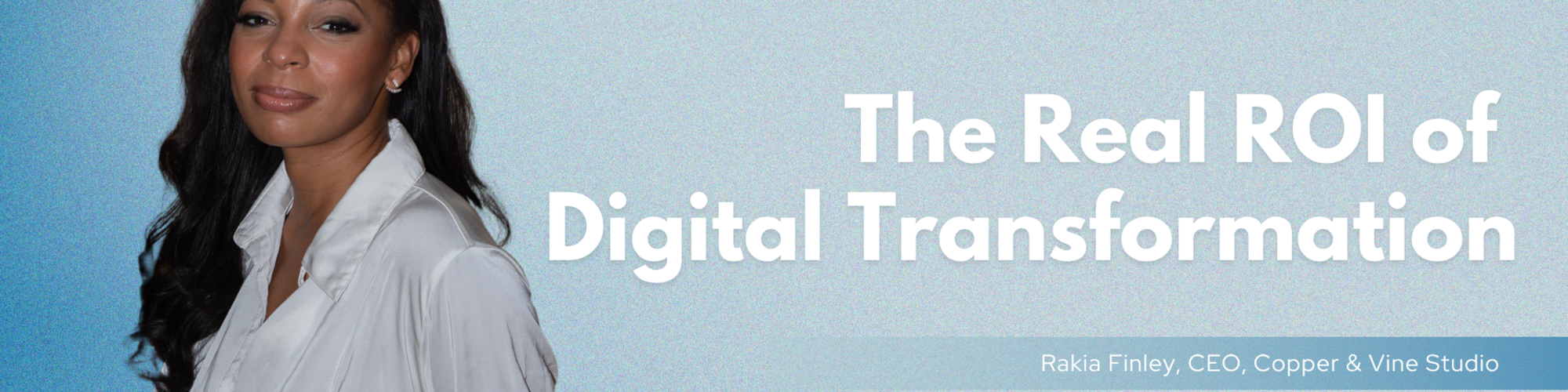

Rakia Finley
Human-Centered AI Systems Strategist | Founder & CEO, Copper & Vine Studio | AI Governance, Organizational Transformation & Future Infrastructure
Washington, District of Columbia, United States
Actions
Rakia Finley is a strategist, founder, and systems thinker working at the intersection of AI governance, organizational transformation, and human-centered innovation.
As the Founder and CEO of Copper & Vine Studio, she advises startups, enterprises, public-sector organizations, and emerging leaders on how to responsibly scale technology, build resilient operating systems, and prepare institutions for the next era of AI-enabled business and society.
Her work focuses on translating complex innovation into practical implementation — helping organizations move from fragmented experimentation into scalable systems, governance frameworks, operational clarity, and measurable growth. She is especially known for her ability to bridge executive strategy, emerging technology, security, human behavior, and organizational design into conversations that are both visionary and deeply actionable.
Rakia’s speaking explores the future of AI adoption, trust, governance, workforce transformation, digital infrastructure, and institutional resilience. Her sessions challenge organizations to think beyond tools and automation toward the deeper question: what kind of systems, leadership, and human experience are we building for the future?
She has spoken on topics spanning responsible AI, organizational transformation, secure system design, inclusive innovation, and the future of work — with a focus on helping leaders navigate complexity while building systems people actually trust.
Links
Area of Expertise
Topics
Agentic DevOps in Action: Building Resilient AI Microservices with .NET & Azure
This immersive 2-day lab walks development teams through building a secure, AI-enabled microservices stack using .NET, Azure OpenAI, and Azure Kubernetes Service (AKS). Participants will go from design to deployment, applying DevSecOps practices and leveraging agentic development patterns. This workshop is tailored for teams preparing to scale GenAI workloads without sacrificing control, compliance, or performance.
What AI Agents Actually Need from Your Cloud Stack
Everyone wants an AI assistant. No one wants to maintain the infrastructure behind one. In this practical session, Rakia Finley unpacks the cloud-native realities of building AI agents that aren’t just cool but stable, scalable, and secure.
You’ll learn what RAG workflows actually demand of your storage and container orchestration, how to build latency-aware event pipelines that play nice with LLMs, and what monitoring looks like when your system is generating outputs you can’t always predict. Whether you’re prototyping GenAI features or scaling a production-ready AI tool, this talk helps you make sure your stack is ready for the complexity ahead.
The GenAI Stack is Broken: What I Learned Rebuilding It for Real Clients
Most GenAI demos are slick. Most GenAI systems in the wild are brittle, confused, and failing at scale. In this session, Rakia Finley breaks down what happens when GenAI moves from the lab to real-world production. From hallucinating customer support agents to broken RAG pipelines and silent prompt injection vulnerabilities, she’ll share hard-earned insights from shipping systems for social ventures, government teams, and startups racing toward product-market fit. You’ll walk away with a clearer picture of how to architect GenAI infrastructure that doesn’t collapse under pressure and how to avoid building a Frankenstein of disconnected tools and plugins.
Beyond the Prompt: Building Generative Agents that Think with Context
A good GenAI agent doesn’t just respond, it reasons. But most of what we’re seeing today is just prompt-chaining dressed up as intelligence. In this session, Rakia Finley walks through what it takes to design generative agents that truly leverage memory, task orchestration, and operational context. She’ll share real use cases from startups and enterprise environments, highlighting design decisions that unlock smarter behavior and pitfalls that leave agents stuck in loops. Whether you’re a builder or just GenAI-curious, you’ll leave with a better understanding of where agentic design is heading and how to start building systems that think before they talk.
Architecting for Resilience: Scaling Systems with Risk in Mind
As decentralized technologies and generative AI converge, a new question emerges: What does it take to build systems that deserve trust, not just demand it? In this keynote, Rakia Finley shares field-tested frameworks for secure, scalable, and socially conscious system design developed from two decades of building for institutions like JD Power, Paramount, and MyFitnessPal. With real use cases in tokenized healthcare, secure-by-design AI, and resilient infrastructure for emerging economies, this talk explores how to move beyond hype and build the next generation of trusted digital ecosystems.
Modernizing the Old Guard: Deploying AI in Legacy Industries Without Breaking the System
AI is revolutionizing logistics, real estate, infrastructure, and manufacturing—but retrofitting these legacy systems with intelligent agents isn’t plug-and-play. In this session, Rakia Finley, draws from 20+ years of digital transformation experience to unpack how to successfully implement AI in industries where the stakes are high, and the systems are brittle.
This session will explore what it takes to modernize outdated workflows with agentic AI—while maintaining operational continuity, regulatory compliance, and human oversight. Attendees will leave with an actionable roadmap to evolve enterprise systems that weren’t built for intelligence into ones that can scale it.
What You’ll Learn:
- Key challenges and risks of introducing agentic AI into legacy industries
- How to bridge the gap between old infrastructure and new intelligent workflows
- Tools and methods for AI-readiness assessments in traditional enterprises
- Strategies for aligning stakeholders around automation without resistance
- Real use cases from construction, infrastructure, and real estate transformation
Privacy by Pattern: Architecting Ethical AI into National-Scale Platforms
How do you design AI systems that respect privacy at scale across borders, bureaucracies, and behavioral patterns? In this talk, Rakia Finley shares behind-the-scenes insights from her work architecting enterprise-grade, AI-powered platforms for civic, financial, and healthcare institutions. Rather than bolt on compliance late in the lifecycle, she’ll demonstrate how to use design patterns, embedded logic, and multi-system orchestration to build governance-first infrastructure. This isn’t about checkboxes, it’s about pattern-matching privacy into every layer of your stack so regulation doesn’t become the bottleneck to innovation.
Secure by Design: Architecting Resilient Systems in a Time of AI Hype
The rush to embed generative AI into everything has left most teams skipping the part where they ask, “Can we trust what we’re building?” This session walks through a playbook for building resilient, secure systems from the first whiteboard sketch, not as a compliance afterthought. Drawing from 20+ years of leading AI architecture and backend infrastructure for institutions like JD Power, University of Minnesota, and MyFitnessPal, Rakia Finley shares threat modeling techniques, DevSecOps practices, and high-impact system patterns for engineering teams under pressure to ship fast and scale smart. If you’ve ever been asked to deliver innovation without compromising trust, this session is for you.
Trust, But Verify: LLMs, Prompt Injection, and the New Frontier of Secure AI Dev
Prompt injection is one of the most underestimated attack vectors in modern .NET applications using LLMs. In this lightning-fast talk, Rakia breaks down how developers can proactively secure AI prompts in app workflows, monitor misuse, and implement real-time controls. You’ll walk away with actionable Visual Studio tooling and GitHub workflow integrations that prevent prompt exploitation before it reaches production.
From Prompt to Breach: Memory Forensics in AI-Augmented Attack Surfaces
AI-augmented applications are redefining the attack surface, from prompt injection in LLMs to memory-resident payloads that blur the lines between inference and intrusion. This session examines real-world case studies where generative AI systems were exploited and how memory forensics plays a pivotal role in uncovering volatile threats. We’ll walk through advanced techniques for detecting and analyzing malicious behavior in memory, especially where conventional logging fails, and offer a forward-facing look at what “threat surfaces” truly mean in a post-AI era.
The Invisible Architecture: Threat Modeling AI Systems Before the First Line of Code
Threat modeling in AI is often an afterthought, yet ignoring risk during ideation creates blind spots that cascade into architecture, training, and trust. This session explores how to design secure AI systems before a single line of code is written. Drawing from real-world case studies, Rakia Finley presents frameworks for aligning threat modeling to model ethics, data governance, and long-term resilience from day zero.
Beyond Prompts and Policies: Threat Modeling the Invisible Risk in AI Systems
While most AI conversations center on data privacy and model hallucinations, the real threat lies in what we don’t model: shadow APIs, opaque decision layers, and system misuse vectors. This session breaks down how to threat model AI pipelines from the start, including open-source tools, role-based red teaming, and mapping misuse early.
AI Hype vs. Security Reality: A Field Guide for CISOs, Engineers, and the “WTF Is This Prompt Doing?
The security conversation around AI is broken. While devs are shipping faster with LLMs, security teams are left debugging hallucinations, prompt injections, and policy gaps with little support. Rakia Finley brings her product strategist and AI architecture lens to this session—mapping the actual threat landscape of AI-first systems. She’ll demo common vulnerabilities across generative and predictive models, decode the blind spots in open-source vs. proprietary tooling, and offer playbooks for AI governance that don’t slow your ship to a crawl.
Designing Cross-Platform AI with Responsibility in Mind
AI in mobile apps shouldn’t just be lightweight; it should be accountable. As more teams build with Flutter, Firebase, and cross-platform ML tooling, the need for ethical-by-design systems is more urgent than ever.
In this session, Rakia Finley shares a playbook for building AI features into mobile and cross-platform products using Google tools without sacrificing transparency, user autonomy, or performance. She’ll cover edge compute with TensorFlow Lite, privacy-aware analytics in Firebase, and platform design principles that reflect human-centered tech.
Human in the Loop: Engineering AI with People at the Center
As AI systems grow in autonomy and complexity, the role of human oversight is more critical than ever. In this session, Rakia Finley—CEO of Copper & Vine Studio and CTO of SökerData—makes the case for “human-in-the-loop” design as both a moral imperative and a systems engineering advantage. She shares how the most effective AI ecosystems aren’t fully autonomous—they’re co-designed with people at the core.
Drawing from 20+ years of building human-centered technology for governments, global health orgs, and startups, Rakia outlines how human empathy, intuition, and context must be integrated into AI pipelines—from training and validation to deployment and accountability. With practical takeaways and proven frameworks, this session will challenge technologists to think beyond automation and build AI systems that adapt to people—not the other way around.
What You’ll Learn:
- What “human-in-the-loop” means beyond compliance—and how to architect it
- Where and when human oversight strengthens AI outcomes
- Case studies from real-world AI systems in health, gov, and social sectors
- How to build multidisciplinary teams that center empathy and accountability
- Why people-centric AI drives better product design, trust, and resilience
No Justice, No Models: Designing Responsible AI from the Stack Up
We talk a lot about fairness in AI, but rarely about where fairness lives. Hint: it’s not just in your dataset. This session dives into the technical stack decisions, data engineering, inference orchestration, cloud storage models, and pipeline governance that shape AI behavior long before it reaches the interface.
Led by Rakia Finley, Fractional CTO and founder of Copper & Vine Studio, you’ll explore how today’s cloud-native architectures (including Google Cloud tools) can either scale equity or reinforce bias depending on how they’re structured. With real-world examples from social impact tech, Rakia will show how to align performance with responsibility across the AI lifecycle.
Scaling with Intention: Building Ethical AI Infrastructure in Legacy Industries
Legacy sectors like real estate, construction, and infrastructure are under pressure to modernize—but many are racing to implement AI without the systems to support it. This session offers a roadmap for scaling AI within traditional industries through intentional, ethical, and inclusive infrastructure design. Rakia Finley, a seasoned systems architect and AI strategist, draws on 20+ years leading digital transformation across high-stakes environments, from hospital systems to enterprise software.
You’ll explore the human, technical, and organizational components that make AI scalable and sustainable—especially in slow-moving or highly regulated sectors. Whether you’re leading innovation inside government or an enterprise, this session helps you build with clarity, not just velocity.
What You’ll Learn
- How to align AI infrastructure with human systems in legacy sectors
- The risks of implementing AI without inclusive governance models
- Design frameworks for ethical data pipelines and decision architecture
- How to build internal readiness for AI-driven transformation
- Key takeaways for CTOs and innovation officers leading slow-moving systems
Scaling with Guardrails: Designing Ethical Agentic Systems for Public Sector Use
As autonomous agents become integrated into public sector workflows—from benefits administration to disaster response—the promise of efficiency is often at odds with the realities of equity, accountability, and trust. In this session, Rakia Finley, Co-Founder & CTO of SökerData and CEO of Copper & Vine Studio, explores how to design agentic AI systems that are not only performant, but governable.
Drawing from her work scaling digital systems for governments and regulated sectors, Rakia will present a blueprint for embedding ethics, bias-mitigation, and human-centered oversight into intelligent automation. This is not a conversation about slowing innovation—it’s about making sure it survives and scales responsibly.
What You’ll Learn:
- A practical systems framework for integrating AI agents into civic infrastructure
- Strategies for aligning autonomous decision-making with equity mandates and legal compliance
- Lessons from scaling AI in high-stakes sectors like healthcare and government
- How to implement “ethical guardrails” into product development without stifling speed
- What public trust requires in the age of machine-led decisions
Leading AI with Intention: How CTOs Can Embed Ethics into Every Layer of the Stack
This session explores practical frameworks for embedding ethical principles into AI design and deployment, with insights from Rakia’s real-world experience leading public and private AI systems. Learn how to align business outcomes with ethical responsibility at scale.
Threat Models Aren’t Enough: Building AI Systems That Defend Themselves
We’ve reached the tipping point where AI models are not just tools, they’re targets. Yet, too many organizations are trying to protect AI systems with yesterday’s threat models. In this session, Rakia Finley draws on her experience designing AI-infused platforms for critical industries to reframe how we secure next-gen systems: with self-defending architecture that evolves with every prompt, query, and edge case. Attendees will explore common LLM attack vectors, breakdowns in enterprise model pipelines, and where fine-tuning meets fine-failure. You’ll leave with practical strategies for governing AI behavior, protecting datasets, and ensuring that models act in the interest of your users, not your attackers.
Ethical AI Frameworks: Balancing Innovation and Responsibility
As AI systems become deeply embedded across both government and enterprise, the pressure to deploy quickly often overrides the need to deploy responsibly. But the long-term risks from systemic bias to public mistrust can’t be solved after launch. They must be addressed at the design stage.
In this session, Rakia Finley, a technologist, full-stack developer, and CTO, draws from over two decades of experience building human-centered platforms to walk attendees through real-world ethical frameworks for AI implementation. With use cases from healthcare, infrastructure, and public sector AI deployments, Rakia explores how to operationalize ethics into system architecture while still delivering speed, scalability, and innovation.
This talk is ideal for public sector leaders, policy strategists, and AI product teams navigating the tension between rapid advancement and responsible deployment. Attendees will leave with a tangible blueprint for leading with ethics without sacrificing impact.
What You’ll Learn
- How to apply an ethics-by-design approach in the early stages of AI product development
- Tools and processes for identifying risks related to data bias, representation, and downstream harm
- Examples of ethical frameworks used in federal and healthcare AI projects, what worked, what failed
- How to communicate ethical tradeoffs to stakeholders without stalling innovation
- Strategies to align AI governance with operational objectives across high-stakes environments
Rakia Finley
Human-Centered AI Systems Strategist | Founder & CEO, Copper & Vine Studio | AI Governance, Organizational Transformation & Future Infrastructure
Washington, District of Columbia, United States
Links
Actions
Please note that Sessionize is not responsible for the accuracy or validity of the data provided by speakers. If you suspect this profile to be fake or spam, please let us know.
Jump to top