
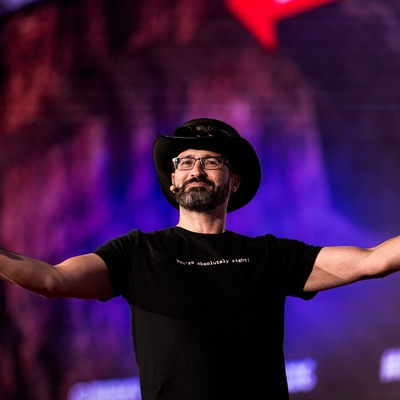
Baruch Sadogursky
Head of DevRel, Port.io
Лид ДевРела
Nashville, Tennessee, United States
Actions
Baruch Sadogursky (@jbaruch) did Java before it had generics, DevOps before there was Docker, and DevRel before it had a name. He built DevRel at JFrog from a ten-person company through an IPO, co-authored "Liquid Software" and "DevOps Tools for Java Developers," and is a Java Champion, a Microsoft MVP for AI, and a CNCF Ambassador alum.
Today he's head of DevRel at Port, working on the agentic SDLC, and a self-certified Level 3 AI Context Sommelier. In addition to sharing knowledge with AI agents, Baruch also shares knowledge with developers through blog posts, meetups, and conferences such as DevNexus, QCon, Kubecon, and Devoxx, mostly on how to use Agentic SDLC platforms to turn off the lights in your software factory once and for all.
Барух Садогурский (@jbaruch) писал на Джаве до того, как в ней появились дженерики, рассказывал про ДевОпс до того, как появился Докер, и занимался ДевРелом до того, как его стали так называть. Барух основал DevRel в JFrog когда там было 10 человек, и помог компании дойти до IPO с оценкой в $6B помогая инженерам лучше делать их работу. Теперь Барух продолжает помогать иженерам, а так же помогает компаниям помогать инженерам. Он соавтор книг "Liquid Software" и "DevOps Tools for Java Developers", является членом ПК нескольких престижных конференций и выступает регулярно на таких конференциях как Kubecon, JavaOne (мир праху его), Devoxx, QCon, DevRelCon, DevOpsDays (по всему миру), DevOops (не опечатка) и так далее.
Badges



Area of Expertise
Topics
Back to the Future of Software: How to Survive the AI Apocalypse with Tests, Prompts, and Specs
Great Scott! The robots are coming for your job—and this time, they brought unit tests. Join Doc and Marty from the Software Future (Baruch and Leonid) as they race back in time to help you fight the machines using only your domain expertise, a well-structured prompt, and a pinch of Gherkin. This keynote is your survival guide for the AI age: how to close the intent-to-prompt chasm before it swallows your roadmap, how to weaponize the Intent Integrity Chain to steer AI output safely, and why the Art of the Possible is your most powerful resistance tool. Expect:
- Bad puns
- Good tests
- Wild demos
The machines may be fast. But with structure, constraint, and a little time travel, you’ll still be the one writing the future.
Engineering Context So AI Stops Guessing
"You're absolutely right," my AI coding agent said, while removing validation logic and confidently explaining why this is an improvement. It agrees when I'm right, agrees when I'm wrong, and will keep agreeing while your production database burns.
The model is fine — it's also working blind, deciding based on whatever you happened to shove into its context window. A cheap, small model with good context consistently outperforms the most expensive frontier model without it — and six months from now, the teams that got their context right will be the ones wondering what the fuss over model upgrades was about.
Three kinds of context artifacts actually work: skills (executable instructions), rules (constraints and conventions), and scripts (deterministic operations) — all versioned, testable, and shareable. We'll start from real failures caused by missing context and rebuild them live on stage: write an artifact, add an eval, watch it fail, iterate until it passes, then publish and install it on a fresh agent. The craft comes down to four things: expertise (encode what you actually know, not vague instructions), feedback loops (measure with evals, iterate), repeatability (version so behavior doesn't drift), and distribution (package so every agent on the team gets the same knowledge).
New talk for 2026 — built from patterns validated across 190+ conference deliveries. The four engineering principles come from the Arc of AI 2026 keynote. Includes live artifact creation and eval demo. Works as 45-min session, keynote, or 90-min hands-on workshop. Solo talk.
The Right 300 Tokens Beat 100k Noisy Ones: Four Context Antipatterns That Kill Your AI Agent
Your agent has the README, the architecture docs, half the issue tracker, and a super prompt that ends with "make no mistakes." A hundred thousand tokens of excellent advice. It still hands back a 500 where the tests wanted a 404.
A bigger context window wouldn't have saved it, because the problem isn't the model, it's the context architecture the model sees.
Baruch will show you four things that quietly wreck that architecture: the stuffed prompt, the wrong tool, the goldfish, and the eval nobody runs. Every one of them is easy to cause and immune to pasting in another document.
Your context window is not a giant socks drawer. Break it into artifacts you can version and test, match the tool to the shape of the problem, and measure what each piece buys you.
And yeah, we'll do it live! It'll be cool if it works and absolutely hilarious if it doesn't.
The session reruns failing agent tasks after each context fix and evaluates the combined changes at the end. Developers can use that approach to test their own context choices. Recorded fallbacks support the live format.
Skill Issue: How to Write Skills That Actually Work
You've written a dozen skills. Some work, some don't, and you have no way to tell which. The agent says "you're absolutely right" while invoking the wrong one, and you keep re-explaining the same things to it. Without a way to measure what a skill adds, there's no way to find out. Meanwhile, the team next door is writing the same ones you already wrote, because nobody can find yours.
If you get why skills matter but can't get yours to do what you want, this is for you. 301, no "what is a skill," straight to the craft.
Skills are context artifacts: prose for flexible guidance, scripts for deterministic work, rules for hard constraints. Let's make them better:
1. A context artifact library that grows and patches itself: new skills emerge from agent friction, existing ones get fixed when they drift.
2. Design evals that grade only what the context adds — scenarios that probe the contribution, rubrics that ignore everything else, guards against state bleed and prompt leakage.
3. Pair every change with a second-model reviewer that catches regressions before merge. Version the library so rollback costs a checkout, not a postmortem.
4. Treat skills like code: scan, sign, gate at install. But also, treat them like prompts: add scanners for the attack surface conventional tooling can't see, like injection in the skill body, indirect poisoning through whatever the skill ingests, and tool-abuse paths that didn't exist before the agent had browsing tools.
5. Build a context artifact supply chain: registry, discovery, telemetry, staged rollout, so the team next door finds your skill instead of writing it for the third time. The same registry that solves discovery solves compliance: one push updates every agent in the org. Measure what proves reuse is real: installation and activation rates, because a skill nobody finds is a skill nobody uses.
Every practice above is itself a skill. "This is how we write context artifacts around here" belongs in the library: versioned, installed on every agent, graded by its own eval. The meta-skill has to earn its tokens too.
New talk for 2026. Scales across formats: 45-min session and 90-min hands-on stay pure 301 — attendees should already know what a skill is; 2- and 3-hour workshops expand the scope to 101→301, opening with the fundamentals (what skills are, how triggers work, installing and invoking them) before the 301 material.
Code-heavy, low-philosophy — targeted at engineers already using agents daily who want to stop repeating themselves. Solo talk.
Like It or Not, You're the CTO Now
Ever had your CTO show up at your desk and ask about the one decision you weren't sure of all month? How the hell did they know to ask about that? You're going to need that trick, because whether you wanted the promotion or not, you now have developers reporting to you, and every one of them is an AI coding agent.
So you built a nice agentic workflow where the agents write the code and review each other's work. Then you gave them an architect, a tester and a team lead (because that's what real teams have, right?), and now a whole software factory runs while you do something else, and you go "oh my god". And then you look at what it shipped and ask, "What is this crap?" The AI reviewers, mind you, approved all of it.
We've all worked on a team where everybody LGTMed everybody else's pull requests without reading them, and the tech lead didn't have time to read them all either. The good tech leads still knew which one to open. In this talk, we'll build the software factory and then learn to run it the way those leads ran their teams, so you know when to show up at the agent's desk and which question to ask once you're there.
Developers whose agents write and review code acquire a team to manage. The session applies engineering leadership skills to that team, including the uncanny CTO ability to ask the right question at the right time. Attendees learn how to brief agents and decide when an approval needs human scrutiny.
Let's Fire All the Developers: The 10x Developer Is a Queueing Problem
The headcount spreadsheet says we can fire ninety percent of the developers, because an AI coding agent writes ten times more code and shows up in the budget as a software subscription. The arithmetic is impeccable.
A decade ago, the same spreadsheet fired the testers "because DevOps". Guess what? They are still here.
The spreadsheet fails the same way every time, and Eliyahu Goldratt told us why back in 1984, when he wrote that an hour saved at a non-bottleneck is a mirage. Writing code was never our bottleneck, of course. Hand it to the agents and the pull requests pile up in front of whoever has to review them, so we hand the reviewing to agents too, and the bottleneck moves again, this time somewhere much harder to see.
I've been running that experiment on myself, with a software factory built exactly the way the spreadsheet dreams of, agents doing all the work and one human (barely) in the room. For a week it shipped like crazy. Two weeks later it had slowed way down, while nothing looked broken and none of the diffs explained why.
We'll go through that factory's history to find where the work went, and the answer is good news for everyone except the spreadsheet. A team with agents ships much, much faster than the same team without them, and it still needs its people (who are, after all, still here), busy with the decisions the agents would rather make quietly on their own.
The talk tests the case for cutting developer headcount against a public project's history. By following the work after agents take over coding and review, engineering leaders learn to locate the constraint before deciding where their developers are needed.
The Agent That Didn't Know Who to Ask
Once upon a time, a company hired a tireless developer who wrote code before breakfast and even used Jira without complaining. They gave their new colleague access to every repository and a license for every tool. Onboarding complete.
A junior developer would have had questions. Who owns payments? Why don't we use that library anymore? Eventually they'd learn that Alice knows, the incident report explains, and the runbook they found survived two reorganizations because nobody ever followed it.
Our developer is an AI agent, and it has to work all that out too. Except tomorrow a fresh context window makes it a new hire again, with the same impressive résumé and no memory of orientation, so it rebuilds the company from whatever it finds, one guessed unbounded MCP call at a time, burning tokens like it's 2025 and tokenmaxing is still a thing. Yesterday it found Alice, today a wiki page written by her predecessor, and both answers sounded convincing.
Even if the frontier labs give us an agent that writes great code, who teaches it how we do things around here?
So let's follow our unfortunate new hire through a company that assumes access means understanding, and work out how company knowledge becomes something an agent finds the same way twice. Who keeps it current, and which questions should still end in a conversation with Alice?
Alice has gotten good at onboarding agents and calls herself a "prompt engineer" now. But onboarding the same colleague every morning is getting old, even for her.
The talk challenges the assumption that a coding agent is ready to work once it has repository access and tools. A fictional onboarding story makes conflicting company knowledge concrete, with questions about reliable reuse, maintenance, and the decisions that still require a person.
Is It a Factory Yet? Building (and Rebuilding) Our Own Software Factories
Software factory means whatever the speaker needs, so we took the most generous definition: agents that ship without you. Whoever has a coding agent and tells it "to build something" has built a software factory. Add /goal so it doesn't stop until it decides it's done, turn on GitHub Actions, and maybe even enable a vanilla Copilot Review, and you're literally building a frontier solution; go humble-brag about it on X.
But of course that's not enough. Context engineering is all the rage, so we'll pile on rules, skills, scripts, hooks, and governance until our factory is a monstrous bureaucracy machine that burns tokens into handoff documents and inter-agent briefs and ships nothing. And of course it always runs the most expensive model on extra-high thinking with the whole rulebook in context on every turn, because your engineering problem (a to-do app) deserves nothing but the best, and who cares about token cost, right?
We can do better. We've each built our own factory multiple times, and we didn't always run into the same problems. In this talk, we'll go through what went wrong each time, and how (we think) we solved it (for now). We'll look at how to educate the model about the virtue of simplicity, where a cheaper model will do, and how to keep self-improvement from turning into self-bureaucracy. And yes, we're going to talk about tools: which ones are our favorites, which you can skip, and why.
Come reinvent the wheel with us, software factories first and then the rest of software engineering, at least until we remember to go back to basics and do the right thing.
Co-presented with Viktor Gamov. This is the restructured version of RoboCoders: Judgment Day, which has run 13 times since June 2025, one of them as a workshop at WeAreDevelopers North America 2026. The IntelliJ IDEA Conf 2026 delivery has slides, video and notes at https://speaking.jbaru.ch/talks/ideaconf-2026-robocoders/ .
The Case of the Missing Bottleneck
"Holmes, we've eliminated every bottleneck. So why is everything slower?"
Dr. Watson has built a thoroughly modern software factory, and he intends to keep it that way. He reads Hacker News over breakfast, follows all the right AI influencers, and tracks model benchmarks like a stock ticker. A new model takes the lead at noon; by teatime, it's on the payroll. No promising framework, agent harness or orchestration trick goes untried.
And the results look spectacular. Agents write code, review pull requests, triage issues, generate tests and coordinate other agents around the clock, the token bill grows along with the pull request count, and every step on Watson's dashboard is faster than it has ever been.
Yet somehow, customers are waiting longer.
The usual suspects all have alibis, of course. Coding is fast, review is automated, there are tests galore, and every local optimization comes with a benchmark proving it worked. Somewhere between all that furious activity and actual delivery, the bottleneck has gone missing.
Join Baruch Sadogursky and Leonid Igolnik as Watson and Holmes follow the work through an agentic software factory, from the customer's request to delivery, looking for a constraint that got harder to see precisely because the machines move so fast. Watson is convinced that unprecedented technology demands an unprecedented management technique. Holmes keeps finding ideas engineers have used for decades to manage people, queues, dependencies and constraints that never stay put.
"An entirely new problem, Holmes?"
"Then why, Watson, does the evidence look so familiar?"
The Agent Is the Least Important Part: What Actually Makes an Agentic SDLC Work
Imagine hiring a developer, giving them exactly one permission (Git access) and asking them to ship an issue. Their first commit brings back the dependency we ripped out last week in the middle of an incident because it was compromised, and of course we blame the new hire.
This is roughly how we deploy coding agents.
The company, inconveniently, is much larger than its Git repositories. Who owns which service, what got deployed yesterday, which incidents are still open and which policies apply all live somewhere else, and they keep changing while the agent works. So how does the agent learn all that before its first commit, and who keeps it away from the buttons it has no business pressing?
Most of the answer is boring deterministic plumbing, which is great news for your token bill and bad news for the frontier labs, who'll have to find their next billion somewhere else.
HR calls all of this onboarding, and annoyingly, they were right.
Vibecoding Fast and Slow: Your Brain on AI Agents
It's so tempting to hand a task to an agent and cross it off the list in our heads, as if it'll do the job as well as we would, and on time. Then three other agents pull us away with questions, and by the time the first one comes back, the tests pass, the explanation sounds right and we click Approve. More times than I'd like to admit, I've LGTMed my way through code I knew I was supposed to read (LGTM on AI steroids, basically).
Nobel laureate Daniel Kahneman described two ways we think, a fast automatic one and a slow deliberate one, and working with agents turns out to be very good at keeping us in the fast one. So where is slow thinking worth the effort, and how do we keep enough expertise to judge and debug code we didn't write? And what do we change, alone and as a team, for the days when we're tired and the agents aren't?
This talk helps developers and engineering leaders decide which agent results need closer examination, where delegation can cost them practice needed to build expertise, and how to organize work so they have the attention to make those decisions. It brings cognitive research into practical choices about learning, team coordination and feedback from development tools.
Technical Enshittification: Why Everything in IT is Horrible Right Now and How to Fix It
Did you notice how everything in IT is crap right now? Basic apps demand absurd amounts of memory, updates remove features people actually use, and moving a button counts as innovation; add a chatbot and there's a keynote. When Facebook was bragging about breaking things, at least it was to move faster. What's the excuse now?
And when somebody finally tries to fix the mess, they inherit years of decisions nobody can explain. Why does this ugly workaround exist, and is it safe to remove? The code is in Git, the ticket says "done", and the explanation left during the last reorg, so good luck with the refactoring.
Baruch will examine how we get here: incentives that reward shipping over maintaining, reorganizations that scatter responsibility, and technical decisions that outlive everybody who understood them. Each change can look reasonable on its own while making the whole system worse. We call the result technical debt, but a backlog of cleanup tickets won't recover the knowledge we've lost. LLMs love adding documentation to the pile, which looks helpful until finding the answer buried in it becomes as hard as finding the colleague who left.
Baruch will discuss what it takes to keep the reasons behind architectural decisions available to the next developer, along with who owns the service and what depends on it. Someone has to keep that knowledge current and retire what's obsolete, so finding an answer doesn't require an archaeological expedition through generated Markdown.
Fixing the Googles and Metas may be beyond the reach of a conference talk, but there's still time to stop your own project from providing material for the next one.
This talk connects familiar software decay to the incentives and missing decision history that make maintenance difficult. Developers and engineering leaders get a way to examine why their own systems are deteriorating, including what the next maintainer needs to know before removing an ugly workaround.
Codepocalypse Now: LangChain4j vs JetBrains Koog
Java developers keep hearing that AI agents are a Python thing, and as two Java Champions, we took it personally. So we're building a real personal agent, the kind OpenClaw made famous, that reads your email, manages your calendar, orders pizza and remembers who you are the next morning, and we're building it twice, in Java, live on stage, with JetBrains Koog in one corner and LangChain4j in the other.
Holding the features and the model equal should make it a boring race, and it doesn't, because the two frameworks can't even agree whether memory is an Advisor or a Provider, or whether an agent is a composed service or a first-class citizen. By the time we get to guardrails, the frameworks, the model and the two of us all disagree about who's in charge.
It's live coding, so something will break on stage, and we'll have to fix it in front of you with whatever the framework gives us. We don't know a faster way to find out which of these philosophies you'd want to debug at 2 AM.
5 deliveries including Devoxx France, Dev2Next, and Arc of AI 2026. Co-presented with Viktor Gamov. Live competitive coding format — two speakers build the same app simultaneously with different frameworks, audience votes on winner. High-energy, high-engagement format. Best in long formats (2-3 hours), can be done as short as 45-min slot. Java/AI track.
Never Trust a Monkey: From AI Slop to Code You Can Ship
We gave the infinite monkeys GPUs, and one of them wrote `assertEquals(true, true)`. The test passed. Naturally, we asked the monkey to review its own work.
When the code, tests, and review can all inherit the same wrong assumption, a second opinion is an expensive way to agree with yourself. Somebody has to establish what correct means before the agent starts explaining why it has achieved it.
We'll challenge the specification before deriving tests from it. Once we've agreed on the assertions, we'll lock them and try to get broken code through by changing its exam. You'll see which checks catch that attempt and where we still depend on a human understanding the requirement.
That agreement also has to survive the trip to production. At the release gate, we'll check who approved the change and whether the passing CI run belongs to the revision we're about to ship. A green run for yesterday's code won't do. If the specification changes, we'll send it back for a decision before treating the new tests as the agreed exam.
"The monkey seemed confident" remains a terrible acceptance criterion.
This session attacks a verification chain by trying to change the tests that judge the generated code. Developers see how to keep the agreed requirement intact through implementation and check that approval and passing CI belong to the revision being released. The release checks are new material.
Devnexus 2027 Sessionize Event Upcoming
Jfokus 2027 Sessionize Event Upcoming
PortCon 2026 Sessionize Event
KubeCon + CloudNativeCon North America 2026 Sessionize Event
CNCF-Hosted Co-located Events North America 2026 Sessionize Event
AI Native DevCon New York 2026 Sessionize Event
BaselOne 2026 Sessionize Event
WeAreDevelopers World Congress 2026 - North America Sessionize Event
AgentCon - Saint Louis Sessionize Event
AgentCon - Miami Sessionize Event
AgentCon - Phoenix Sessionize Event
J-Spring 2026 Sessionize Event
JNation 2026 Sessionize Event
KotlinConf 2026 Sessionize Event
JCON EUROPE 2026 Sessionize Event
Devnexus 2026 Sessionize Event
Voxxed Days Tichino 2026
Technical Enshittification: Why Everything in IT is Horrible Right Now and How to Fix It
Jfokus 2026 Sessionize Event
Open Conf - 2025 / PANELS and OPEN SPACE ACTIVITIES Sessionize Event
AI by the Bay Sessionize Event
DevFest Toulouse 2025 Sessionize Event
J-Fall 2025 Sessionize Event
BaselOne 2025 Sessionize Event
AI fokus Sessionize Event
J-Spring 2025 Sessionize Event
Spring I/O 2025 Sessionize Event
JCON EUROPE 2025 Sessionize Event
IJ Internal Conference 2025 Sessionize Event
Devnexus 2025 Sessionize Event
DevOps Vision and MLOps Vision 2024 Sessionize Event
DevOpsDays Tel Aviv 2023 Sessionize Event
BaselOne 2024 Sessionize Event
JConf.dev 2024 Sessionize Event
swampUP 2024 Sessionize Event
KCDC 2024 Sessionize Event
JNation 2024 Sessionize Event
JCON EUROPE 2024 Sessionize Event
Devnexus 2024 Sessionize Event
DeveloperWeek 2024 Sessionize Event
DevRel Experience 2023 Sessionize Event
DevOps Vision 2023 Sessionize Event
Oπe\n Conf - 2023 Sessionize Event
BaselOne 2023 Sessionize Event
DevOps Days Buffalo 2023 Sessionize Event
Infobip Shift 2023 Sessionize Event
DevOpsDays Birmingham (UK) 2023 Sessionize Event
swampUP 2022 City Tour - Munich Sessionize Event
swampUP 2022 City Tour - London Sessionize Event
swampUP 2022 City Tour - New York City Sessionize Event
Yalla DevOps Tel Aviv 2022 Sessionize Event
JNation 2022 Sessionize Event
swampUP 2022 Sessionize Event
DevOpsDays Austin 2022 Sessionize Event
Cloud Native Kitchen Sessionize Event
DeveloperWeek New York 2020 Sessionize Event
EuropeClouds Summit Sessionize Event
DeveloperWeek Global 2020 Sessionize Event
Azure Day Rome 2020 Sessionize Event
All The Talks Sessionize Event
DevOps Summit Amsterdam 2019 - Two days DevOps experience Sessionize Event
Yalla! DevOps 2019 Sessionize Event
swampUP 2018 Sessionize Event
Please note that Sessionize is not responsible for the accuracy or validity of the data provided by speakers. If you suspect this profile to be fake or spam, please let us know.
Jump to top