
Artem Chernevskiy
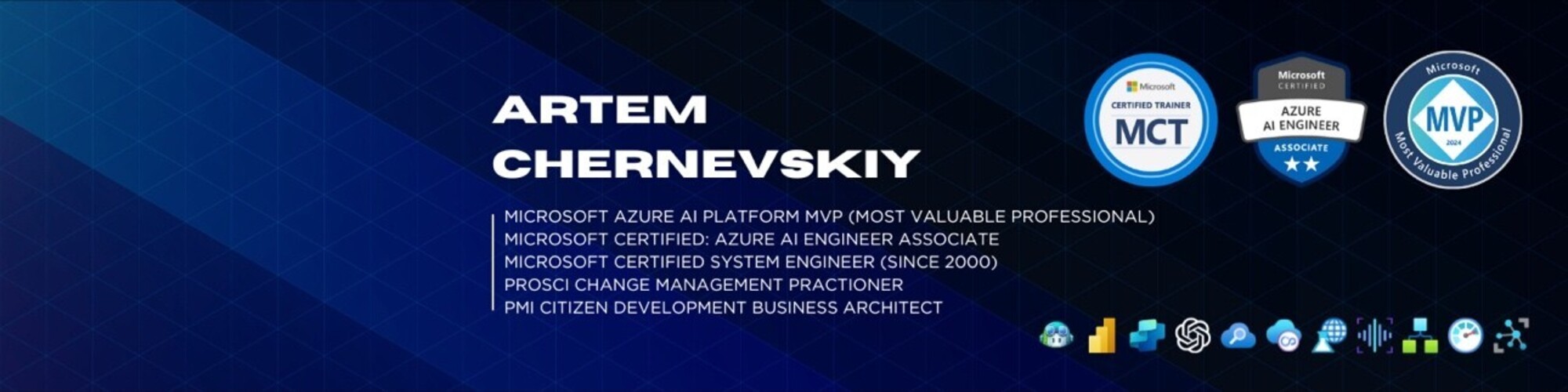
Azure Foundry MVP
Razlog, Bulgaria
Actions
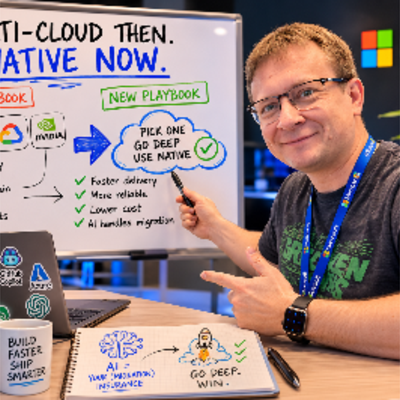
Artem Chernevskiy is the founder of AICA and a Microsoft Azure Foundry MVP who helps B2B AI startups become enterprise-ready on Azure. A former Microsoft professional with more than 20 years of experience in enterprise AI, cloud platforms, and product delivery, he has contributed to the Microsoft Cloud Adoption Framework and other Microsoft best practices.
He is also an ICF-trained coach, which influences his practical, people-first approach to teaching and mentoring. Artem regularly speaks about building secure, scalable, production-grade AI solutions that deliver real business value.
Badges

Area of Expertise
Topics
Microsoft Work IQ: Making Copilot and AI Agents Understand How Your Company Actually Works
Microsoft 365 Copilot is powerful, yet many organizations struggle to move beyond generic answers and isolated productivity gains. The missing piece is context.
Microsoft Work IQ introduces an intelligence layer that enables Copilot and AI agents to understand how work actually happens inside an organization, including relationships, priorities, patterns, and history.
In this beginner-friendly session, you will learn what Microsoft Work IQ is, how it fits into the Microsoft AI architecture, and why it fundamentally changes how Copilot and agents behave in real enterprise environments. Through short, practical demos, we will show how Work IQ transforms Copilot from a reactive assistant into a context-aware work partner.
This session is designed for business leaders, IT professionals, and AI practitioners who want practical clarity, not hype.
⸻
What You Will Learn
• What Microsoft Work IQ is and how it differs from Microsoft Graph, search, and prompts
• How Work IQ improves Copilot relevance, personalization, and decision support
• Where Work IQ fits within Microsoft’s AI stack alongside Fabric IQ and Foundry IQ
• How Work IQ enables intelligent, context-aware AI agents
• How to start experimenting with Work IQ concepts safely and effectively
Artem Chernevskiy is a Microsoft Most Valuable Professional (Azure AI Platform) and CEO of AI Cloud Agency (AICA), with over 20 years of experience delivering enterprise solutions on the Microsoft stack. He has hands-on experience working with Microsoft Viva Advanced Insights, focusing on organizational work patterns, productivity analytics, and data-driven decision making.
Artem is also a winner of the Microsoft Global Hack Together Hackathon 2025, where he built AI-first solutions leveraging Microsoft Copilot, agents, and organizational context. His work bridges Microsoft AI strategy with real-world enterprise adoption, helping organizations move from experimentation to measurable impact.
Designing Intelligent Coaching Experiences with Azure AI Foundry Agents
In this session you will learn how to build a fully functional AI-driven coaching application using Azure AI Foundry’s latest capabilities. We will present an end-to-end architecture based on Microsoft Agent Framework (public preview) — a unified, enterprise-grade SDK and runtime that consolidates strengths of previous frameworks (e.g. AutoGen and Semantic Kernel) and enables both multi-agent orchestration and structured, long-running workflows.
The demo will showcase:
- Voice-enabled, expressive agents built with Azure AI Speech, including photorealistic avatars
- Integration with Azure OpenAI Service to power natural-language reasoning and generation under the hood.
- Advanced monitoring, evaluation and observability capabilities powered by Built-in “Tracing, Evaluation and Monitoring” (AgentOps) features — enabling transparent evaluation of agent behavior (intent resolution, tool-call accuracy, task adherence, etc.) and full traceability of agent workflows in production.
This provides a practical blueprint for delivering a secure, scalable, human-like coaching experience — from prototype to production — with enterprise-grade quality, governance, and observability baked in.
To encourage live participation, small tokens of appreciation will be offered for the best questions during Q&A.
Microsoft Work IQ: Making Copilot Studio Agents Understand How Your Organization Actually Works
Copilot Studio enables Power Platform builders to extend Microsoft Copilot with custom AI agents. However, many agents still behave like reactive chatbots, responding to prompts without understanding how work happens inside an organization.
Microsoft Work IQ introduces an intelligence layer that allows Copilot and Copilot Studio agents to reason about organizational relationships, priorities, patterns, and historical signals across Microsoft 365. This context fundamentally changes how Copilot extensions and AI agents behave in real enterprise environments.
In this session, we explore Microsoft Work IQ through the lens of Power Platform extensibility and Copilot Studio agent design. You will learn how organizational context influences agent reasoning, personalization, and decision-making, and how to design AI agents that extend Copilot beyond generic productivity scenarios.
Through focused demos and architectural walkthroughs, we demonstrate how Power Platform builders and architects can design work-aware AI agents using Copilot Studio and Microsoft’s AI stack.
This session is designed for Power Platform developers, solution architects, and AI practitioners who are building intelligent Copilot extensions and agent-based solutions.
What You Will Learn:
- How Copilot Studio acts as an extension layer for Microsoft Copilot on Power Platform
- Why organizational context matters when designing Copilot extensions and AI agents
- What Microsoft Work IQ is and how it differs from Microsoft Graph, Dataverse, and prompt engineering
- How Work IQ influences agent reasoning and behavior in Copilot Studio
- Architectural patterns for building context-aware AI agents on Power Platform
- How Work IQ fits within Microsoft’s AI stack alongside Copilot Studio, Foundry IQ, and Fabric IQ
Artem Chernevskiy is a Microsoft Most Valuable Professional (Azure AI Platform) and CEO of AI Cloud Agency (AICA), with over 20 years of experience delivering enterprise solutions on the Microsoft stack. He has hands-on experience working with Microsoft Viva Advanced Insights, with a focus on organizational work patterns, productivity analytics, and data-driven decision making.
Artem works closely with organizations to apply Microsoft AI technologies to real-world enterprise scenarios, helping teams move from experimentation to measurable business impact.
Katerina Chernevskaya is a Power Platform Architect, BizApps MVP, and Microsoft Certified Trainer. She designs enterprise-grade Power Platform solutions with a strong focus on Copilot Studio, agent architecture, and AI-driven experiences. Katerina helps organizations translate complex business processes into intelligent, maintainable AI solutions on Power Platform.
Artem Chernevskiy and Katerina Chernevskaya are winners of the Microsoft Global Hack Together Hackathon 2025, where they built AI-first solutions leveraging Microsoft Copilot, intelligent agents, and organizational context.
Panel Session: AI for Startups – From Idea to Impact
In this dynamic panel, we explore how startups can harness the power of AI to accelerate product development, improve decision-making, and unlock new market opportunities. Whether you're building your MVP, scaling operations, or pitching to investors, AI offers transformative potential—but also unique challenges.
Join a diverse group of founders, engineers, and investors as they share real-world experiences, practical tools, and strategic insights. From low-code platforms to ethical AI practices, this session will equip you with the knowledge to make smarter, faster, and more responsible decisions in your startup journey.
Key Takeaways:
How to integrate AI into your startup from day one
Tools and platforms that make AI accessible to small teams
What investors look for in AI-driven startups
Common pitfalls and how to avoid them
Building ethical and scalable AI solutions
Ideal for:
Startup founders, product managers, developers, and anyone curious about applying AI in early-stage ventures.
Panel: Reimagining Data Analytics with GenAI: Patterns, Platforms, and Pitfalls
Generative AI is redefining how organizations design, build, and consume analytics. This panel unpacks the patterns that matter—retrieval-augmented generation, vector search, agentic workflows, and NL-to-SQL—showing how they integrate with modern data platforms, semantic layers, and governance. Practitioners will share concrete case studies: accelerating data engineering, automating documentation and testing, enabling natural-language exploration, and embedding copilots into BI and operational decisioning. We will also examine the pitfalls: data quality and lineage in an LLM world, cost management, evaluation and observability, security and IP protection, and responsible-AI controls. Attendees will leave with actionable guidance: architecture blueprints, build-vs-buy criteria, and operating models to move from pilots to production while maintaining trust, scale, and ROI.
The Value Gambit: Faster ROI with Copilot Studio vs Azure AI Foundry
One of the first and most important decisions for a new low-code developer working with AI is where to start: Copilot Studio or Azure AI Foundry. The paradox is that at the very beginning of your career, you may not yet know the criteria for comparing these products, the challenges you’ll face when using them, or which other Azure or Power Platform services you’ll need to deliver a successful project.
This session is designed to clarify those choices. It’s framed as a friendly family chess match between Katerina Chernevskaya (MVP BizApps), and Artem Chernevskiy (MVP Azure AI Foundry). In this playful match, each chess piece represents a Microsoft product we use to build our solutions.
Join us for an engaging format, numerous practical demos, and a clear goal and outcome for your time. By the end, you’ll know which questions to ask and how to choose between Copilot Studio and Azure AI Foundry for your specific project.
Why AI Agent Adoption Needs a Cloud Adoption Framework
Why AI Agent Adoption Needs a Framework: A Practical Introduction Using Microsoft’s Cloud Adoption Framework
AI agents are rapidly becoming part of core business operations, supporting productivity, analytics, security, and customer engagement. As adoption accelerates, many organizations deploy AI agents faster than their governance, compliance, and operating models can mature. This often results in fragmented implementations, increased risk, and challenges when scaling AI across the enterprise.
This session explains why AI agent adoption requires a structured framework, and how Microsoft’s Cloud Adoption Framework (CAF) provides a clear, Microsoft-validated approach for adopting AI agents in a secure, compliant, and scalable way.
Designed as a beginner-friendly technical session, it starts with fundamentals. Attendees will gain a clear understanding of what AI agents are, how they differ from traditional AI workloads, and why they introduce new requirements for architecture, security, and lifecycle management. The session then introduces the AI Agent Adoption Guidance, a newly published addition to CAF, created based on real customer and partner adoption challenges.
The session walks through the four stages of AI agent adoption defined in the guidance:
• Plan for agents: Identify high-value use cases, select appropriate technologies, prepare teams, and ensure data readiness for scale and governance
• Govern and secure agents: Establish governance, security, and observability across the organization using consistent policies and controls
• Build agents: Apply standardized approaches for single-agent and multi-agent systems
• Manage agents: Integrate agents into operations, optimize costs, manage lifecycle, and measure adoption success
Best practices are mapped to Microsoft Foundry, Microsoft Copilot Studio, Microsoft Fabric, and Microsoft SaaS Copilot agents, demonstrating how Microsoft platforms support each adoption stage in practice.
A strong focus is placed on governance, security, and compliance, helping organizations reduce risk, meet enterprise and regulatory expectations, and prepare AI solutions for audit and scale. For Microsoft partners, the session explains how applying Cloud Adoption Framework guidance strengthens solution architecture and directly supports requirements associated with the Azure AI Advanced Competency
Speaker:
Artem Chernevskiy is a Cloud Adoption Framework Collaborator, Microsoft Most Valuable Professional (AI Foundry), and an expert with hands-on experience in designing AI adoption processes and successfully passing Microsoft Azure AI Advanced Partner Competency audits. His perspective is grounded in real enterprise and partner delivery scenarios, helping audiences understand not only the guidance itself, but how to apply it effectively in compliant, production-ready environments.
Построение процесса управления работой больших языковых моделей (LLMOPS) в Azure ML Studio и Azure A
С учетом быстрого развития нейросетей, частого обновления исходных данных на которых мы дообучаем модели, роста сложности систем с использованием одновременно нескольких моделей для повышения точности результата - очень важно постоянно контролировтаь качество работы вашего рещшения. Особенно при изменении промптов, переходе на новые улучшенные модели и обновдении исходных данных. Мы рассмотрим два ключевых решения Microsoft которые позволят вам управлять качеством овтетов вашего решения через симуляцию исполнения множественных пользовательских запросов и анализа выданных результатов. А также монтироинга производительности и качества работы вашего решения на основе большой языковой модели.
Voice Live API: Real-Time Conversational Agents in Azure
Tired of gluing speech-to-text, LLM calls and TTS into brittle pipelines? Azure’s new Voice Live API collapses that triathlon into a single WebSocket, letting developers ship natural, interruptible conversations in minutes. In this 40-minute session, you’ll watch a travel-advising agent come to life, delegate work to searcher sub-agent, and still answer within 300 ms. We’ll unpack architecture, cost, and production guard-rails so you leave ready to plug Voice Live into your own apps
Использование AI для помощи в создании приложений low-code разработчикам на Power Apps (язык Power F
Может ли low-code стать еще доступней для разработчиков? Рассмотрим популярные инструменты и сценарии использования от Microsoft и Open AI. Живые демо, очень мало слайдов.
Transforming Education with Azure AI Agents
Discover how Azure AI Agents in AI Foundry can enhance education by automating tasks, personalising learning, and improving administrative workflows. This session will cover:
-What Azure AI Agents are and how they work.
- Practical applications in education, including virtual tutors, automated grading, and AI-powered assistance.
- A live demo on building an AI Agent in the Azure AI Foundry Portal with no coding required.
Ideal for educators, IT teams, and ed-tech professionals, this session provides a quick, hands-on introduction to leveraging AI for smarter learning environments.
Using Microsoft Azure ML Studio Prompt Flow for classification tasks
Azure ML Prompt Flow stands out as a remarkably versatile tool that serves a multitude of purposes, especially in enhancing how chatbots interact with users. Consider a scenario where a user asks a chatbot a question, anticipating a precise and relevant response. For the chatbot to deliver an accurate answer, its first task is to "understand" the essence of the question posed. This preliminary step involves the chatbot's ability to dissect the query and classify it accurately into a specific category and subcategory. This classification is crucial because it determines the pathway the chatbot will follow to fetch or formulate an appropriate response.
Let's delve into how to make such Prompt Flow in Azure ML.
Talk Announcement: Building Content-Aware M365 Copilot Extensions with Azure AI & Copilot Studio
Discover how to create intelligent Microsoft 365 Copilot extensions that analyze and reason over enterprise content using Azure AI Services and Copilot Studio. This session will guide you through selecting the right AI tool for tasks like document summarization, classification, and extraction - based on Microsoft’s official Content Understanding tool selection framework. (https://learn.microsoft.com/en-us/azure/ai-services/content-understanding/choosing-right-ai-tool)
We’ll showcase how to integrate these capabilities into Copilot Studio, enabling personalized, context-aware copilots that enhance decision-making and content workflows inside M365 apps.
The talk includes a real-world use case focused on building content review and optimization logic, using orchestration patterns, prebuilt models, and Retrieval-Augmented Generation (RAG).
Ideal for solution architects, AI developers, and innovation leads looking to extend Copilot beyond simple Q&A - into actionable, structured insights.
Supercharging Contact Center Chatbots with Microsoft Process Mining
Microsoft Process Mining—your secret weapon for turning chatbot chaos into a well-oiled AI assistant. In this session, we’ll explore how to:
- Mine real conversations to uncover hidden patterns and customer pain points
- Clean and prepare training data so your chatbot doesn’t learn bad habits
- Analyze operator interactions to find what works (and what definitely doesn’t)
- Optimize chatbot flows based on real-world insights
We’ll walk through practical process mining use cases in contact centers and show how it helps AI-driven assistants sound less like robots and more like pros.
Who Should Attend?
✅ Contact center leaders & CX professionals who want smarter bots
✅ Data analysts & AI developers tired of messy chatbot training data
✅ Business & IT strategists looking to optimize customer interactions
If you’ve ever yelled “Agent! AGENT!!” at a chatbot, this session is for you. Join us and learn how Microsoft Process Mining can take chatbots from frustrating to fantastic!
Revolutionizing LMS with Azure Real-Time Custom Avatars
Join us for an insightful session on transforming your Learning Management System by integrating Azure Real-Time Text-to-Speech (TTS) custom avatars and Power Pages to create an AI-powered salesperson. This innovative approach addresses the need for engaging, interactive, and personalized learning experiences in modern LMS systems.
You will learn:
- The limitations of traditional LMS systems in maintaining user engagement and providing personalized support.
- Why enhancing user engagement and personalization is crucial for effective learning and information retention.
- How to integrate Azure Real-Time TTS, custom avatars, and Power Pages to create a dynamic AI salesperson that boosts user interaction and learning outcomes.
Key Takeaways:
1. Learn how to utilize Azure TTS to convert text into natural-sounding speech with customizable voice options.
2. Discover the process of creating a digital character that visually represents your AI salesperson and aligns with your brand’s identity.
3. Explore the creation of responsive, interactive web pages using Power Pages that serve as the interface for the AI salesperson.
4. Gain insights on seamlessly integrating custom avatars and Azure TTS into Power Pages, ensuring smooth interaction and data flow within your LMS.
By attending this session, you will acquire the knowledge and tools to revolutionize your LMS, making learning more engaging, interactive, and effective. Don't miss the opportunity to elevate your LMS experience with cutting-edge AI technology.
People Analytics with Viva Advanced Insights and Azure Machine Learning
Lets have fun on this session for beginners. We will analyze your and your team work patterns with the help of Power BI, Teams, Graph, Viva Advanced Insights, Azure Machine Learning Studio. No-code, live technical demo.
Project GraphRAG- LLM-Derived Knowledge Graph
Join us to explore GraphRAG, Microsoft Research’s innovative approach to Retrieval-Augmented Generation (RAG) that enhances enterprise knowledge retrieval with graph-based reasoning. Learn how GraphRAG overcomes traditional RAG limitations by leveraging semantic relationships, structured knowledge graphs, and contextualized insights, delivering more accurate and explainable AI-driven answers. This session will showcase real-world applications, best practices for integration into enterprise workflows, and how it can enhance AI-powered decision-making. Perfect for AI developers, enterprise architects, and data strategists looking to optimize Copilot and other intelligent assistants.
Optimizing Microsoft 365 Copilot Agents with Copilot Studio and Power Platform Analytics
Optimizing multi-agent systems built with Microsoft Copilot Studio poses a significant challenge: most user interactions - simple Q&A exchanges - lack structured feedback suitable for traditional analytics. Are users clarifying their tasks? Questioning model quality? Reporting confusion? Without answers, it’s hard to decide whether to retrain models, educate users, or redesign the agent architecture.
In this session, we present a practical framework that uses LLM-based classification to characterize user intent. Each incoming user message is automatically labeled by type (clarification, feedback, additional info, etc.), forming a structured event log for analysis.
We’ll walk through:
- Using Microsoft Copilot Studio to enrich agent telemetry and route structured data to Application Insights
- Applying LLM pipelines to tag conversation intents
- Leveraging Power Automate Process Mining to detect interaction bottlenecks and user friction points
- Making actionable decisions: from training material improvements to architecture redesign
This is a highly practical, demo-driven session for:
- Power Platform developers building AI-powered solutions
- Architects designing conversational interfaces
- System analysts optimizing Copilot usage in enterprise environments
Join us to discover how structured data and process insights can turn black-box agent behavior into measurable, improvable systems.
Optimizing BC workloads with quantum calculations
There is a number of tasks whete quantum algorithms perform better than standard code. I have used quantum computing algorithms to speedup heavy BC calculations by substituting native code with q#, adjusted via AI with Azure Quantum Co-Pilot - and look what was the result!
Managing the work of large language models (LLMOPS) in Azure ML Studio and Azure AI Studio
Considering the rapid development of neural networks, frequent updates of the source data on which we fine-tune the models, the increasing complexity of systems using several models simultaneously to improve result accuracy - it is very important to constantly monitor the quality of your solution's performance. Especially when changing prompts, switching to new improved models, and updating the source data. We will discuss two key Microsoft solutions that will allow you to manage the quality of your solution's responses through the simulation of executing multiple user requests and analysis of the results provided. As well as monitoring the performance and quality of your solution based on a large language model.
Microsoft Azure Custom text-to-video avatars.
Have you ever dreamed of updating your videos as quickly as regular text? Keeping them constantly up-to-date, even in a rapidly changing field like IT? In the meeting, we will examine the entire process from A to Z of creating AI-powered Azure Custom text-to-video avatars. And of course, many useful tips and tricks. See you all!
Free open-source Power Apps application Prompt Wagon for interacting with Azure OpenAI/Azure ML
We will cover process of deployment and configuration your “own corporate GPT-4 chat” for your company. With required flexibility and corporate-level security. And also check some examples of popular prompts for business tasks and prompt management in Azure ML Studio.
Extending the backend of Business Central AI Agents with Azure AI Foundry
Business Central provides built-in AI-driven capabilities for automating business processes. However, real-world business scenarios often require deeper backend extensions - integrating with external APIs, adding advanced AI capabilities, and customizing data flows beyond what is natively available.
In this session, we’ll explore how to extend Business Central AI Agents backend using Azure AI Foundry. With Azure AI Foundry, you get a robust tool not only for generating intelligent responses but also for monitoring, evaluating, and optimizing your AI solution. It enables you to ensure the AI model performs optimally, aligns with business needs, and manages costs efficiently.
Key takeaways include:
✅ When and why to extend beyond built-in Business Central AI capabilities.
✅ How to build your own Prompt Flow in Azure AI Foundry and deploy it to an endpoint for API integration in Business Central.
✅ The importance of AI monitoring, evaluation, and cost management.
✅ Practical architectural patterns for backend extensions.
Exploring the Latest Features of Azure Machine Learning Studio for Non-Coders
Join us for an insightful session at Data Saturday, where we will delve into the exciting advancements in Azure Machine Learning Studio specifically designed for non-coders. In this session, we will explore the latest features and capabilities that empower individuals without extensive programming knowledge to leverage the power of machine learning. Discover how Azure Machine Learning Studio enables you to build, deploy, and manage machine learning models effortlessly, allowing you to unlock the potential of your data and drive informed decision-making.
Enhancing AI Performance for RAG solutions: Strategies and Metrics for Success
Many AI applications suffer from inefficient data processing and outdated responses, leading to poor performance and user dissatisfaction.
Optimizing AI performance is crucial to ensure that systems are both accurate and efficient, meeting the growing demands for real-time, relevant responses in professional environments.
This session will explore the integration of Retrieval-Augmented Generation (RAG) with Azure AI, focusing on practical strategies like effective vectorization, prompt engineering, and leveraging cached responses to enhance AI performance. We will also dive into performance measurement techniques, explaining why these metrics are vital for continuous improvement in AI systems. By the end of this session, participants will understand how to apply these optimizations to create more dynamic, responsive, and efficient AI applications using Azure Machine Learning.
This approach improves AI interaction quality and ensures systems are scalable and responsive to the evolving needs of users and industries.
Enhancing ERP Supply Chain Optimization through Azure Quantum Service
The presentation discusses the enhancement of supply chain optimization in ERP (Enterprise Resource Planning) systems through the integration of Azure Quantum Service. It highlights the challenges faced in traditional supply chain management, such as complexity in demand forecasting, inventory control, and logistics planning. The session introduces Azure Quantum Service as a solution, explaining how its advanced quantum algorithms can significantly improve optimization processes. It details the benefits of quantum computing, like speed and efficiency, in handling complex computations and large data sets involved in supply chain management. The presentation also covers case studies or practical examples where Azure Quantum Service has been implemented, demonstrating measurable improvements in cost reduction, process efficiency, and decision-making speed in supply chain operations within ERP systems.
Digital farming. Microsoft Azure Data for Agriculture project.
Azure Data Manager for Agriculture extends the Microsoft Intelligent Data Platform with industry-specific data connectors and capabilities to connect farm data from disparate sources. Leverage high-quality datasets to accelerate development of digital agriculture solutions.
In our educational agriculture project, we started out using Farm Beats for collecting and analyzing data from our organic farm. However, as our needs and scale grew, we found that we needed a more robust and scalable solution. After availability of new version in public preview, we decided to migrate our data to the Azure Data for Agriculture project.
Our experience of transitioning from Farm Beats to the Azure Data for Agriculture project will be shared.
City farming. Integration FarmBot with Azure IoT Central and Azure Machine Learning Studio.
FarmBot is an open source precision agriculture CNC farming project consisting of a Cartesian coordinate robot farming machine, software and documentation including a farming data repository. The project aims to "Create an open and accessible technology aiding everyone to grow food and to grow food for everyone."
Microsoft Azure is a cloud computing platform that provides a wide range of services for educational institutions. With Microsoft Azure, schools and universities can complete cloud computing tasks at any scale and on-demand using a pay-as-you-go plan. Azure is ideal for educational institutions because it gives them the computing power of enterprise-level businesses without putting strain on their limited budgets1
Our aim is to demonstrate the potential of combining these two platforms for educational purposes, highlighting the power of integration.
Copilot in Copilot Studio can be used to create your own Copilot with Microsoft Copilot
Tired of hearing Copilot, Copilot, Copilot? Microsoft has dozens of them, from Azure Quantum Copilot to Microsoft 365 Copilot. Let's understand what the idea of a copilot is and why it's not an autopilot. We'll also discuss which copilots are suitable for which tasks and what their fundamental differences are.
Agentic AI for Coaching & Wellbeing: Building Secure Multi-Agent Systems on Azure
Burnout isn’t just a productivity issue — it’s a recognized medical condition (ICD-11). Meanwhile, millions now turn to tools like ChatGPT for coaching, daily motivation, or even stress self-management. However, this rapid shift opens critical questions around privacy, regulatory compliance (GDPR, HIPAA, mental health guidelines), and responsible deployment.
In this session, we’ll explore how to build secure, regulation-aligned multi-agent coaching systems using the new Azure AI Foundry, a powerful framework for orchestrating “Agentic AI.” You’ll see how to move beyond simple chat to create goal-driven agents that sense, plan, act, and adapt — all while ensuring data is protected with Trustworthy & Responsible AI principles, content filtering, and confidential inference compute.
⸻
⚙️ Key highlights
• Why Azure?
• Azure offers a unique stack with enterprise-grade compliance certifications, confidential computing, and advanced governance to meet tough health-sector standards.
• Microsoft’s global startup programs actively support PoCs in wellbeing & mental health, accelerating time-to-market.
• Why it matters:
• Users rely on AI coaches for deeply personal goals — burnout prevention, habit building, leadership resilience. Getting this wrong is both an ethical and compliance risk.
⸻
🚀 Live technical demo
• We’ll build a multi-agent coaching system on Azure AI Foundry, showing:
• Data ingestion from calendar + CRM signals (via Graph APIs & Event Grid).
• A reflection agent (using OpenAI) that generates tailored micro-habit suggestions.
• A planner agent that auto-schedules deep work or wellbeing slots.
• A trust guardrail: content filters & policy checks via Azure Content Safety.
• Confidential inference compute protecting sensitive user data end-to-end.
• Wrap with live dashboards showing progress tracking and policy audit logs.
⸻
✅ Takeaways
• Learn how to design with Trustworthy & Responsible AI by default (auditing, explainability, user controls).
• See practical blueprints for protecting mental health data in coaching contexts.
• Understand how Microsoft’s ecosystem makes it simpler to build, govern, and scale AI-powered wellbeing tools.
Optimizing Microsoft 365 Copilot Agents with Copilot Studio and Power Platform Process Mining
Optimizing multi-agent systems built with Microsoft Copilot Studio poses a significant challenge: most user interactions - simple Q&A exchanges - lack structured feedback suitable for traditional analytics. Are users clarifying their tasks? Questioning model quality? Reporting confusion? Without answers, it’s hard to decide whether to retrain models, educate users, or redesign the agent architecture.
In this session, we present a practical framework that uses LLM-based classification to characterize user intent. Each incoming user message is automatically labeled by type (clarification, feedback, additional info, etc.), forming a structured event log for analysis.
We’ll walk through:
- Using Microsoft Copilot Studio to enrich agent telemetry and route structured data to Application Insights
- Applying LLM pipelines to tag conversation intents
- Leveraging Power Automate Process Mining to detect interaction bottlenecks and user friction points
- Making actionable decisions: from training material improvements to architecture redesign
This is a highly practical, demo-driven session for:
- Power Platform developers building AI-powered solutions
- Architects designing conversational interfaces
- System analysts optimizing Copilot usage in enterprise environments
Join us to discover how structured data and process insights can turn black-box agent behavior into measurable, improvable systems.
Audit as a Dashboard: Building Enterprise AI Agents on Azure That Stay Compliant
Most AI agents pass their security and compliance review once — on demo day — and then quietly drift out of compliance in real use. The reason is simple: teams check the agent by hand, at a single moment in time. The moment passes, the agent keeps changing, and no one is watching.
This session shows a better approach: instead of treating the audit as a one-time event, you make it continuous, so the agent constantly checks and corrects itself — the way a live dashboard shows real-time status instead of a once-a-year report.
We'll build this step by step on Microsoft Azure.
You'll get a simple five-point scorecard every enterprise agent should be measured against continuously — effectiveness, security, cost, reliability, and compliance — and you'll see "agents that check other agents": a small set of specialized AI reviewers, each grading one part of the scorecard. Then we'll add automatic gates in the delivery pipeline using Microsoft Foundry and GitHub, so a risky change is caught before it ever reaches production. Finally, we'll watch a live incident handled end to end: Azure SRE Agent resolves the issue, and Work IQ pulls the surrounding context — who owned it, who approved the change — so the audit trail is complete.
Everything maps to Microsoft's Cloud Adoption Framework, the official best-practice methodology for running on Azure. You'll leave able to turn a one-time audit into an always-on dashboard.
What you'll learn (takeaways):
- Why a security and compliance audit should be continuous, not a one-time check
- A reusable five-point scorecard for any production AI agent
- How to build the build → check → fix → operate loop on Azure using Foundry, GitHub, Azure SRE Agent, and Work IQ
Session format / length: Breakout session. Primary 45 min; also delivered as 30 min and 15 min lightning
Tags / topics: Azure, AI Agents, Microsoft Foundry, GitHub, Azure SRE Agent, Work IQ, Cloud Adoption Framework, DevOps, Security & Compliance, Responsible AI
Target audience: AI startup founders, solution architects, DevOps/platform engineers, and innovation or governance leaders building production AI agents on Azure
The Department of One: Leading People Who Now Manage Agents
For most of us, work is quietly changing shape. Instead of doing every task ourselves, we increasingly direct AI agents that do the work for us.
Taken to its conclusion, the long-running joke of the "one-person department" becomes the normal operating model — one person, supervising dozens of agents.
That's either a disaster or a superpower. Without proper oversight, a department of one is a single point of failure: no backup, no audit trail, and "shadow" agents nobody approved. But give that person the right control layer, and the same setup becomes enormous leverage — one human safely overseeing an entire fleet.
This session looks at both halves: the people and the platform. On the people side, we'll walk through five practical shifts — how an individual's role moves from doer to director, which human skills suddenly matter most, how the workplace itself changes, the new job of the IT department, and why the change manager becomes one of the most important roles in the company. On the platform side, we'll show — live — how one person can keep a whole fleet of agents secure, compliant, on-budget, and sustainable on Microsoft Azure, using Microsoft Agent 365 and the Foundry Control Plane to see and govern every agent, Microsoft Defender and Purview to handle security and compliance automatically, Work IQ to supply context, cost and sustainability checks to watch spend and carbon, and Azure SRE Agent to resolve incidents on its own.
You'll leave understanding what "managing performance" means when your team is part human, part agent — and how to lead people through that shift without losing accountability.
What you'll learn (takeaways)
- The five shifts that redefine roles, skills, and the workplace when people manage agents instead of doing the work
- How a single person can keep an entire agent fleet secure, compliant, cost-aware, and sustainable on Azure
- Why the IT department and the change manager are the roles that make or break this transition
Target audience: Founders, people and HR leaders, IT and innovation leaders, and change managers preparing their teams for an agent-driven way of working
Session format / length: Breakout session. Primary 45 min; also delivered as 30 min and 15 min lightning
Tags / topics: Future of Work, AI Agents, Change Management, Microsoft Agent 365, Foundry Control Plane, Microsoft Purview, Microsoft Defender, Work IQ, Azure SRE Agent, FinOps, Sustainability, Governance
Global Power Platform Bootcamp | Austrian Power Platform Enthusiasts Edition Sessionize Event
AI Industrial Summit 2025 Sessionize Event
Global Power Platform Bootcamp Bulgaria 2024 Sessionize Event
Prompt Engineering Bulgaria Sessionize Event
Data Saturday Sofia 2023 Sessionize Event
AI Industrial Summit 2023 Sessionize Event
Data Saturday Sofia 2022 Sessionize Event
Please note that Sessionize is not responsible for the accuracy or validity of the data provided by speakers. If you suspect this profile to be fake or spam, please let us know.
Jump to top