
Lisa Crosbie
Copilot Practice Lead | Microsoft MVP | Author & Speaker | Making sense of AI at work
Melbourne, Australia
Actions
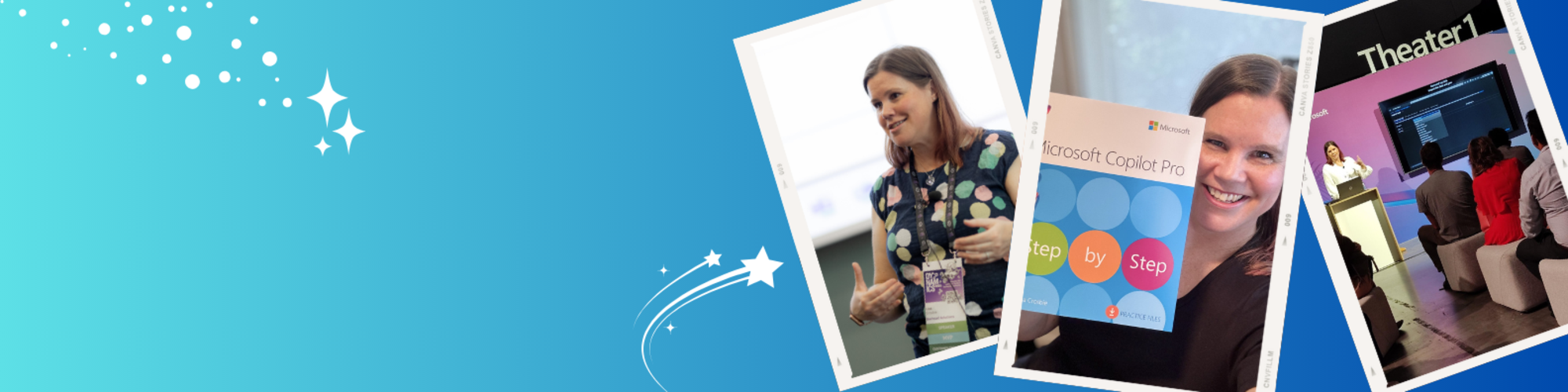
Lisa Crosbie helps organisations make sense of AI and what it means for the way we work. With more than a decade of experience in Microsoft business applications, her work now focuses on Copilot, AI agents and the broader shift to AI at work.
Lisa is a Microsoft MVP, author of two books for Microsoft Press, and has built a YouTube community of more than 120,000 people by making complex technology understandable and useful. She speaks at conferences around the world, bringing together deep technical understanding with a practical perspective on what AI means for organisations.
Her focus is on working out which changes in AI really matter, what they mean for organisations, and how they will reshape the way we work.
Links
Area of Expertise
Topics
What Answering 1,000 Questions About Copilot Taught Me About AI at Work
I get asked a lot of questions about Copilot. Through my YouTube channel with 120,000 subscribers and my work as a consultant and advisor to large organisations, I hear from people at every stage of figuring out AI: curious beginners, experienced users, champions, leaders and teams trying to make Copilot work at scale. That gives me a fairly unusual window into what people ask when they're learning in public, what they ask when they're responsible for everyone else, and what they ask when the demo is over and they just want to know why their Copilot can't do the thing they saw five minutes ago. It turns out those questions tell us a lot more about AI at work than I expected, so I started collecting them.
Once you hear enough of these questions, something interesting happens. A thousand different questions start to sound suspiciously like the same handful of questions being asked in hundreds of different ways. People want to know what the AI knows, what it can access, which version they have, which tool they're supposed to use, what it will remember, who else can see their information, whether they can trust the answer, and what any of this is going to cost. They ask product questions, but underneath them are much bigger questions about what it actually means to work with AI.
In this session, I'll share what I've learned from having a front-row seat to so many people figuring this out in real time. We'll unpack what someone might actually mean when they say "Copilot isn't any good," why choosing the right AI is becoming more difficult than writing the prompt, and what happens when the technology is changing faster than people can learn to use it.
This won't be a tour of every Copilot feature. For one thing, we'd need a much longer session. For another, there's a reasonable chance three of them would change while I was presenting. Instead, we'll use real questions from real people, including some wonderfully blunt ones, to work out where people are actually getting stuck and the mental models that make all of this easier to navigate.
Along the way, I'll share the misconceptions I keep hearing, the explanations that seem to make things finally click, and a few things all these questions have changed my mind about.
This session is for business users, leaders, champions and anyone who supports people using Copilot.
You'll leave with a much clearer way to think about AI at work, even when the buttons move, the names change and another shiny new capability turns up tomorrow. And if you've ever wondered whether everyone else understands this better than you do, I can save you the suspense: they don't.
The Most Expensive Prompt in Your Organisation: The Economics of AI at Work
Every conversation about AI eventually comes back to cost.
How much does a Copilot licence cost? What will our agents cost to run? How much consumption are we going to burn through? And how do we stop people spending money on AI without creating any value?
They’re reasonable questions. But they focus on the cost of running AI rather than what AI is doing to the economics of work.
AI is making content, analysis and recommendations dramatically cheaper and faster to produce. What used to take hours can take minutes. What used to take minutes can happen automatically. But making work cheaper to create doesn’t necessarily make an organisation more productive. When writing a report becomes almost free, we can produce more reports. When presentations take minutes, somebody still has to review them. When everyone can generate professional-looking analysis and recommendations, somebody still has to decide which ones deserve attention.
In this session, we’ll explore the economics of AI at work through three lenses: licence economics, consumption economics and attention economics. We’ll look at when paying more for AI can create extraordinary value, when cheap AI becomes surprisingly expensive, and how to decide what work belongs with people, copilots, agents and increasingly autonomous AI.
We’ll also look at one of the less comfortable consequences of AI adoption: sometimes we haven’t removed the cost of work at all. We’ve moved it. A report that takes two minutes to generate can still take ten people twenty minutes each to read. Poor or unnecessary AI output doesn’t just waste the creator’s time. It consumes the attention of everyone who has to read it, review it, validate it, make a decision about it or clean it up afterwards.
Drawing on lessons from real-world Copilot deployments, adoption programs and customer conversations, this session gives business leaders a practical way to think about AI investment beyond licence counts, usage statistics and token consumption. The goal isn’t to spend as little as possible on AI. It’s to understand where spending more creates value, where AI is simply creating more work, and what’s actually worth doing in the first place.
Because the most expensive prompt in your organisation isn’t necessarily the one that costs the most to run.
It may be the one that creates work for everybody else.
The Copilot Workshop You Wish Your Organisation Had Run: Develop Your Own AI Playbook
You've probably had some kind of Copilot training by now. It might have been an hour-long webinar when the licences arrived, a lunch-and-learn, a few videos, or a quick tour of what Copilot can do in Word, Outlook and Teams. It was useful, but it probably didn't spend much time on your actual job, and that's where most people get stuck. Knowing what Copilot can do is a long way from knowing how it can help you on a busy Tuesday afternoon when your inbox is full and a report is due.
This hands-on day takes you much deeper. You'll learn practical frameworks for looking at any piece of work and spotting where AI can make a real difference. That means breaking your workflows into the parts Copilot can help with, choosing the right approach for each part, and giving Copilot the context it needs to do your kind of work well. Every framework comes with guided exercises you work through on your own laptop with your own work, at your own pace. Start with the basics or go straight for the stretch exercises, and push into things you've never tried before.
Expect at least one moment when you turn to the person next to you and say, "Wait, it can do that?"
Throughout the day, everyone in the room shares the use cases that worked for them. With people from different roles and industries all contributing, you'll end up with a library of ideas nobody could put together on their own, and you're encouraged to borrow shamelessly from all of it. You'll leave with a lot more than notes. You'll have your own AI playbook, built from your own experiments and the best of what the room came up with, showing how you'll work with Copilot from the day you get back to the office. You'll also take home the frameworks and the full exercise workbook so you can keep practising as Copilot keeps changing, along with the approaches that worked for your role.
If you're a champion, adoption lead or leader, you'll also have everything you need to run a version of this day with your own people. That means the session your organisation didn't run can be the one you run when you get back.
This workshop is for business users, leaders, adoption leads and champions who already have Copilot and want to get much more out of it.
Please note: this is a hands-on workshop. You'll need to bring your own laptop and have your own paid Microsoft Copilot (Premium) seat licence. I can't provide trial or demo access on the day, so please check your access before you come.
I'm Lisa Crosbie. I've spent years helping people who aren't technical make sense of low code and AI, through my YouTube channel with 120,000 subscribers and my work as a consultant and advisor to large organisations. I get genuinely excited when people realise what they can do with tools they already have, and I'd love to spend a day helping you get there.
Canadian Power Platform Summit 2026 Sessionize Event
Power Platform Conference (Community Content) Sessionize Event
Teams Nation 2022 Sessionize Event
Microsoft Dynamics 365 Urdu Hindi Bootcamp 2021 Sessionize Event
Virtual Scottish Summit 2021 Sessionize Event
Microsoft 365 May 2020 Sessionize Event
Power Platform 24 Sessionize Event
Lisa Crosbie
Copilot Practice Lead | Microsoft MVP | Author & Speaker | Making sense of AI at work
Melbourne, Australia
Links
Actions
Please note that Sessionize is not responsible for the accuracy or validity of the data provided by speakers. If you suspect this profile to be fake or spam, please let us know.
Jump to top