

Naval Thakur
Practice Manager, SLB | Thought Leader in DevSecOps, FinOps & GenAI
Pune, India
Actions
Naval Thakur is a Practice Manager at SLB and a practitioner-turned-thought-leader in enterprise cloud transformation. Over 18+ years he has led some of the most complex DevSecOps, FinOps, and GenAI adoption programs in the energy and professional services sectors — with $600K+ in documented cost savings, a 30% average cloud cost reduction, and 35+ projects spanning SLB, Genpact and Sapient.
He is the creator of the CognitiveOps Model — a four-layer maturity framework (AutoOps → DevSecOps → FinOps → CognitiveOps) that maps where enterprises sit today and what intelligent operations looks like in practice. The model underpins his speaking, writing, and consulting work.
Naval holds 39+ certifications across Azure, AWS, GCP, Kubernetes, FinOps, Scrum, TOGAF, and GenAI — including FinOps Certified Practitioner, Google Cloud GenAI Leader, CKA, AWS Solutions Architect, and TOGAF 9 Certified. He holds an MBA from MDI Gurgaon (Gold Medalist).
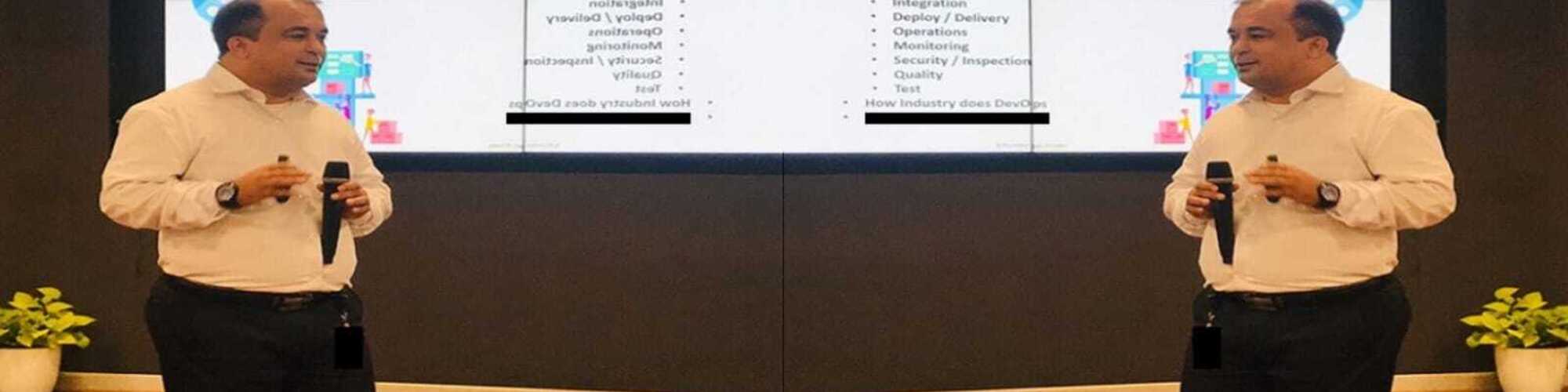
He has spoken at the Global Azure Bootcamp, APGI, Microsoft DevCon, the FinOps Foundation community, and delivered 20+ sessions on DevOps, Blockchain, IaC, and FinOps to engineering teams. His sessions are consistently practitioner-first: real architectures, real failures, real numbers.
He writes at nthakur.com and publishes The CognitiveOps Brief — a bi-weekly newsletter for enterprise engineers and architects.
Area of Expertise
Topics
Building Trust Economies: Blockchain, Smart Contracts & DApps on Azure
Blockchain is misunderstood in enterprise because it is sold as a database replacement. It is not. It is a trust primitive — and understanding that one reframe changes which problems it is actually worth solving.
In this session Naval covers the three cases where blockchain earns its complexity: multi-party settlement without a trusted intermediary, immutable audit trails where the auditor is also a participant, and tokenised incentive systems for communities and supply chains. He then walks through the architecture of a production DApp on Azure: the smart contract layer (Solidity), the middleware (Web3.js / Ethers.js), the front end, and the Azure Kubernetes deployment that makes it operationally manageable.
Based on the session delivered at Global Azure Bootcamp 2019, Pune.
Level: Intermediate | Tags: Blockchain, Smart Contracts, DApps, Azure, Web3, Ethereum
GenAI in Enterprise Operations: Patterns That Actually Work
Enterprise teams are running GenAI pilots, declaring success on demos, and struggling to move to production. The gap is almost never the model — it is the operational wrapper: observability, guardrails, cost controls, fallback logic, and the feedback loops that let the system improve without human intervention.
This session presents five GenAI operational patterns that Naval has seen work at enterprise scale: AI-assisted incident triage, LLM-backed runbook generation, cost anomaly narration, automated PR review and policy enforcement, and intelligent capacity forecasting. Each pattern includes the architecture, the prompt engineering approach, the failure mode to watch for, and a cost-per-call estimate. No demos of chatbots answering HR questions.
Level: Intermediate–Advanced | Tags: GenAI, AIOps, LLM, Platform Engineering, SecOps
Cloud Financial Intelligence: What FinOps Practitioners Get Wrong
Most FinOps efforts follow the same arc: tagging campaign, showback report, one big savings win — then stagnation. The problem isn't the tooling. It's that teams optimise for visibility and miss accountability.
Naval has run FinOps programmes at a $50B energy company and seen the patterns that kill momentum. In this session he walks through the five failure modes — diffuse ownership, savings theatre, the RI trap, tagging as a substitute for governance, and treating FinOps as a finance function — and the operational model that prevents each one. He also introduces the FinOps Maturity Assessment used in his practice: a scored diagnostic that tells you exactly where the friction is.
Level: Intermediate | Tags: FinOps, Cloud Cost Optimisation, Cloud Governance, FinOps Foundation, Azure, AWS
Achieving Enterprise-wide Agility: Beyond the Technology Stack
The technology is the easy part. The hard part is getting 5,000 engineers across 12 time zones to behave like one team. In this session, Naval draws on his experience leading enterprise-wide agility programmes at SLB to show what actually drives adoption — and what doesn't.
The session covers the three layers that must align: the technical layer (pipelines, platforms, toolchains), the process layer (portfolio management, OKR alignment, delivery governance), and the cultural layer (ownership, trust, incentive design). He introduces the Enterprise Agility Readiness model and walks through three case studies where one of the layers was missing and what happened as a result.
Level: Intermediate | Tags: Enterprise Agility, Transformation, DevOps, Organisational Design, Leadership
Infrastructure as Code with Azure Pipelines: Terraform + SaltStack in Production
This workshop takes engineers from a working Azure DevOps project to a fully automated infrastructure pipeline using Terraform for provisioning and SaltStack for configuration management — the exact stack delivered in production at Pune DevCon 2019.
Participants work through: structuring Terraform for real-world modules (not tutorials), integrating state management in Azure Pipelines, managing secrets without putting them in YAML, running SaltStack configuration runs as pipeline stages, and enforcing policy gates before any change touches production. The session assumes working Azure DevOps access and basic familiarity with cloud infrastructure concepts.
Level: Intermediate–Advanced | Tags: IaC, Terraform, Azure DevOps, Azure Pipelines, SaltStack, DevOps
From DevOps to CognitiveOps: The Next Five Years
Most enterprises declare DevOps done when their pipelines are green and their deployments are automated. But automation is not intelligence — and the gap between the two is where the next wave of transformation lives.
In this session, Naval Thakur introduces the CognitiveOps Model: a four-layer maturity framework that maps the journey from manual operations (AutoOps) through DevSecOps and FinOps, and into CognitiveOps — where AI agents monitor, reason, and respond without human intervention.
Drawing on 18 years of enterprise transformation across SLB, Genpact, and Accenture, Naval walks through what each layer looks like in practice, what breaks at each transition, and what the organisations already at Layer 4 are doing differently. Attendees leave with a concrete diagnostic — which layer are they on, and what is the one constraint holding them back.
Level: Intermediate–Advanced | Tags: DevOps, GenAI, AIOps, Platform Engineering, Transformation
The 7 Cs of DevOps: A Framework That Actually Sticks
After years of delivering DevOps training, Naval found that frameworks with ten pillars get forgotten by Tuesday. The 7 Cs stick because they map directly to the daily work of an engineering team: Continuous Integration, Continuous Delivery, Continuous Deployment, Continuous Quality, Continuous Compliance, Continuous Monitoring, and Continuous Feedback.
This session unpacks each C with real pipeline examples, real failure modes, and honest benchmarks — what good looks like, what cutting corners looks like, and how to sequence the improvements without stopping delivery. It is built for teams that are somewhere in the middle: past the basics, not yet at the top.
Level: Intermediate | Tags: DevOps, CI/CD, Engineering Practices, Platform Engineering
Seven Habits of Highly Effective DevOps Teams
Tools don't transform teams — habits do. In this session Naval shares the seven behavioural patterns he has consistently observed in DevOps teams that ship reliably, recover fast, and keep improving: psychological safety in post-mortems, a no-blame blameless culture, metrics that matter (DORA not vanity), a shared definition of done that includes security and cost, fast feedback at every stage, continuous learning embedded in sprint rhythm, and ownership that doesn't stop at deployment.
Each habit is grounded in a real example from enterprise environments. This is not theory — it is a practical, transferable checklist that any team lead or engineering manager can begin applying in their next sprint.
Level: All levels | Tags: DevOps, Engineering Culture, Team Effectiveness, Leadership
Naval Thakur
Practice Manager, SLB | Thought Leader in DevSecOps, FinOps & GenAI
Pune, India
Actions
Please note that Sessionize is not responsible for the accuracy or validity of the data provided by speakers. If you suspect this profile to be fake or spam, please let us know.
Jump to top