
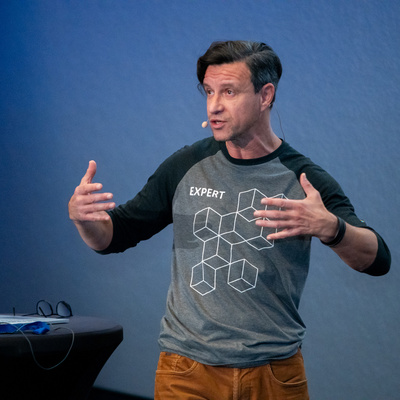
Dr. Damir Dobric
daenet GmbH - ACP Digital, Microsoft Regional Director, Most Valuable Professional for Azure & AI
daenet GmbH - ACP Digital, Microsoft Regional Director, Most Valuable Professional für Azure & AI
Frankfurt am Main, Germany
Actions
Area of Expertise
Topics
Best practices: Building Enterprise Applications that leverage GenAI en de
The new era of software development brings intelligent applications powered by Large Language Models (LLMs) and Generative AI (GenAI), revolutionizing business processes. While these tools offer immense potential, building AI-powered applications involves challenges beyond prompt optimization or low-code techniques.
In this demo-driven session, you’ll learn to build enterprise applications seamlessly integrating GenAI. We’ll showcase OpenAI, Azure OpenAI, and explore advanced concepts using Microsoft’s Semantic Kernel, an open-source toolkit for creating enterprise-grade AI agents.
Targeted at developers, architects, and technical decision-makers, this session provides valuable insights into GenAI and intelligent application development—even for those without a C# background.
Best practices: Building Enterprise Applications that leverage GenAI en de
Die neue Ära der Softwareentwicklung bringt intelligente Anwendungen hervor, die von Large Language Models (LLMs) und Generativer KI (GenAI) angetrieben werden und Geschäftsprozesse revolutionieren. Obwohl diese Tools enormes Potenzial bieten, geht die Entwicklung KI-gestützter Anwendungen über die Optimierung von Prompts oder Low-Code-Techniken hinaus.
In dieser praxisorientierten Session erfahren Sie, wie Sie Unternehmensanwendungen entwickeln, die GenAI nahtlos integrieren. Wir präsentieren OpenAI, Azure OpenAI und vertiefen fortgeschrittene Konzepte mit Microsofts Semantic Kernel, einem Open-Source-Toolkit zur Erstellung von KI-Agenten auf Unternehmensniveau.
Diese Session richtet sich an Entwickler, Architekten und technische Entscheidungsträger und bietet wertvolle Einblicke in Generative KI und die Entwicklung intelligenter Anwendungen – auch für Teilnehmer ohne C#-Kenntnisse.
Deep Dive: Mastering Agents, MCP and other hypes en
Building intelligent applications and integrating AI into modern software is an exciting but complex task.
Real-world AI solutions demand much more than Agents defined by prompts, low-code tools, or data science prototypes. Agents require robust architectures, integration flexibility, and intelligent design.
In this demo-driven session, you’ll discover how to build AI agents that seamlessly integrate into any type of application, across virtually any platform or operating system. You’ll also learn how to extend agent capabilities using Function Calling with MCP and the RAG algorithm.
Even if C#/.NET isn’t your primary focus, this session will help you understand the core concepts behind agents and plugins, empowering you to create your own custom Agents by using Microsoft Agent Framework. You’ll also explore Microsoft Foundry, learn how to work with different AI models, and see how to leverage the Agent Framework and Semantic Kernel to bring intelligent solutions to life.
This session is a technical presentation designed for developers, architects, and technical decision-makers.
GenAI Unpacked: Beyond Basics en
In this demo-driven engineering session, we will explore the hidden aspects of Generative Artificial Intelligence that go far beyond prompt engineering and basics. The goal of the session is to learn how GenAI works and how to implement various use cases, such as classification, recommendation, and semantic search.
We will start with core topics such as tokens, demonstrating how transformers learn associations between them. Next, we will discuss completions to explain how text generation works, providing a deeper understanding of model functionality. Additionally, we will cover embedding vectors, cosine similarity, and vector databases to explain the semantics behind models.
Afterwards, you will learn how to expand and manipulate model knowledge using techniques like Retrieval Augmented Generation (RAG).
Finally, we will explore different model types and tools such as OpenAI, Microsoft Foundry (also a local one) and more.
This session is a technical presentation designed for anyone interested in understanding and building intelligent applications leveraging large language models.
Best practices: Building Enterprise Applications with AI Agents en
The new era of software development introduces a new breed of intelligent applications, unlike anything we have seen before. It is fundamentally about integrating Large Language Models (LLMs) and Generative AI (GenAI) into various applications. This integration offers incredible opportunities for enhancing business processes in entirely novel ways by using Agents. However, building intelligent applications that leverage AI presents significant challenges, beyond just finding the best prompts or relying on low-code techniques.
In this demo-driven session, you’ll discover how to build AI agents with the Microsoft Agent Framework. You’ll also learn how to extend agent capabilities using Function Calling with MCP and the RAG algorithm.
This session is aimed at developers, architects, and technical decision-makers within enterprises. Even if C# is not your primary language, this session offers valuable insights into the realm of GenAI and modern intelligent applications. You’ll also explore Azure Foundry, learn how to work with different AI models, and see how to leverage the Agent Framework and Semantic Kernel to bring intelligent solutions to life.
A New Perspective: Revolutionizing Azure Management with AI en de
In the complex landscape of Azure resource management, enterprises have traditionally depended on a diverse array of tools and interfaces: the intuitive Azure Portal for visual operations, Azure Resource Manager (ARM) templates for declarative deployments, the concise Bicep language (Microsoft's recommended evolution of ARM), command-line power with Azure CLI and Azure PowerShell, and multi-cloud flexibility through Terraform.
But with an ever-growing ecosystem and continuous team change, how do you select the optimal approach? What if we shifted paradigms entirely?
This session explores a groundbreaking approach that leverages generative AI to manage Azure resources through natural-language interactions.
Dive into an inspiring, demo-driven experience where you'll discover how AI can streamline operations by simply "talking" to the Azure CLI, unlocking unprecedented efficiency and simplicity.
Beyond this innovative management approach, you'll gain important insights into assembling generative AI components (Agents, Tools, MCP server and more) for a new high-impact approach.
This session is tailored for strategists and decision-makers, as well as technical professionals. This talk will definitely inspire you with actionable ideas to drive organisational agility, reduce operational overhead, and foster AI-driven innovation in cloud infrastructure.
Die neue Perspektive: Azure Management mit KI neu denken en de
Im komplexen Umfeld des Azure-Ressourcenmanagements haben Unternehmen und Teams traditionell auf eine vielfältige Palette an Tools und Schnittstellen gesetzt: das intuitive Azure-Portal (Visual & Manual), Azure Resource Manager (ARM - declarative templates) , Bicep (Microsofts empfohlene Weiterentwicklung von ARM), Powerfull Azure CLI und Azure PowerShell sowie Multi-Cloud-Flexibilität durch Terraform.
Angesichts eines stetig wachsenden Anforderungs stellt sich die Frage: Wie wählt man den optimalen Ansatz aus? Was wäre, wenn wir das Paradigma grundlegend verändern?
Diese Session stellt einen bahnbrechenden Ansatz vor, der generative KI nutzt, um Azure-Ressourcen über natürliche Sprachinteraktionen zu verwalten.
Tauchen Sie ein in eine inspirierende, demo-lastige Session und erleben Sie live, wie KI den Betrieb radikal vereinfacht, indem man einfach „mit der Azure CLI spricht“. Dadurch entstehen bisher unerreichte Effizienz und Bedienfreundlichkeit.
Über diesen innovativen Management-Ansatz hinaus erhalten Sie wertvolle Einblicke, wie sich generative-KI-Komponenten (Agents, Tools, MCP-Server & Co.) zu realen wirkungsvollen Lösungen zusammenfügen lassen.
Die Session richtet sich gezielt an Strategen und Entscheider ebenso wie an technische Professionals. Sie werden mit konkreten, umsetzbaren Ideen inspiriert, um organisationale Agilität zu steigern, Betriebsaufwand deutlich zu senken und KI-getriebene Innovationen in der Cloud-Infrastruktur nachhaltig voranzutreiben.
Master Class: Design and implementation of Enterprise AI-Agents en de
As a professional enterprise architect or developer, you are required to build new applications that leverage large language models and Generative AI.
In this one-day master class, we will demystify how Generative AI works. We will start with the basics and then dive deep into important topics such as token generation, vector similarity, embeddings, different model types, and more. Next, we will explore various levels of application for specific use cases. We will begin with simple application types that use prompt engineering and demonstrate how these can be enhanced with techniques like Retrieval-Augmented Generation (RAG).
Finally, we will showcase how plugins can help integrate Generative AI into any software system and explain techniques to reduce or even prevent hallucinations.
Through numerous demos, we will illustrate how .NET developers and developers from other backgrounds can build AI agents that execute intelligent code in any application.
You will also gain insights into Microsoft Azure AI Foundry and the Open Source Semantic Kernel, both used internally at Microsoft. We will demonstrate how these frameworks can be employed to build applications and powerful backends that integrate AI into any software system, whether running in Azure or on-premises.
Most Demos will be in C#/.NET and Visual Studio. However, you are required to have a good technical knowledge of any programming language and any IDE.
Master Class: Design and implementation of Enterprise AI-Agents en de
Als professioneller Architekt oder Software Entwickler sind Sie gefordert, neue Anwendungen zu entwickeln, die Large Labguage Modelle (LLM) nutzen.
In dieser Master-Class erklären wir zuerst, wie LLMs und GenAI unter der Haube funktionieren. Wir beginnen mit den Grundlagen und tauchen tief ein in die Themen wie Token-Generierung, Vector-Similarity, Embeddings, verschiedene Modelltypen, Plugins, Agents und vieles mehr. Wir werden demonstrieren, wie .NET-Entwickler und Entwickler aus anderen Bereichen AI-Agents erstellen können, die intelligenten Code in jeder Anwendung über zahlreiche Demos ausführen.
Sie lernen auch über Microsofts Semantic Kernel und wie Sie Anwendungen und mächtige Backends erstellen können, die AI in die Azure-Plattform integrieren.
Diese Master-Class ist konzipiert für professionelle Softwarearchitekten und Entwickler.
Advanced Technology Days 15 Sessionize Event
Please note that Sessionize is not responsible for the accuracy or validity of the data provided by speakers. If you suspect this profile to be fake or spam, please let us know.
Jump to top