

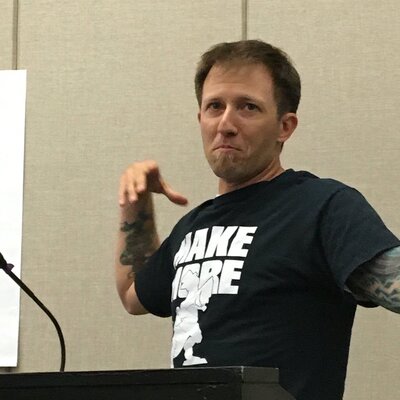
Joel Tosi
Co-author of 'Signals & Levers (ITRevolution, September 2026)'; Coaching for Learning' and 'Creating your Dojo' - helping organizations learn to learn, make work easier, and deliver better products.
Chicago, Illinois, United States
Actions
Co-Author of 'Signals & Levers (ITRevolution, September 2026)', 'Coaching for Learning; the Art and Practice' and 'Create Your Dojo; Upskilling Your Organization for Digital Evolution,' Joel helps organizations evolve through learning. This combines a blend of systems thinking, XP, agile, lean, devops and product thinking practices all to embrace learning in the context of work.
With deep experience in architecture modernization, blending product discovery with delivery and architecture, and systems thinking, Joel helps organizations make it easier for their teams to do great work.
Badges


Area of Expertise
Topics
How Continuous Improvement Actually Works
Organizations love to talk about continuous improvement, learning, and more. Yet...they struggle with making it actually work or impactful.
In this session, we will lay out how improvement and learning actually work. Hint - certifications don't do it, the improvement and learning needs to be contextual.
We will look at immersive learning, how teams learn and improve, and how the organization learns from teams learning and improving - namely double loop learning.
Leave this session ready to have focus on improvement that actually works.
Deming's Red Bead Game
Dr. Deming designed his 'red bead game' to help people understand how the overall system (for example, the organization) has a greater impact on a person's ability to do their job than individual skill.
In this session, attendees will experience Deming's Red Bead Game. Using the game, we will see how systemic affects play the greatest role in an individual or team's ability to deliver their work. From there, we will explore systems thinking, understanding the non-linearity of cause and effect in software delivery.
Leave this session with a better way of explaining how the things around you make your work more difficult to get done, ideas on how to address it, and of course with experience of playing the wonderful red bead game.
Signals and Levers
Linear thinking doesn't work in software delivery. You simply don't do one thing differently and get one change (for better or worse). This, frequently, leads to pain and unintended consequences. We can do better, and systems thinking helps us.
Software delivery is a function of a sociotechnical adaptive system. Sociotechnical (people interacting with technology, creating technology); adaptive (system changes based on feedback - i.e. people change based on tools; tools adapt to people; teams and products adapt to influences); system (product of the whole - all people and teams and influence and more...not just the parts).
Signals - ways that we understand the system at play.
Levers - ways to influence the system
Signals are everywhere, but usually not on your dashboard. 'No meetings Friday' is a signal, and the problem isn't that there are so many meetings. 'Testing is hard / not really automated / flaky' - is a signal. Planning for months across lots of teams...signal. The levers that are frequently pulled - more process!, 20% innovation time, etc - are levers with little leverage.
This talk will help you understand how systems thinking applies to software delivery and give you real techniques to make your context more visible and find the appropriate lever - the lever that shifts the way work works where the signal is caused, and not just where you see it.
We're all part of the system and have more influence than we may know. Let's see that together.
Right Today, Wrong Tomorrow - Systems Thinking for Architects
Architecture and design is understanding the core needs of a product and making decisions that makes those factors easy to deliver on.
Getting those decision right today doesn't mean those decisions will be right tomorrow. And those decisions that were wrong today can be right tomorrow. How? The context you are working in and the context your product exists in change.
Learn to see some of the signals to look out for and how to identify more, how to find levers to using causal models, externalizing your context with u-curves, and see what context would cause you to make different decisions. Along the way, we will explore strategy and how to create more options in architecture so the cost of being right today and wrong tomorrow is low.
Leave this session more in tune with the system your architecture lives in and influences.
Your Work Has Variety, Your Process Needs To
Think about the work inside your organization. If you are delivering software, some of the software is core and critical; other parts of the software are supporting; perhaps other parts are simply cosmetic or informational. Those different aspects most likely have different SLAs.
Look at the software slightly different, perhaps even in your own team. Some changes are easy - the code is clean, fresh, modern with a good test suite that gives you confidence. Perhaps other changes are slightly more complicated because of an integration that is difficult to test. And maybe there is another set of changes where 'the dragons are' - nasty, old code that has always been rushed and needs to be refactored (when we have time, which we never do).
The work across teams is different. The work within teams can be different. So why would you ever have one process to rule them all?
In this session we will talk about variety and variability. We will capture variability using Shewhart charts and identify causes of variability with causal models. Not happy with the amount of variability? We will identify and separate naturally occurring variability from variability caused by the organization that could be remedied.
We will look at U-curves and context to see find the 'appropriate process (like batch size, deployment rate, etc)' for a given team in a given context at a given time.
Lastly, we will talk about how to use variability and its affect on decision making.
Leave this session with the ability to see variability and make better decisions than 'one process to rule them all.'
Buying Information - Handling Uncertainty In Products, Architecture, and More
The majority of software delivery sits in an uncertain space. It could be the products we are building and we aren't sure how the customers would like it. Or it could be the architecture that the products sit on. Either way, we are dealing with imperfect information and uncertainty. How should we respond?
We buy information. By buying information, we reduce uncertainty and increase our chance of success. But how much should we pay? And how do we determine the actual cost of buying the information?
This session walks through the concept of buying information and the impact of 'perfect information' from information theory. We will walk through examples in product and architecture which tells us how much information is worth. Sometimes, that information is worth multiple parallel solutions - we will see how to determine that.
From there we will walk through calculating the costs of acquiring the information. We will talk about context in an organization and understanding that while the cost of acquiring information in one organization may be cheap, it may be prohibitive in another...because of the organizational system. We will also cover how changing technology landscapes (AI!) can change the cost of buying information.
We will leave the session with how to address your organizational cost if it is inhibiting your ability to buy information.
If you like math, economics, and using them to help you make better software decisions, this session is for you.
Creating Continual Learning Organizations - Your Dojo
In the DevOps Handbook, Gene Kim introduces the Third Way - The Technical Practices of Continual Learning. Enter the DevOps Dojo - an immersive environment where whole teams come together to learn and practice their skills while solving real business problems.
Teams learn better in the immersive eco-system of Dojos than they do using traditional forms of training. In this session, you will learn how Dojos help teams bond around product, foster rapid experimentation, and reframe small failures as learning. Learn the common dojo format and how it is designed to address whole value stream learning. The session wraps up with simple calls to actions for people to take to bring learning forward.
Come to this session not only to learn about what works in creating a Dojo but also how Dojos help upskill your teams and support the cultural DevOps change.
Product Discovery Workshop - OKRs, Personas, Storymapping, Oh My
In this hands on workshop, teams (4-5) will use Product Chartering, Personas, Storymapping, and User Journeys along with Experience Tests to explore a product of their choice.
Along the way we will touch on how you blend architecture needs into this as well as chaos engineering - especially if the audience is more technical
The takeaways are hands on approaches to product discovery and how it blends into delivery
Metrics that Matter - Moving from Easy to Impactful
This session is a walk through of a popular blog post we did on metrics. In general, we are leading transformations where the standard questions around metrics (velocity, bug, mttr, come up) - and we use these groupings to help organizations to get some answers for questions organizations want, but also understand their limits. I.e. if code coverage goes up, that might be good directionaly but does not say we are getting code coverage of the important code paths. We wrap up the session giving examples of more impactful measurements and walk through process behavior charts to help separate signal from noise in data.
Your Maturity Models and Dashboard Are Noise
Noise - information that does not help us from making a decision or seeing the problem more clearly. Noise is a distraction.
Maturity models (where teams / organizations answer questions and get radar charts showing their maturity in various areas) as well as dashboards of 'productivity' are noise.
But that doesn't mean that there is no way of measuring progress or improving. This session shows you how.
Starting with defining the problem and identifying appropriate signals that don't show up on dashboards, this session then takes attendees into how to model the influences on those signals. This provides a more complete view of the problem space as well as creates a multitude of possible interventions - at the team level, the product level, and the organizational level.
With these signals and model in hand, attendees will then learn how to create a context map, identifying the optional paths along the route to improvement, while seeing ways to identify early signals of progress.
Cut through the noise and get to the essence of the problem.
Growing a Learning Organization
Organizations claim to be 'learning' organizations because they have budget put aside for education. How frequently does that budget translate into real gains? There has to be a better way, and learning while working is how you achieve that.
This session starts off by grounding what learning means in complex domains like software delivery where there are multiple right answers and multiple influences on the problem space. From there, the session will walk through what continuous learning looks like as well as balancing learning with delivery. You will learn RPDM(recognition-primed decision making), tacit vs explicit knowledge, how to blend learning in your daily work with your team, and how to grow this practice in your organization.
Mob / Ensemble Programming Workshop
Mob Programming: All the brilliant people working on the same thing, at the same time, in the same place, and on the same computer.
Mob Programming is a cost-effective, collaborative and fun way to get work done together. It's a whole-team approach to development, where coding, designing, testing, and working with the "customer" (partner, Product Owner, User, etc.) is all done as a team.
Participants in this workshop experience learning and doing Mob Programming. We cover the mechanics of how to work together as a Mob as well as the techniques that make this form of development so effective.
We’ll learn how a Mob performs sample project work, including user stories, prioritization, test-driven development, refactoring, and retrospectives.
This workshop provides a hands-on education in the art of mobbing and it's significant benefits for your teams.
Value stream mapping workshop
The work we do is part of a larger system with a goal of ultimately delivering value to a person. Understanding how all of those pieces fit together helps us make better decisions on where to improve. If we automate the infrastructure creation to on demand, but any database changes take weeks, making the infrastructure faster doesn’t help.
In this workshop, you will learn (by doing):
- Creating a value stream
- Calculating lead time and cycle time
- Calculating % complete and accurate
- Calculating overall efficiency of your value stream
- Identifying areas for improvement
Leave this workshop ready to create your value stream in your organization
Content isn't the problem - Application is
Content - How to do something; learn a new technique; configure a new tool; write some code in a new framework - the content is everywhere.
Yet, with all that content, why is it not easy to immediately apply new learnings at work?
The problem is we try and substitute content and seeing / hearing with doing.
In this session we will frame up the new for a new way of learning (learning in the flow of work instead of learning as an outlier). We will look at how teams achieve this, what changes occur to the team and organization to support this, and what the outcomes are for teams and organizations that have tried this approach.
The problems that arise when focusing on predictability instead of variability
Many organizations want more predictability - When will it be done? When we can't answer that question, plans become larger - more initiatives, more work in flight.
In this session we will start off looking at the value stream and what variability means when, along with the cost.
We will then explore examples of variability in the right side (dev / test / operations) of the value stream and how that becomes a negatively reinforcing loop.
You will learn Shewhart charts, how to create them, and how to use them in software delivery.
We end this sessions with simple ways to start capturing the cost of variability and ideas to start addressing it.
Blending Product Thinking with Architecture
What is 'good architecture?' While it may be hard to quantify, it is (somewhat) easier when we are in it. The solution 'makes sense' with the product; language is consistent; it is easy to make changes; and the product can adapt within expected reason.
You get architecture one way or another. You can have it intentionally or accidentally.
In this session we will walk through approaches that leverage product context to keep architecture aligned with the needs of the product. We will look at strategic DDD, C4 modeling, and architecture decision records. We will talk about signals that the architecture is drifting from the product and how to continuously iterate on architecture.
Leave this session with simple techniques that you can apply immediately to start blending product with architecture.
Systems Thinking Workshop - Seeing Signals and Finding Levers for Appropriate Shifts
Software delivery is a function of your organizational system. Frequently, we see a challenge and react with the best intentions. Sometimes, we are lucky and it works. Frequently, we get unintended consequences. Systems gonna system.
In this hands-on workshop, attendees will learn how to see the signals all around them, telling them what is happening in the system. From there, they will learn how model systems and look for levers as means of introducing intentional, impactful shifts in an organization.
The workshop will cover:
- Identifying signals - qualitative and quantitative
- Systems Diagramming (Nouns, Verbs, Reinforcing, Balancing Loops)
- Identify levers
- Value Demand / Failure Demand
- Understanding and modeling context
- Applying context to u-curves to understand the best available options (and they very bad possibilities)
- Creating Shewhart charts to understand natural occurring variability
- How to avoid 'tampering' with the system
This workshop is designed for anyone that is interested in helping teams and organizations be more effective and worry less about 'the process'. This can be from the team level up to the executive level. Examples will be given throughout applying concepts to different levels of the organization.
Systems Thinking - Concepts to see the whole
Ever feel like process changes or change initiatives aren't quite getting the results you had hoped for? Turns out that there is much more to how a team or organization delivers products than isolated optimizations can help with.
Enter the world of Systems Thinking.
Come and learn what Systems Thinking is and why it is important to software. Leave the session understanding how to read and create system models as well as identify leverage points to introduce meaningful, impactful change in your organization.
Modernizing Legacy Code - While Not Bringing Down Prod
Imagine you have some legacy code. It may be on an outdated tech stack, or perhaps you are looking to go to the cloud, or perhaps it just isn't properly aligned with the product anymore. How do you actually go through and modernize the application when multiple teams are involved...and not bring down production?
In this session, you will learn real world techniques to help you with modernization. Including
Realigning product, architecture, and teams with Strategic DDD
Finding seams in your existing product
Questioning product assumptions
Making boring changes to get quick learning
Natural code expansion and contraction
As well as how to decided if you are better of modernizing than migrating.
3 Illusions in Software Delivery
A crisis is simply the end of an illusion, and software Delivery is full of illusions. In this session, we will look at 3 of them - Illusion of Progress, Illusion of Predictability, and Illusion of Control.
But why do these illusions happen? No one is intentionally fooling themselves. Rather, most frequently what is happening is that we aren't seeing the system at play and are making decisions that either lack context (and therefore backfire) or are familiar decisions.
To break out of these illusions sooner, we need systems thinking. This session teaches you how to use systems thinking to identify when you are in an illusions, how to break out, and how to prevent them going forward.
Want to understand why all of those meetings aren't helping? What about all of that planning? How about why all that agile stuff we are doing (our own special way) just seems to make things slower?
We have you covered.
The Fundamentals of Strategy
Strategy requires choice. No choice? No strategy.
In this session we will explore how to find choices - in architecture, leadership, improvement initiatives, products, and more.
This session covers:
- Problem framing (and the lack of something is never the problem)
- Causal modeling as a means of finding options
- Context mapping to show multiple paths to a desired outcome
- Ways to identify leading indicators (early signals)
Leave this session understanding how to find more choices and learn more quickly, ultimately leading you to better strategy.
Solving Test Dependency Issues - Without Creating Another Team
Testing gets real tough as soon as multiple teams start getting involved...or older code...or just the system isn't designed to be testable.
Sure we want to automate, but wow is it hard to start. Unit test? I wish.
In this session, we will walk through (in code) 4 techniques your teams can do right now to start having more confidence in your code and deployments. Even better, all of these techniques are controllable by the team - no need for another external team or infrastructure to make it possible.
CodeMash 2026 Sessionize Event
Agile + DevOpsDays Des Moines 2025 Sessionize Event
KCDC 2025 Sessionize Event
dev up 2025 Sessionize Event
Nebraska.Code() 2025 Sessionize Event
NDC Oslo 2025 Sessionize Event
Salt Lake City DevOps Days 2025 Sessionize Event
Michigan Technology Conference 2025 Sessionize Event
CodeMash 2025 Sessionize Event
Øredev 2024 Sessionize Event
2024 All Day DevOps Sessionize Event
2024 Project to Product Summit Sessionize Event
dev up 2024 Sessionize Event
Nebraska.Code() 2024 Sessionize Event
KCDC 2024 Sessionize Event
Agile & Beyond 2024 Sessionize Event
Michigan Technology Conference 2024 Sessionize Event
2023 All Day DevOps Sessionize Event
dev up 2023 Sessionize Event
Beer City Code 2023 Sessionize Event
KCDC 2023 Sessionize Event
Agile & Beyond 2023 Sessionize Event
2022 All Day DevOps Sessionize Event
Festival Agile Trends Sessionize Event
DevSecOps Days Washington, D.C. 2022 Sessionize Event
KCDC 2022 Sessionize Event
Beer City Code 2022 Sessionize Event
InnoVAte Virginia 2022 Sessionize Event
2021 All Day DevOps Sessionize Event
Tech Con '21 Sessionize Event
Momentum 2021 Sessionize Event
KCDC 2021 Sessionize Event
Music City Tech 2021 Sessionize Event
DevOpsDays Zurich 2021 Sessionize Event
Momentum 2020 Sessionize Event
DevOpsDays Boston 2020 Sessionize Event
Agile Midwest Conference 2019 Sessionize Event
Music City Tech 2019 Sessionize Event
KCDC 2019 Sessionize Event
Agile & Beyond 2019 Sessionize Event
Momentum 2019 Sessionize Event
Lean Agile KC Sessionize Event
DevOpsDays KC 2018 Sessionize Event
KCDC 2018 Sessionize Event
Please note that Sessionize is not responsible for the accuracy or validity of the data provided by speakers. If you suspect this profile to be fake or spam, please let us know.
Jump to top